



Executive Story
The AI agent that will pay for itself this year is not the one in the demo. The demos show an autonomous employee booking travel, writing strategy, running a whole function. What is actually earning, is kept inside enterprises, is duller and far more valuable: an agent that resolves a customer's refund end to end, or clears a backlog of invoices overnight, or reviews every pull request before a human sees it. The pattern in the 2026 data is unambiguous. Agents create value first in the boring, bounded, high-volume work, and the enterprises capturing that value are the ones that resisted the temptation to start with the spectacular. Knowing where autonomous AI pays off first, and why those workflows and not others, is now the difference between an agent program that compounds and one that stalls in a graveyard of pilots.
Executive Summary
The previous article established what the agentic shift is. This one answers the question every leader asks next: where do we point it? The evidence from early enterprise deployments is consistent and useful. Autonomous agents create value first in workflows that are multi-step, high-volume, verifiable, and bounded enough that a human can catch a rare bad decision. Four domains lead: customer service, IT and HR helpdesk, finance back-office, and software engineering. Adoption is already broad, with PwC reporting that 79 percent of organizations use AI agents to some degree and 66 percent seeing measurable productivity gains, yet the gap between deployment and production remains wide. The winners are not chasing the autonomous-employee headline; they are starting narrow, proving value, and expanding.

Figure 1. Where autonomous agents create value first.
Industry Context
For most of the last two years, the honest advice on enterprise AI was to experiment and learn. That advice has expired. Agents are now in production across every major function, adoption is broad, and the analyst consensus has hardened around a single message: the question is no longer whether agentic AI belongs in your enterprise, but which use case you start with, and whether you are moving fast enough to matter. Gartner projects that 40 percent of enterprise systems will feature task-specific agents by the end of 2026, and the agent market is forecast to grow at nearly 50 percent a year through the decade. That momentum makes the choice of where to begin more consequential, not less, because the enterprises that pick well compound a lead while the rest accumulate stalled pilots.
The Map: Where Agents Create Value First
Four domains show the clearest, fastest return today. Customer service is the most common starting point and the highest in ROI velocity: agents resolve routine tickets end to end, route and escalate the rest, and commonly reach positive ROI in under six months, with reported ticket deflection of 45 to 80 percent. IT and HR helpdesk is the canonical first deployment, automating password resets, access requests, knowledge queries, and onboarding, work that is high in volume and low in consequence. Finance and back-office agents process invoices, reconcile accounts, and triage fraud, bounded and verifiable tasks with clean payback. And software engineering agents review code, generate tests, and handle migrations, accelerating delivery on well-defined work. Beyond these four, supply chain, sales, insurance, and healthcare workflows are following the same curve. The functions differ, but the winning use cases rhyme. In supply chain, agents monitor supplier deliveries, rebalance inventory, and reroute logistics in real time; in sales, they qualify leads and keep the CRM current; in insurance and healthcare, they accelerate claims, underwriting, and clinical documentation. In every case, the workflows that succeed share the same underlying shape as the core four.
The Signature of an Agent-Ready Workflow
Look across those domains and the same signature appears. An agent-ready workflow is multi-step, so there is a process worth automating rather than a single reply; it spans systems, which is exactly where agents outperform both humans and single-shot AI by acting across applications; it is high-volume, so small per-task gains compound into real savings; its outcome is verifiable, so success can be measured and a wrong result caught; and it is bounded and reversible, so a rare bad decision is recoverable and a human can stay in the loop. As one 2026 analysis put it, agents earn their keep where the task is repetitive, the success signal is verifiable, and a human can catch the occasional bad decision before it becomes an expensive one.

Figure 2. The signature of a workflow ready for an agent, and one that is not.
The inverse is equally clear, and it explains the demos that disappoint. Agents are a poor fit today for work that is open-ended, high in judgment, low in volume, hard to verify, or high-stakes and irreversible. The autonomous employee running a function unsupervised is the canonical example: impressive on stage, unshippable in production. Not every workflow needs an agent, and forcing one onto the wrong workflow is how programs stall.
Start Narrow, Then Expand
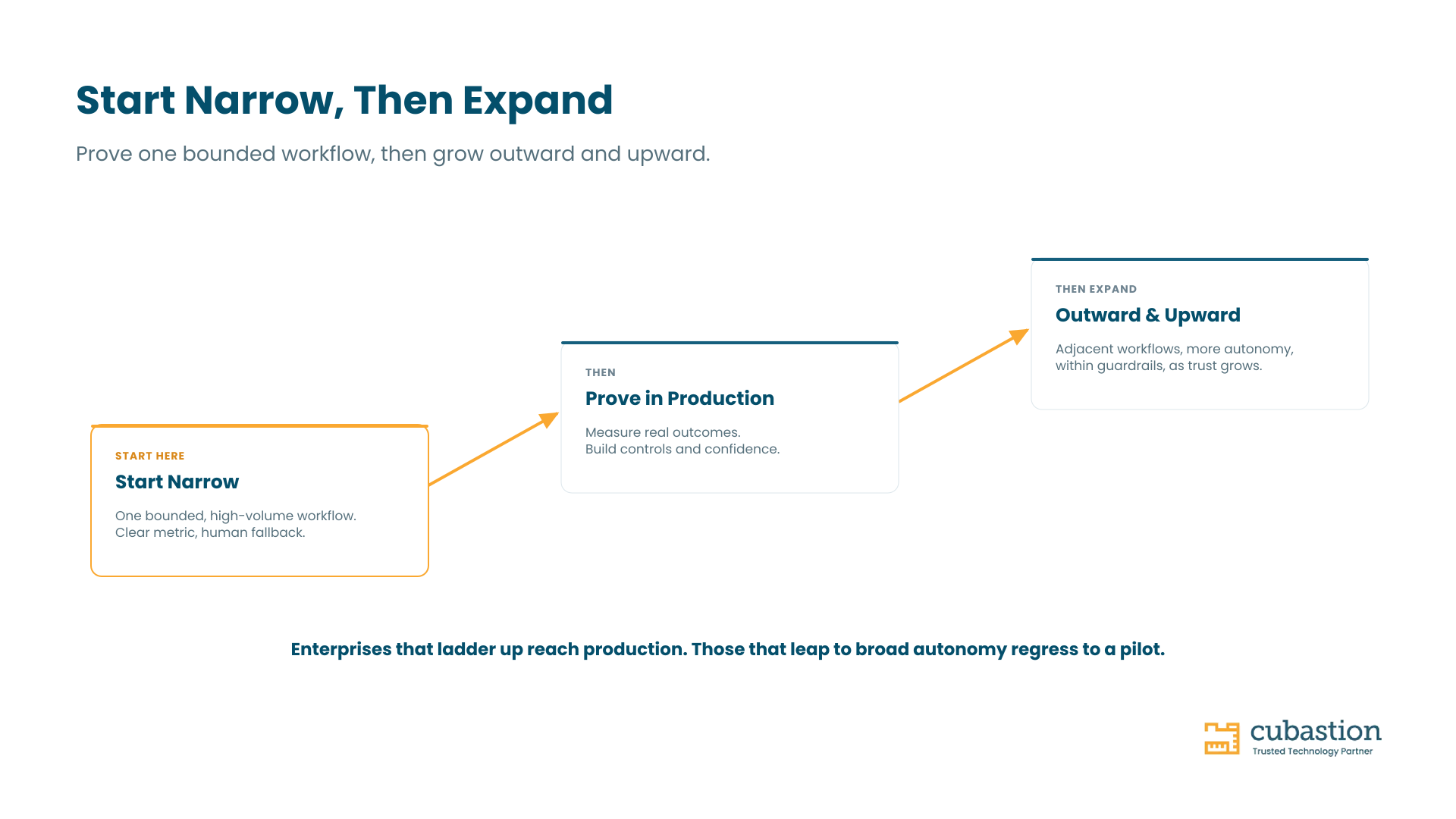
The sequencing that works is boring by design. Start with a single narrow, high-volume, low-consequence workflow that has a clear success metric and an obvious human fallback, an internal IT or HR helpdesk, or customer-service deflection. Prove it in production, not in a demo. Then expand along two axes: outward, to adjacent workflows in the same function, and upward, to greater autonomy as trust and evidence accumulate. That is a deliberate progression, from an agent that drafts, to one that recommends and waits for approval, to one that acts within guardrails. The point of starting small is not caution for its own sake; it is that the first deployment builds the data, the controls, and the organizational confidence that every later one depends on. Enterprises that try to leap straight to broad autonomy almost always regress to a pilot; those that ladder up rarely do.

Figure 3. Start narrow and safe, then expand outward and upward.
The Numbers
The early ROI evidence is strong where the pattern holds. PwC reports that 66 percent of organizations already see measurable productivity improvements from agents and 62 percent expect ROI exceeding 100 percent, while 88 percent plan to increase their agentic budgets. At the workflow level, enterprises report ticket deflection of 45 to 80 percent, up to threefold lower total cost of ownership, deployments in as little as six weeks, and, in some cases, more than 500,000 dollars in annual support-cost reduction from a single high-volume workflow. The lesson from the prior series applies directly: these numbers are credible because they are measured at the level of a specific workflow, cost-to-serve, deflection, cycle time, not as an abstract "AI ROI" the board must take on faith. Notably, the strongest returns tend to come not from replacing people wholesale but from removing the repetitive load that consumed them and redirecting that time to work only people can do.
The Reality Check
The value is real; capturing it is hard. By one 2026 estimate, roughly 88 percent of enterprise agents never reach production, and the failures cluster around the same operational blockers regardless of industry: agents that lack real-time context, cannot reach the systems they need, or were deployed without the guardrails and oversight to be trusted. The difference between the agents that reach production and the majority that do not is rarely the model; it is context, integration, and control, the unglamorous engineering that turns a promising agent into a dependable one. This is the honest tension of the moment. The use cases that create value are well understood; the difficulty has moved from knowing where to point an agent to building the machinery that lets it run reliably. That machinery, the architecture and the stack beneath production agents, is the subject of the next article.
Recommendations
Five priorities separate an agent portfolio that compounds from one that stalls:
- Start with the boring and bounded. Choose a high-volume, low-consequence workflow with a clear metric, not the flashiest demo.
- Pick for the signature, not the function. Favor multi-step, system-spanning, verifiable, reversible work wherever it lives.
- Keep a human fallback. Design the rare bad decision to be caught and recovered, especially early.
- Prove it in production, then expand. Bank one real deployment before scaling outward and upward.
- Measure at the workflow level. Track deflection, cost-to-serve, and cycle time against a baseline, not aggregate AI ROI.
Conclusion
The most valuable agents in the enterprise are not the ones that look most like a person. They are the ones quietly resolving tickets, clearing invoices, and reviewing code, bounded, high-volume, verifiable work where autonomy pays and a human can still catch the rare mistake. The map of where to start is now clear enough to act on. What separates the enterprises that will capture the value from those that will not is no longer insight into the use cases; it is the ability to build and run the agents reliably. At Cubastion, this is where we help enterprise leaders move first, choosing the use cases that pay and standing up the ones that last. The question the next article takes up is the one that now decides who wins: what does it take to build the agentic stack?