


Learn how to govern AI agents at work: map the approval boundary, apply five guardrail pillars, and move from pilot to production safely.
From answering to acting
For two years, enterprise AI mostly answered. It summarized the case, drafted the reply, found the clause. A human read the output and decided what happened next, which meant the human was the safety system, built in for free.
That era is ending. As of early 2026, around 80% of enterprise applications embed at least one AI agent, up from a third in 2024 and roughly one in three enterprises now has agents in production, registering orders, scheduling engineers, updating records, moving real work through real systems. The safety system that came free with a human reader is gone the moment the agent acts on its own.
And the strain shows. Some 88% of agent pilots never reach production, and 41% of enterprises that did deploy experienced at least one production rollback in the past year. Gartner now predicts that by 2027, 40% of enterprises will demote or decommission autonomous agents, not because the technology failed, but because governance did.
The bottleneck in agentic AI is no longer capability. It is trust, and trust, at enterprise scale, has to be engineered.

The agentic enterprise, mid-2026
The approval boundary
Every organization deploying agents is drawing a line, deliberately or by accident: the line between what an agent may do on its own and what requires a human. We call it the approval boundary, and where you draw it is the single most consequential design decision in an agentic system.
Two questions position any action against that boundary. How consequential is it - what is the cost if it is wrong? And how reversible is it - can it be undone cheaply, or is it final the moment it executes? Cross those two questions and the policy almost writes itself. Reversible and low-stakes: let the agent act, and sample-audit later. Reversible but high stakes: act, notify, and review. Irreversible but low stakes: a lightweight approval. Irreversible and high-stakes: the human decides, the agent’s job is to prepare the decision perfectly, not to make it.
One warning from the research: uniform governance fails in both directions. Gartner finds that applying identical controls to every agent either over-restricts the simple ones, slowing delivery and breeding ungoverned shadow agents or under-restricts the autonomous ones, which is how incidents happen. The boundary must be drawn per action and per agent, not once for the enterprise.

The approval boundary, mapped
The five guardrail pillars
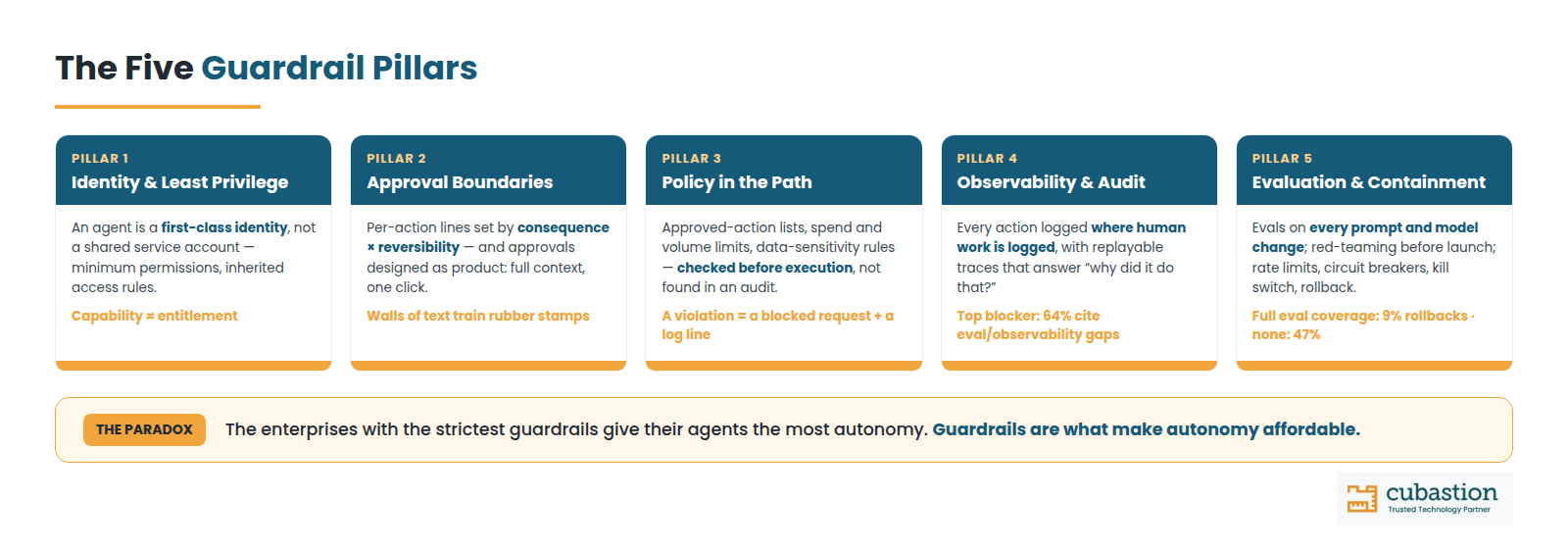
Underneath the boundary sits the machinery that enforces it. Five pillars recur in every agentic deployment that has earned its autonomy.
Identity and least privilege. An agent is a first-class identity, not a shared service account. It authenticates like an employee, holds the minimum permissions its role needs, and inherits the access rules of the systems it touches. Capability is not entitlement: what a model could do must be firmly separated from what this agent may do.
Approval boundaries, designed as product. The boundary only works if approving is easy and informed - the full context, the proposed action, and one click. Approvals that arrive as walls of text train humans to rubber-stamp, and a rubber stamp is autonomy without the honesty of admitting it.
Policy enforcement in the execution path. Approved-action lists, spend and volume limits, data-sensitivity rules - checked before the action runs, not discovered in an audit weeks later. A violation should be a blocked request and a log entry, never a headline.
Observability and audit. Every agent action logged in the same place human work is logged, with traces that can be replayed to answer, "why did it do that?" This is now the top production blocker - 64% of enterprises cite evaluation and observability gaps - and, in Europe, a legal floor: high-risk systems must retain automatically generated logs for at least six months.
Evaluation and containment. Test before trust: automated evaluations on every prompt and model change, red-teaming before anything customer-facing ships. The numbers are stark - agents with full evaluation coverage roll back at 9%; agents without, at 47%. And because no test suite catches everything, containment finishes the job: rate limits, circuit breakers, a kill switch, and a rehearsed rollback path.

The five guardrail pillars
The regulation is not waiting
If the engineering argument does not move your organization, the legal one now will. On 2 August 2026, the EU AI Act’s obligations for high-risk systems came into force: documented human oversight procedures, log retention, transparency to affected individuals, penalties up to €15 million or 3% of global turnover. Most enterprise agents will fall outside the high-risk categories, but the direction of travel is unmistakable, and the pillars above are, not coincidentally, the same machinery regulators are beginning to expect as a matter of course.
Enterprises are responding: 56% now have a named owner for agent operations, up from 11% two years ago, and formal AI usage policies have doubled. Governance is becoming an operating function, not a policy document.
Autonomy is earned, not granted
The practical path is the one you would use with a new hire. Agents start by observing - read-only, watched. They advance to advising, then to acting with approval, and only then with evaluation evidence, clean audit trails, and incident-free volume behind them, to acting alone within guardrails. Autonomy is a promotion, and like any promotion it can be revoked.
Here is the paradox worth sitting with: the enterprises with the strictest guardrails are the ones giving their agents the most autonomy. That is not a contradiction, it is the mechanism. Guardrails are what make autonomy affordable. The companies that skip them will spend 2027 demoting their agents; the companies that build them will spend it promoting theirs.
The question is not whether your agents will act. It is whether anyone decided where they must stop.