


Discover how AI-powered inventory monitoring and computer vision transform automotive paint shop operations through real-time inventory tracking, automated traceability, and improved manufacturing efficiency.
Why Real-Time Inventory Visibility is Becoming Critical in Modern Manufacturing
Manufacturing environments today operate under increasing pressure to improve production efficiency, reduce operational delays, and maintain complete traceability across shop-floor processes. In industries such as automotive manufacturing, where multiple product variants move continuously through paint shop operations, maintaining accurate real-time inventory visibility remains a major challenge.
Traditional tracking systems often rely on manual logging, barcode scanning, or RFID infrastructure. While these methods provide basic operational control, they struggle to deliver the speed, accuracy, and scalability required in modern high-volume manufacturing environments.
Artificial Intelligence (AI) and Computer Vision are introducing a new operating model for industrial inventory management. By combining industrial cameras, AI-powered image recognition, and real-time analytics, manufacturers can now automate inventory monitoring, track product movement across production stages, and generate intelligent operational insights without heavy manual intervention.
This article explores how AI-driven inventory monitoring systems are transforming paint shop operations, the challenges manufacturers face with traditional approaches, and how intelligent traceability solutions help organizations move toward Industry 4.0-enabled manufacturing ecosystems.
The Evolution of Inventory Monitoring in Manufacturing Operations

Historically, manufacturing inventory tracking depended heavily on manual supervision and physical tagging systems. Production teams relied on:
- Manual inventory counting
- Barcode scanning
- RFID tags
- Spreadsheet-based movement logging
- Human checkpoint validation
These methods worked reasonably well in slower or less complex production environments. However, modern manufacturing operations, especially in automotive production, involve continuous movement of thousands of components through multiple processing stages every day.
Today’s manufacturing environments demand:
- Real-time inventory visibility
- Automated traceability across production stages
- Faster operational decision-making
- Reduced manual dependency
- Data-driven manufacturing intelligence
To address these needs, many organizations adopted digital systems such as ERP platforms, MES systems, and production dashboards. While these technologies improved data visibility, they often depended on manual data input or physical tracking infrastructure.
Paint shop operations present additional complexity because:
- Components move continuously between stages
- Product variants can appear visually similar
- Harsh industrial conditions impact tag reliability
- Manual checkpoints slow operational flow
AI-powered computer vision builds upon existing manufacturing systems by transforming visual data into actionable operational intelligence, enabling manufacturers to move from reactive inventory management toward real-time automated traceability.
Why Traditional Paint Shop Tracking Systems Struggle at Scale
The challenge facing modern manufacturing operations is not the absence of tracking systems — it is the inability to maintain accurate visibility in fast-moving production environments.
Several structural issues commonly exist in paint shop operations:
1. Lack of Real-Time Inventory Visibility
Production teams often struggle to identify:
- Which components are currently at each stage
- How many units are waiting between checkpoints
- Whether bottlenecks are forming within the process
Without real-time visibility, operational planning becomes reactive instead of proactive.
2. Manual Tracking Delays and Errors
Manual logging processes frequently create:
- Data inconsistencies
- Delayed inventory updates
- Missing movement records
- Duplicate entries
As production volumes increase, maintaining accurate stage-wise inventory tracking becomes increasingly difficult.
3. Limited Traceability Across Production Stages
Manufacturers require complete movement history for:
- Quality inspection
- Production audits
- Rework analysis
- Operational accountability
However, traditional systems often lack automated stage-level traceability.
4. Dependence on Barcode and RFID Infrastructure
Conventional systems rely heavily on physical tagging methods such as:
- RFID tags
- QR codes
- Barcode labels
In paint shop environments, these methods can become unreliable due to:
- Paint exposure
- Heat and chemical conditions
- Physical wear and tear
- Scanning limitations
5. Lack of Intelligent Operational Insights
Without centralized digital tracking, organizations struggle to generate:
- Live production dashboards
- Process optimization insights
- Predictive operational analytics
- Intelligent manufacturing visibility
These challenges create inefficiencies that directly impact production flow, operational control, and manufacturing productivity.
AI-Powered Computer Vision for Real-Time Inventory Monitoring
To address these operational challenges, Cubastion Consulting Pvt. Ltd. designed an AI-powered Inventory Monitoring & Traceability framework using industrial computer vision and real-time analytics.
The solution combines:
- Industrial cameras
- AI-based image recognition
- Python-powered detection models
- Real-time event processing
- Centralized operational dashboards
Rather than depending entirely on barcode or RFID systems, the platform uses visual intelligence to automatically identify and track components moving across production stages.
Intelligent Checkpoint Monitoring
Multiple checkpoints are deployed across paint shop operations.
At every checkpoint:
- Industrial cameras capture component images
- AI models identify product variants
- Timestamps and checkpoint IDs are generated
- Movement logs update automatically
- Inventory dashboards refresh in real time
This enables continuous visibility across the manufacturing process.
Automated Model Detection
The AI engine is trained to recognize:
- Product models
- Variant differences
- Shape characteristics
- Stage transitions
The system generates:
- Model identification
- Confidence scores
- Movement history
- Stage-level inventory status
This significantly reduces dependency on manual verification.
Real-Time Manufacturing Dashboards
A centralized dashboard provides:
- Stage-wise inventory visibility
- Model movement tracking
- Process bottleneck detection
- Traceability logs
- Operational analytics
Production supervisors gain immediate insight into manufacturing flow and inventory conditions.
Scalable Industry 4.0 Architecture
The platform is designed to support:
- ERP integration
- MES connectivity
- Advanced analytics
- Future AI enhancements
- Multi-plant scalability
This creates a long-term foundation for intelligent manufacturing transformation.
The following process flow illustrates how inventory is tracked as components move through various paint shop stages. AI-enabled checkpoints continuously monitor product movement, automatically identifying models, recording timestamps, and updating inventory records in real time. This ensures complete visibility of stage-wise inventory while maintaining end-to-end traceability throughout the manufacturing journey.
Inventory Management Process Flow:-

Image: 1
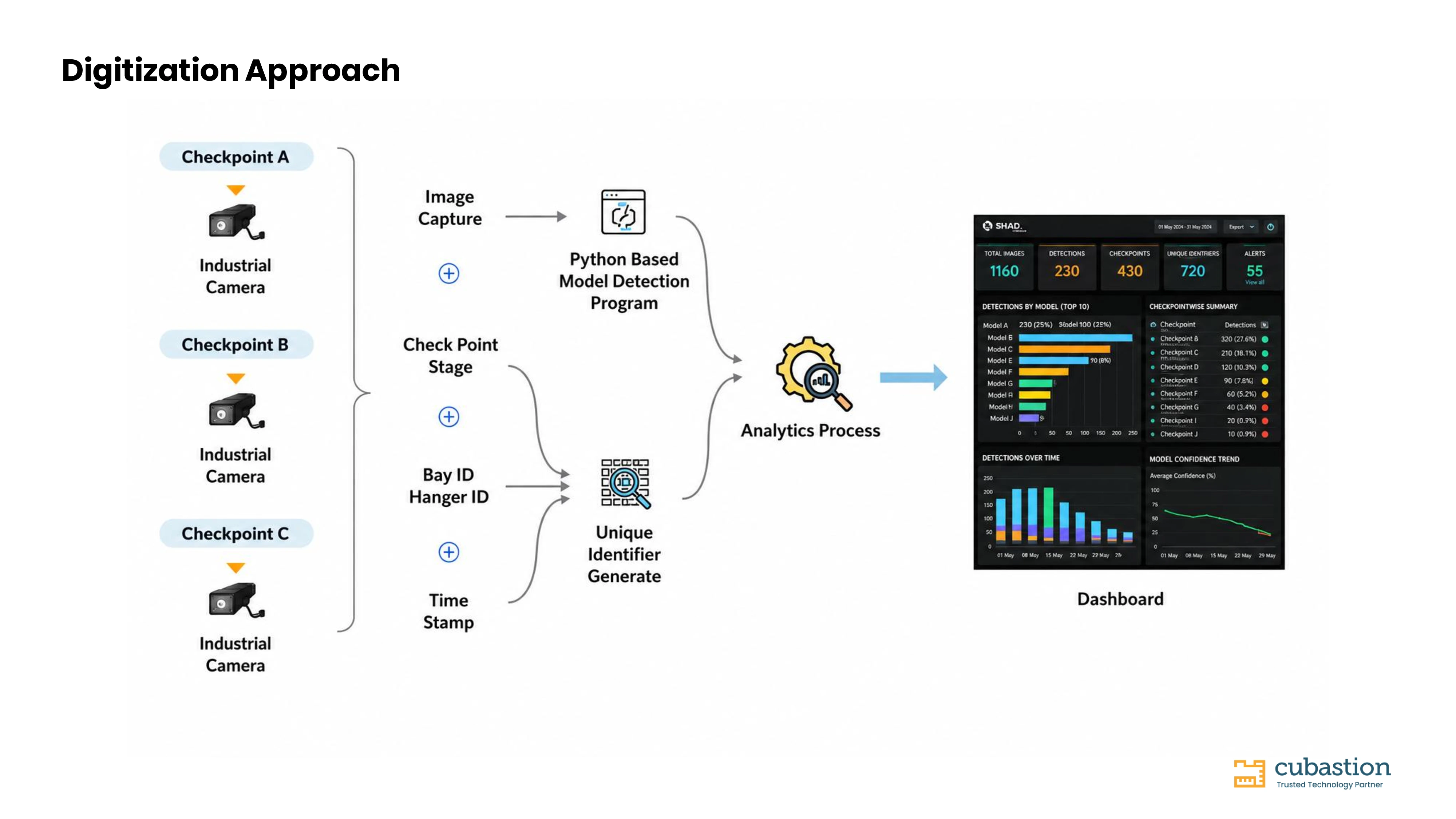
To enable this automated monitoring capability, the solution leverages a digitized architecture built on industrial cameras, AI-powered image recognition, and real-time analytics. At each checkpoint, images are captured and processed to identify products, generate unique identifiers, and record movement events. The collected data is then consolidated into centralized dashboards, providing actionable inventory insights, operational visibility, and data-driven decision-making capabilities.
Digitization Approach :-

Image: 2
AI in Action Across Automotive Manufacturing Operations
To understand how AI transforms paint shop inventory management, imagine an automotive manufacturing facility where hundreds of painted fuel tanks move continuously across pretreatment, painting, decal, lacquer, and inspection stages.
In traditional systems, operators manually record movement or scan barcodes at checkpoints. Delays, missed scans, or incorrect entries can quickly create inventory mismatches.
With AI-powered computer vision, however, the process becomes automated and intelligent.
a. Automated Stage Detection
As fuel tanks move through production stages, industrial cameras capture images at designated checkpoints. AI models identify the component variant and automatically update stage-wise inventory records.
Result:
Improved inventory accuracy and reduced manual tracking dependency.
b. Real-Time Bottleneck Visibility
If inventory begins accumulating between decal and lacquer stages, the dashboard immediately highlights congestion areas and delayed movement patterns.
Result:
Faster operational response and improved production flow management.
c. Intelligent Traceability
If a specific component later requires quality inspection or rework analysis, production teams can instantly access:
- Movement history
- Processing timestamps
- Checkpoint records
- Previous stage transitions
Result:
Faster root-cause analysis and stronger quality assurance.
d. Reduced Manual Intervention
AI-driven monitoring minimizes repetitive administrative activities such as:
- Manual counting
- Spreadsheet updates
- Barcode scanning
- Physical inventory validation
Result:
Higher workforce productivity and lower operational overhead.
Across the manufacturing lifecycle, AI helps organizations move beyond manual inventory management toward intelligent, automated operational control.
What Manufacturing Organizations Achieve with AI-Driven Traceability
When AI becomes embedded within manufacturing operations, organizations move from reactive inventory monitoring to proactive operational intelligence.
Key outcomes include:
- Improved real-time inventory visibility
- Faster identification of operational bottlenecks
- Reduced manual dependency and tracking errors
- Better manufacturing traceability and accountability
- Increased operational efficiency across production stages
- Stronger readiness for Industry 4.0 transformation
- Improved decision-making through live operational analytics
Most importantly, AI enables manufacturing teams to make faster and more accurate operational decisions using real-time production intelligence.
This transforms inventory management from a manual reporting function into a strategic operational capability.
Key Takeaways for Manufacturing Leaders
The adoption of AI-powered inventory monitoring represents more than a technology upgrade — it changes how manufacturing operations are managed and optimized.
Key learnings include:
a) Visual Intelligence Can Reduce Dependency on Physical Tags
Computer vision systems can successfully reduce reliance on:
- Barcode infrastructure
- RFID systems
- Manual logging mechanisms
This creates greater flexibility in industrial environments.
b) Real-Time Visibility Improves Operational Agility
Live production visibility helps teams:
- Detect delays earlier
- Improve throughput planning
- Reduce idle inventory
- Respond faster to disruptions
c) AI Success Depends on Process Understanding
Successful industrial AI implementation requires deep understanding of:
- Production workflows
- Shop-floor movement patterns
- Operational bottlenecks
- Exception handling processes
Technology alone is not enough.
d) Scalability Must Be Built from the Beginning
Manufacturing systems continuously evolve. Solutions should support:
- Additional checkpoints
- New product variants
- ERP integration
- Future analytics capabilities
- Multi-location expansion
As manufacturing industries continue advancing toward smart factory ecosystems, organizations that combine AI-powered operational intelligence with scalable digital infrastructure will be best positioned to achieve long-term operational excellence.
At Cubastion Consulting Pvt. Ltd., we help enterprises design and deploy AI-driven manufacturing solutions that improve visibility, automate operations, and accelerate Industry 4.0 transformation initiatives.