


Enterprise AI starts with data. See how integration, quality and governance build an AI-ready data foundation, with a real IMMS example.
Why Enterprise AI Transformation Begins with Data
Artificial Intelligence is transforming how enterprises operate, analyze information, and make business decisions. From predictive analytics and intelligent automation to Generative AI and advanced business intelligence, organizations are increasingly investing in AI to improve operational efficiency and gain a competitive advantage.
However, the success of enterprise AI transformation depends on something far more fundamental: the quality, accessibility, and reliability of organizational data.
Many enterprises possess enormous volumes of information but struggle to use it effectively because their data is fragmented across legacy applications, disconnected databases, cloud platforms, and departmental systems.
A strong data foundation addresses this challenge. It brings together data integration, quality management, governance, and scalable architecture to create an environment where AI systems can operate reliably and deliver meaningful business value.
This article explores why traditional data environments limit AI adoption, how enterprises can establish an AI-ready data foundation, and what measurable business outcomes they can achieve through structured data modernization.
From Data Accumulation to Data Intelligence
Over the last decade, enterprises have invested significantly in digital platforms, ERP systems, CRM applications, cloud infrastructure, and business intelligence solutions. These investments have enabled organizations to collect and store information across almost every business function.
However, collecting data and making it useful are two different challenges.
As organizations increasingly explore machine learning, predictive analytics, and Generative AI, the limitations of traditional data environments have become more visible.
Most enterprises still operate with:
- Data distributed across multiple applications, databases, and platforms.
- Legacy systems with limited integration capabilities.
- Inconsistent data formats and quality standards.
- Reporting environments that rely heavily on manual consolidation.
- Limited visibility into data ownership, governance, and accessibility.
The emergence of enterprise AI has changed the expectations from organizational data. Businesses no longer need information only for historical reporting; they need connected, reliable, and accessible data that can support intelligent decision-making.
A modern data foundation enables this transition by connecting existing information systems, establishing consistent data management practices, and preparing enterprise information for advanced analytics and AI applications.
Why Enterprise AI Initiatives Struggle Without a Strong Data Foundation
Enterprise AI adoption often faces challenges not because of a lack of AI technologies, but because the underlying data environment is not ready to support them.
First, fragmented data creates incomplete business visibility. When customer, financial, operational, and transactional information exists across independent systems, organizations struggle to establish a unified view of their operations.
Second, poor data quality affects the reliability of AI outputs. Duplicate records, missing information, outdated entries, and inconsistent formats can lead to inaccurate predictions and unreliable recommendations.
Third, legacy infrastructure limits scalability. Older applications and databases may not support modern data processing requirements or integrate easily with cloud-based AI platforms.
Fourth, inadequate data governance creates security and compliance risks. Without clearly defined access controls, ownership, and data management policies, organizations may find it difficult to ensure that sensitive information is handled appropriately.
Finally, limited data accessibility slows business decisions. Teams often depend on manual reporting and IT intervention to retrieve and consolidate information, reducing the speed at which insights can be generated and acted upon.
The result is a disconnect between AI investments and actual business value. Organizations may successfully deploy AI tools but struggle to scale them because the underlying data remains fragmented, inconsistent, and difficult to access.
Building an AI-Ready Data Foundation for Enterprise Transformation
A strong data foundation is not a single technology implementation. It is a combination of integrated systems, data management capabilities, governance frameworks, and scalable infrastructure.
The objective is to make enterprise data reliable, connected, secure, and accessible for current and future business requirements.
An effective data foundation involves:
- Data Assessment and Modernization: Evaluating existing databases, applications, infrastructure, and data flows to identify gaps, redundancies, and modernization opportunities.
- Data Integration: Connecting information from multiple enterprise systems through APIs, ETL/ELT pipelines, and integration platforms to establish consistent data flows.
- Data Quality Management: Implementing validation, cleansing, standardization, and monitoring processes to improve data accuracy and reliability.
- Data Governance and Security: Establishing data ownership, access controls, classification, audit mechanisms, and compliance policies to ensure responsible data management.
- Scalable Data Architecture: Leveraging cloud-based, hybrid, and modern data platforms such as data warehouses and data lakehouses to support growing data volumes and processing requirements.
- AI and Analytics Readiness: Preparing structured and relevant datasets for machine learning, predictive analytics, and Generative AI applications. Technologies such as Retrieval-Augmented Generation (RAG) and vector databases can further enable AI systems to access relevant enterprise knowledge.
At Cubastion, this approach aligns data integration, enterprise application modernization, and technology transformation with evolving business requirements. The focus is on strengthening existing technology ecosystems and creating the foundation required for scalable data-driven operations and future AI adoption.
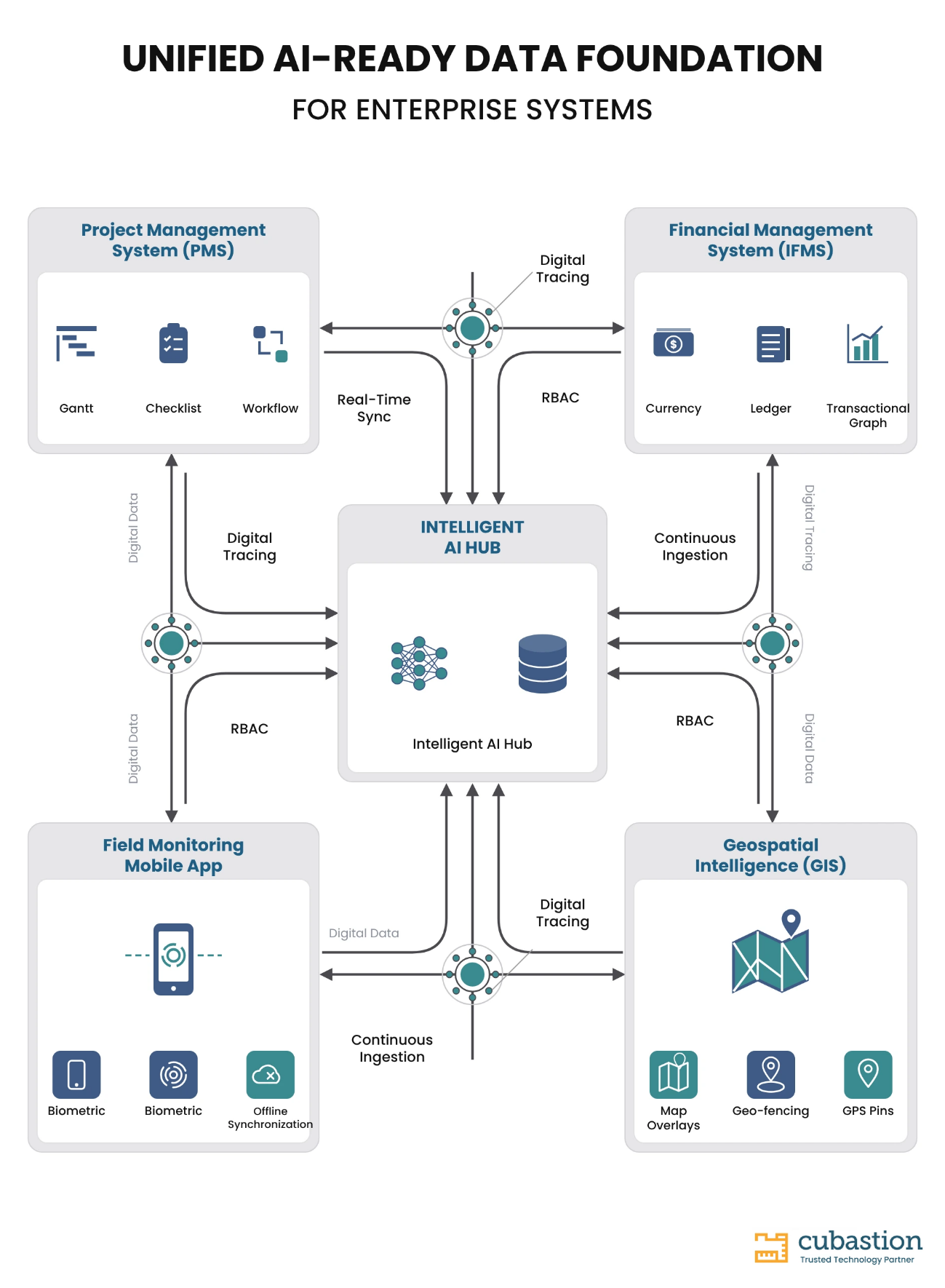
To illustrate how these capabilities come together in practice, the architecture below outlines a unified, AI-ready data foundation connecting project management, financial systems, field monitoring, and geospatial intelligence into a central AI hub through real-time sync and role-based access control (RBAC):

Figure 1.1: Unified AI-ready data foundation architecture integrating PMS, IFMS, field monitoring, and GIS into a central AI hub.
By unifying these core enterprise modules with continuous data ingestion and digital tracing, organizations build a secure, governed ecosystem that is ready to power predictive analytics and AI-driven workflows at scale.
Building a Unified Data Foundation for Large-Scale Public Infrastructure Programmes
Government bodies executing nationwide infrastructure and welfare schemes manage enormous volumes of data, ranging from Detailed Project Reports (DPRs) and financial disbursements to physical milestone tracking and geographical mapping.
Previously, project data, financial records, and physical progress reports were often maintained in isolated silos, leading to inconsistent reporting, delayed fund utilization, and blind spots in execution tracking.
By establishing a unified digital platform, an Integrated Monitoring and Management System (IMMS) is created to bridge these gaps. The modernization effort replaces fragmented legacy systems by integrating a Project Management System (PMS) for lifecycle tracking, a mobile application for real-time field monitoring and geo-tagging, and an Integrated Financial Management System (IFMS) linked to national financial gateways. Standardized data structures, secure API integrations, and centralized governance practices ensure that every rupee released is mapped directly against geo-validated physical milestones.
Once this foundation is established, the organization can leverage advanced analytics and AI capabilities. AI-powered tools assist in drafting digitized Detailed Project Reports (DPRs), while GenAI chatbots rapidly extract necessary data from the central database. Furthermore, automated photo verification and geo-fencing prevent duplicate reporting, and predictive analytics forecast delays and highlight idle balances.
Result: Improved data consistency and accuracy across national, state, and district levels. The integration of physical progress data and financial vouchers minimizes manual reconciliation and allows for the automated generation of compliance reports and Utilization Certificates. This unified environment empowers leadership with real-time dashboards, strengthens audit trails, and establishes a scalable technology foundation ready for ongoing intelligent automation and predictive insights.
To see this in action, the dashboard below illustrates the result: an integrated monitoring system that maps physical project completion directly against financial disbursals in real time.
To see this in action, the dashboard below illustrates the final result- An integrated monitoring system that maps physical project completion directly against financial disbursals in real time.

Figure 1.2: Real-time executive command centre providing 360-degree visibility into large-scale infrastructure delivery.
What Enterprises Achieve with a Strong Data Foundation
A strong data foundation creates value beyond individual technology implementations. It enables enterprises to transition from fragmented information management towards connected, intelligent, and data-driven operations.
Organizations can achieve:
- Improved Data Accessibility: Connected information across departments enables faster access to relevant business insights.
- Higher Data Reliability: Standardized data quality practices improve the consistency and accuracy of organizational information.
- Faster Decision-Making: Reduced manual consolidation and improved reporting capabilities support timely business decisions.
- Stronger Governance and Security: Defined ownership, access controls, and compliance practices improve data accountability.
- Scalable AI Adoption: AI-ready data environments provide reusable capabilities for machine learning, predictive analytics, and Generative AI.
- Better Operational Efficiency: Integrated data systems reduce information silos and unnecessary manual processes.
Most importantly, enterprises create a reusable technology foundation that supports multiple business functions rather than limiting AI initiatives to isolated experiments.
Key Takeaways for Enterprise Leaders
Building a strong data foundation is a strategic requirement for organizations looking to scale AI adoption and achieve sustainable digital transformation.
Key learnings include:
- Data quality determines AI reliability: Advanced AI models cannot consistently deliver meaningful results when the underlying data is incomplete, inconsistent, or outdated.
- Integration creates business visibility: Connecting enterprise applications and databases enables organizations to develop a unified view of business operations.
- Governance must be established early: Data ownership, security, access controls, and compliance should be integral to the data strategy.
- Modernization should align with business objectives – Technology investments must address actual operational challenges rather than introduce complexity without measurable value.
- AI readiness is an ongoing journey – Data environments must continuously evolve as business requirements, technology platforms, and AI capabilities advance.
As enterprises move towards intelligent and automated operations, those that prioritize data readiness will be better positioned to scale AI initiatives, improve business performance, and achieve long-term competitive advantage.
Move Towards Enterprise AI Transformation with the Right Data Foundation
Enterprise AI transformation does not begin with deploying an AI model. It begins with understanding, organizing, integrating, and managing the data that powers intelligent systems.
Organizations that overlook their underlying data challenges risk limiting the effectiveness of their AI investments. The real opportunity lies in building a connected, secure, and scalable data ecosystem that supports both present business requirements and future innovation.
If your organization is dealing with fragmented data environments, legacy infrastructure, integration challenges, or limited data accessibility, now is the time to strengthen your data foundation.
At Cubastion, we work with enterprises to modernize technology ecosystems, strengthen application and data integration capabilities, and build scalable digital solutions aligned with evolving business needs.
Connect with Cubastion to explore how the right data foundation can help your organization move from fragmented information systems to enterprise-wide AI transformation.