



Introduction
Enterprises today are burdened with legacy systems, rapidly changing customer expectations and an expanding array of cloud-native architectures, APIs, and digital channels. Without a structured mechanism to evaluate the current state of their application portfolio, most organizations struggle to prioritize modernization efforts, quantify risks, or justify transformation investments. An Application Assessment Framework addresses this gap by offering a standardized, measurable, and business-aligned method to evaluate applications across functionality, technology, performance, security, user experience, and operational readiness.
Why Application Assessments Matter in Today’s Technology Landscape
Application assessments are pivotal in an era where enterprises must balance innovation with stability. With organizations generating higher transactional loads, integrating multiple digital touchpoints, and aiming for 24x7 availability, applications must consistently deliver performance, security, and usability at scale. Unfortunately, many businesses still operate legacy systems that hinder agility and create operational bottlenecks. An assessment provides a structured approach to identifying these pain points early.
The need for assessments becomes even more acute during cloud migration or digital transformation initiatives. Enterprises must decide which applications to rehost, replatform, refactor, or retire: decisions that carry significant financial and technical risk. A systematic assessment mitigates this risk by basing decisions on empirical data rather than assumptions. It also enables organizations to quantify technical debt, understand integration complexity, and evaluate compliance vulnerabilities.
Beyond technology, assessments also help align IT and business teams. They offer clarity on application relevance, value delivered, cost of ownership, and user satisfaction. The output ensures leadership invests in the right modernization initiatives rather than treating transformation as a generic technology upgrade. Overall, application assessments matter because they reduce uncertainty, improve decision-making, and create a roadmap that balances innovation, cost, and long-term scalability.
Components of a Robust Application Assessment Framework
A strong assessment framework combines structure, repeatability, and adaptability. At its core, it comprises multiple layers: objectives, evaluation pillars, data-collection mechanisms, scoring models, and synthesis logic. Each layer ensures that the assessment moves beyond anecdotal observations to provide quantifiable and comparable results across applications.
1. Assessment Objectives: Define why the evaluation is required and what strategic outcomes are expected. This includes modernization needs, performance issues, compliance concerns, or operational inefficiencies.
2. Evaluation Pillars: Create a consistent lens through which applications can be reviewed, usually covering functionality, technology stack, architecture patterns, performance, security posture, UX, and integration models.
3. Data Collection Model: Combines interviews, architecture reviews, code-level scans, APM logs, incident history, end-user feedback and a maturity or scoring matrix, giving each pillar quantifiable metrics and weighted scoring. This enables comparative analysis between multiple applications.
4. Insight Synthesis: Transforms raw observations into actionable insights. This includes risk scoring, heatmaps, prioritization bands, and recommended strategies.
The Core Pillars: Functionality, Technology, Performance, Security, and UX
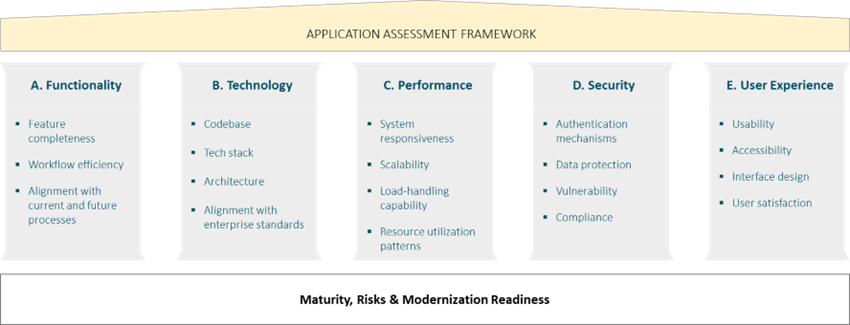
The assessment framework is anchored by five central pillars that collectively represent the full lifecycle and operational footprint of an application.

1. Functionality: Evaluates how well the application meets business needs, its feature completeness, workflow efficiency, and alignment with current and future processes.
2. Technology: Examines the underlying codebase, tech stack, architectural patterns, integration models, and alignment with enterprise standards.
3. Performance: Focuses on system responsiveness, scalability, load-handling capability, and resource utilization patterns.
4. Security: Reviews authentication mechanisms, data protection models, vulnerability exposure, compliance adherence, and threat surfaces.
5. User Experience: Evaluates usability, accessibility, interface design quality, and user satisfaction levels.
Collectively, these pillars create a holistic view of each application’s maturity, risks, and readiness for modernization.
Designing an Assessment Scope Aligned to Business Objectives
An assessment must be tailored to business priorities rather than treated as a purely technical exercise. Defining the right scope ensures the evaluation remains focused, avoids unnecessary complexity, and produces decision-ready outputs. This begins by identifying the business drivers: Are we modernizing for scalability, to reduce technical debt, to enable new digital capabilities, to improve compliance, or to prepare for cloud migration? Defining the scope helps determine the appropriate depth of review (high-level or detailed) and which tools, tests, and datasets are required.
Once drivers are identified, the assessment scope must establish which application modules, integrations, and environments are in focus. For example, some organizations prioritize customer-facing systems to improve digital engagement, while others focus on back-office systems driving efficiency. The scope should also consider operational realities, such as peak business cycles, availability of SMEs, and readiness of system documentation.
Scoping ensures strong alignment between IT and business stakeholders. It sets clear expectations on timelines, deliverables, and the nature of outputs. A well-defined scope prevents resource wastage, reduces assessment fatigue, and ensures the final recommendations directly support business objectives. It transforms a technical audit into a strategic initiative.
Governance, Stakeholders, and Assessment Ownership
Governance provides the structure required to keep the assessment objective, consistent, and transparent. A robust governance model ensures participation from the right stakeholders, defines responsibilities, and enforces quality control across all assessment stages. It begins with identifying an Assessment Steering Group composed of business leads, IT leadership, enterprise architects, and security stakeholders.
Next is assigning assessment owners, typically enterprise architects or modernization leads, responsible for methodology execution, data consolidation, tool-driven evaluations, and framing insights. Subject matter experts (SMEs) from application teams support data collection, walkthroughs, and validation of findings.
A strong governance enhances the assessment process in numerous ways.
1. Enforces a standardized review process, including structured interviews, code scans, performance tests, architecture validations, and security reviews
2. Mandates documentation practices, such as capturing assumptions, evidence, and scoring rationale
3. Ensures the assessment remains unbiased by directing the assessment towards fact-based outcomes
4. Establishes escalation mechanisms, decision checkpoints, and periodic reviews, ensuring that assessment timelines are met, blockers are resolved quickly, and overall assessment quality remains consistent across applications
Methods, Tools, and Data Sources Used in Assessments
A structured assessment relies on a carefully curated combination of data collection methods and diagnostic tools. Each method serves a distinct purpose and collectively ensures that the assessment is evidence-driven rather than based on subjective impressions. Key methods include stakeholder interviews, functional walkthroughs, architecture deep dives, code repository reviews, incident and ticket analysis, and user feedback surveys. These methods generate qualitative insights into pain points, inefficiencies, and areas requiring modernization.
Complementing these are tool-based assessments, which generate empirical data. Modern APM tools such as Dynatrace, New Relic, or AppDynamics offer system telemetry on response times, CPU spikes, memory leaks, and transaction flows. Code analysis tools like SonarQube highlight code smells, vulnerabilities, and maintainability issues. Security testing tools perform SAST, DAST, or dependency scanning to reveal compliance gaps and patching needs.
Data sources include logs, monitoring dashboards, architecture documents, version-control histories, performance test results, and audit reports. Together, these create a multi-dimensional dataset supporting accurate scoring and strategy recommendations.
This combination of tools and methods ensures the assessment is grounded in facts, reducing ambiguity and enabling confident modernization decisions.
Deliverables and Outcomes Expected from the Assessment
An effective assessment culminates in a set of structured, decision-enabling deliverables. These deliverables convert technical findings into actionable modernization pathways, ensuring leadership teams can plan investments confidently.
1. The most common deliverable is a maturity or risk heatmap, visually highlighting strengths, gaps, and areas requiring urgent attention.
2. The assessment could also provide pillar-wise scorecards, detailing functional gaps, tech stack issues, performance bottlenecks, security vulnerabilities, and UX challenges. These scorecards support prioritization discussions and help teams understand both immediate fixes and long-term modernization needs.
3. The modernization recommendation matrix suggests whether each application should be rehosted, refactored, rearchitected, replatformed, replaced, or retired.
4. The deliverables often include a dependency and integration map, cost implications, effort estimates, and a high-level modernization roadmap.
5. For business stakeholders, the outcomes include clarity on value delivery, risk exposure, and alignment to strategic objectives.
Overall, the deliverables transform the assessment from an audit into a decision-support framework, enabling organizations to prioritize modernization initiatives and build a cohesive transformation roadmap.
Conclusion
A well-structured application assessment framework provides the clarity and discipline required for organizations to make informed modernization and investment decisions. As enterprises continue to scale their digital footprint, the ability to evaluate applications through a consistent, objective, and data-backed methodology becomes a strategic differentiator rather than an operational exercise. By anchoring the assessment in well-defined pillars, organizations gain a holistic understanding of their current-state landscape and the challenges that must be addressed to achieve future readiness.