



The most valuable AI in your company will never say a word
Somewhere on LinkedIn right now, someone is demoing a copilot. Meanwhile, in a factory, a machine-learning model just noticed that the vibration signature on a grinding spindle has drifted three weeks before the bearing would have failed mid-shift. It has no chat window. It writes no prose. Nobody will ever screenshot it.
It may be the most profitable AI the company owns. Unplanned downtime in discrete manufacturing now costs around $260,000 per hour; in continuous process industries it can exceed $50,000 per minute (Factory AI, 2026). One prevented failure pays for a lot of software.
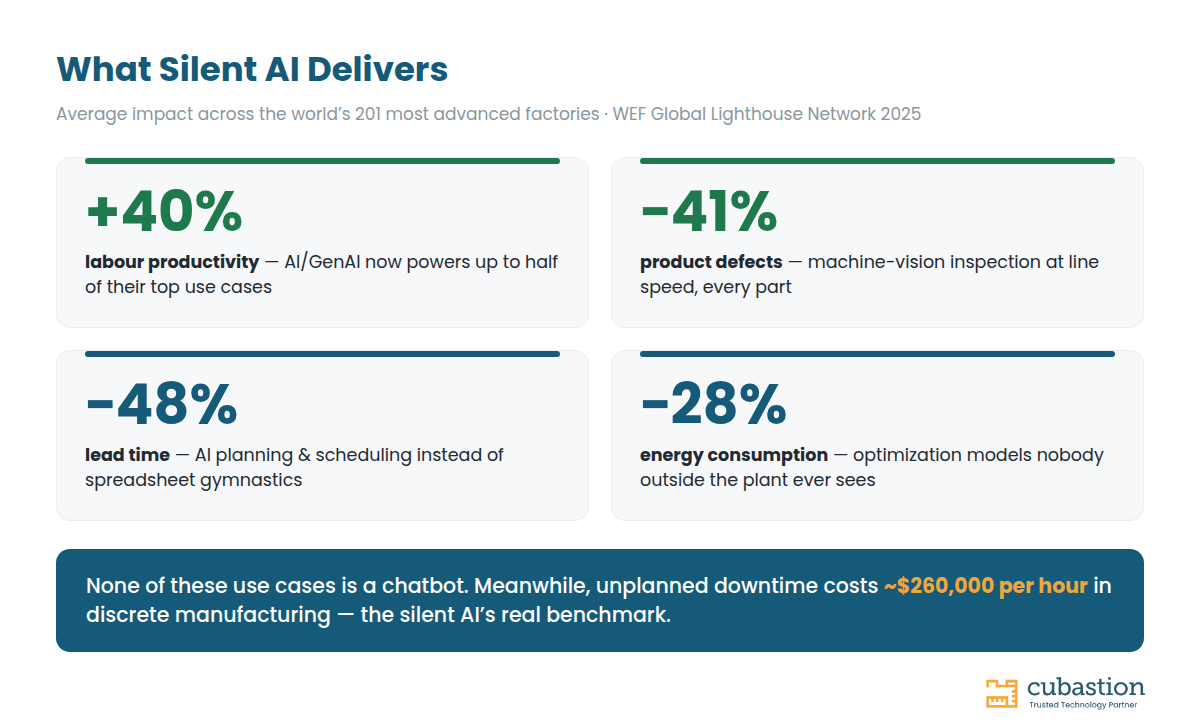
This is the gap in the AI conversation. The public discourse is about chatbots, copilots and content - office AI, demo-friendly AI, AI that talks. But the AI that is quietly transforming operations looks nothing like that. The World Economic Forum’s Global Lighthouse Network - 201 of the world’s most advanced factories, reports what the leaders get from it: 40% higher labour productivity on average, 41% fewer defects, 48% shorter lead times, 28% lower energy consumption. AI or generative AI now powers up to half of their top use cases.
None of those use cases is a chatbot.

What silent AI delivers — WEF Global Lighthouse Network 2025
The four workhorses
Strip away the hype and industrial AI keeps resolving into four families of use cases. They are unglamorous. They pay.
Predictive maintenance. Instead of servicing machines on a calendar, models watch vibration, temperature, current draw and acoustic signatures, and flag failures before they happen. The mature deployments report 30–50% less machine downtime, 25–30% lower maintenance cost, and fault-detection accuracy on rotating equipment around 98.5%. On a line where an hour of stoppage costs a quarter of a million dollars, this is not an innovation project. It is insurance with a payback curve.
Machine-vision quality inspection. Cameras plus models inspecting every part at line speed, catching drift a sampling-based human check would miss for hours. Lighthouse factories report 41% fewer defects on average; typical deployments cut scrap 20–30%. In an automotive components plant, the interesting moment comes about a month in, when the vision system flags a defect pattern that traces back to a worn tool two stations upstream, and the plant realizes it bought a diagnosis engine, not just a camera. Scrap is the most honest metric in manufacturing , nobody argues with a lighter waste bin.
Parts and fix prediction in field service. The AI decides what the technician’s van should carry and what the likely fix is before anyone drives anywhere. The 2025 benchmark across 160 service organizations is blunt: AI-assisted service resolves issues 39% faster with 21% higher accuracy; top performers fix it first time 86% of the time versus 53% at the bottom; one in seven site visits is unnecessary; and every failed first visit adds about fourteen days to resolution. A service network we worked with started exactly here, predicting parts per job from work-order history. First-time fix went up, repeat visits went down, and no customer ever saw the model that did it.
Planning and scheduling optimization. The least photogenic of the four: models simulating and re-sequencing production against orders, materials and capacity. This is where lighthouse-scale numbers come from - 44% shorter cycle times, 10–20% energy savings, overall equipment effectiveness up 11–15% within a year. It replaces the planner’s Excel gymnastics, not the planner.
The pattern: no conversation, no prompt, no demo theatre. Input: sensor and transaction data. Output: a decision made earlier, or a failure that never happened.

The four workhorses of industrial AI
Why your pilot didn’t pay
If these numbers are real and across 201 lighthouses and 160 service organizations, they are, why do so many industrial AI pilots die quietly?
The good news first: the industry is learning. Pilot failure rates have fallen from roughly 70% in 2023 to about 30% in 2026 (Factory AI). The failures that remain are strikingly consistent, and neither is about the model.
First, the data was never ready. An estimated 65% of industrial data goes unused, and around 40% of pre-2010 machines lack native connectivity - the sensors aren’t there, or the data lands in a historian nobody trusts. Readers of my last article will recognize this: it is the shop-floor version of the same disease. An AI on untrusted data doesn’t transform operations; it generates confident nonsense at line speed. Trust first, then automate.
Second, the use case was chosen for the demo, not the P&L. A chatbot for the maintenance manual gets applause in the steering committee. A vibration model on the six machines that caused last year’s worst stoppages gets budget renewed. Companies that start with "what would look impressive" join the failed-pilot statistics; companies that start with "what stopped the line last quarter" don’t.
The boring-first test
Before any industrial AI initiative, run the candidate use case through three filters.
Is it measured in money the plant already tracks? Downtime hours, scrap percentage, first-time-fix rate, OEE. If the benefit needs a new metric invented to be visible, it will not survive its first budget review.
Does the data already exist? Sensors already streaming, work orders already logged, images already captured. The best first AI project consumes data you have, not data you must first spend two years plumbing.
Is the decision loop short? Flag the bearing → schedule the intervention → measure avoided downtime. Weeks, not quarters. Short loops compound trust; long loops compound doubt.
Score your candidates honestly and something humbling happens: the chatbot drops down the list, and a defect camera on line 2 rises to the top. Let it. The applause can come later.

Why pilots die — and the boring-first test
The quiet ROI
There is a version of this article that manufacturing leaders have earned the right to feel smug about: while the office world debates whether its copilots are worth the license fee, factories are compounding 40% productivity gains from AI nobody outside the plant has ever seen.
But the real lesson travels in both directions. Industrial AI works because it is anchored to physics and money - a bearing either fails or it doesn’t; scrap either falls or it doesn’t. That discipline, not the algorithm, is what the rest of the enterprise should import.
The most valuable AI in your company will never talk to anyone. It will just quietly stop the line from stopping and the only place you will ever see it is in the numbers.