



Building Fair, Transparent, and Trusted Outcomes for Large-Scale Government and Institutional Programs
Every year, governments and public institutions make millions of high-impact decisions that shape people's lives like recruiting civil servants, admitting students, allocating affordable housing, awarding scholarships, and distributing welfare benefits. These processes determine access to opportunities that affect careers, livelihoods, and communities.
As populations and digital services grow, so has the scale of these operations - from recruitment exams to admissions, housing, and welfare schemes, all now processing volumes far beyond what these systems were built for. Managing this requires not just speed, but fairness, transparency, and accountability.
Public confidence is increasingly tested by delayed results, verification errors, duplicate applications, eligibility disputes, and allegations of unfair selection - all fuelling appeals and litigation. Citizens now expect government services to be as responsive as private-sector ones.
This is driving a new generation of digital transformation. Rather than just automating existing workflows, governments are exploring AI to strengthen decision-making, governance, and public trust. The goal is no longer faster processing - it's building intelligent, explainable, trustworthy selection systems that operate confidently at national scale.
Why Public Selection Systems Are Becoming Increasingly Complex
These systems were designed for far smaller volumes and simpler evaluation rules. Today, they must calculate merit, apply reservation policies, catch duplicates, and publish accurate results for millions of applicants - all within strict timelines and under public scrutiny.
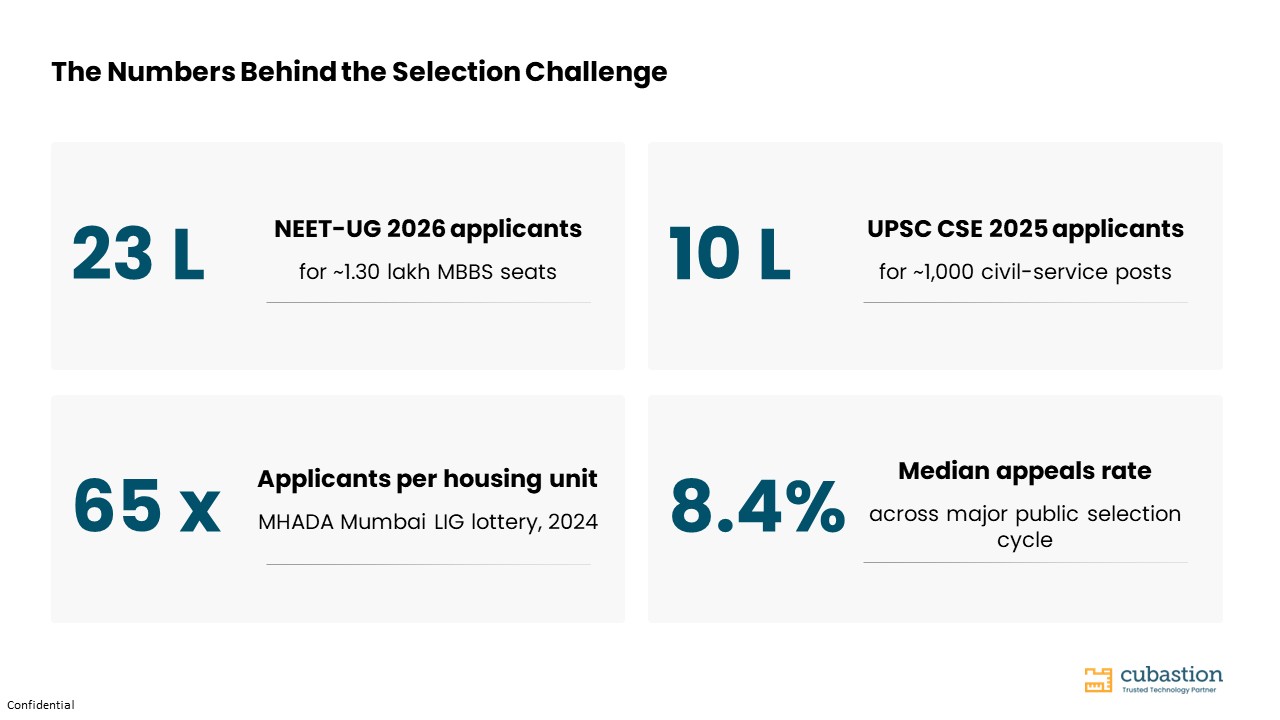
The scale is substantial: India's CUET-UG 2025 received over 1.35 million registrations, one of the world's largest university entrance exams, each requiring accurate scoring and ranking. Authorities like MHADA and DDA face similar pressure on the allocation side, running transparent lotteries across housing applications that exceed available units by several multiples.
As volumes grow, so does the risk in result processing itself - score normalization errors, ranking disputes, and allocation mistakes quickly turn into appeals and public distrust. The OECD notes that citizens judge institutions not just by who gets selected, but by whether the selection process itself was fair - making result processing a matter of public trust, not just administrative output.

Why Traditional Selection Processes Are Reaching Their Limits
Many organizations have digitized application forms, but the actual selection and result processing still relies heavily on manual validation and rigid rule-based workflows - and this is struggling to keep pace.
Merit calculation is a major bottleneck: normalizing scores, weighting eligibility criteria, applying reservation policies, and ranking applicants consistently - whether for an exam, an admission cycle, or a housing lottery - leaves little room for error before results go public.
Duplicate and fraudulent entries - repeat applications, forged certificates, impersonation - are typically caught only after manual investigation, meaning flawed results can slip through before anyone notices.
Result finalization carries its own risk: generating merit lists, allocating seats, homes, or funds, publishing outcomes, and handling the wave of objections and re-evaluation requests that follow - each stage adding a chance for error or delay. As the OECD Digital Government Outlook notes, simply digitizing workflows isn't enough; the next phase needs systems where result processing itself stays accurate, transparent, and continuously governed.

From Rule-Based Automation to AI Decision Intelligence
The first wave of digital government replaced paper processes with online portals - improving access but not changing how results were actually calculated and finalized. Most systems still depend on predefined rules and manual intervention at the scoring and ranking stage.
But modern selection processes - normalizing scores, applying reservation policies, ranking millions of candidates, and catching duplicate or fraudulent entries - have outgrown simple rule-based automation. AI enables a shift toward Decision Intelligence: analysing large volumes of data, flagging anomalies, validating entries, prioritizing exceptions, and helping administrators finalize results faster and more consistently.
But selection systems and result processing can't run on AI alone. Every ranking, allocation, or rejection must stay explainable and accountable - authorities must be able to justify exactly how a result was reached. This is why the OECD and UNESCO emphasize transparency, explainability, fairness, and human oversight as non-negotiable principles. The goal isn't replacing decision-makers - it's giving them intelligent tools that cut manual effort while preserving accountability for every result published.

Inside Cubastion's AI Decision Intelligence Platform
Building trusted public selection systems requires much more than digitizing applications or introducing AI into isolated workflows. Every stage-from receiving an application to publishing the final result-must be designed to ensure fairness, transparency, explainability, and policy compliance.
Cubastion approaches this challenge by engineering an end-to-end AI Decision Intelligence Platform that combines document intelligence, advanced analytics, policy-driven automation, optimization algorithms, and explainable AI into a single decision pipeline. Rather than building different solutions for recruitment, university admissions, housing allocation, or scholarship programs, the same architecture adapts to each use case by changing the business rules while keeping the underlying intelligence consistent.
Stage 1 – Application & Document Intelligence
Every decision begins with data quality. Applicants submit certificates, identity proofs, income records, domicile documents, mark sheets, and other supporting evidence in multiple formats and varying levels of quality.
Cubastion's transformer-based Document AI engine automatically extracts structured information from scanned documents, PDFs, and images, validates mandatory fields, and standardizes applicant data before it enters the evaluation pipeline. This eliminates manual data entry while significantly reducing processing errors.
Stage 2 – Identity & Integrity Intelligence
Large-scale public programs frequently encounter duplicate applications, inconsistent personal information, forged certificates, and identity manipulation.
Instead of relying solely on exact field matching, Cubastion combines entity resolution, fuzzy matching, document verification, image forensics, and biometric validation (where available) to identify suspicious applications before they influence the final outcome. This enables authorities to detect integrity issues early rather than after results have been published.
Stage 3 – Policy & Eligibility Intelligence
Public selection processes are governed by dynamic regulations rather than static business rules. Age relaxations, reservation policies, domicile criteria, income thresholds, qualification requirements, and program-specific conditions continue to evolve with government policy.
Cubastion manages these requirements through a configurable policy engine that separates business rules from application code. As regulations change, administrators can update eligibility logic without requiring software redevelopment, enabling faster policy implementation while maintaining regulatory compliance.
Stage 4 – Evaluation & Decision Intelligence
Evaluation is often the most sensitive stage of any public selection process. Examination scores may require normalization across multiple sessions, admissions involve complex merit calculations, while housing and scholarship programs apply weighted evaluation criteria before generating rankings.
Cubastion applies statistically validated techniques such as equi-percentile equating, z-score normalization, and AI-assisted anomaly detection to ensure that applicants are evaluated consistently regardless of examination session or data complexity. Every recommendation is supported by explainable AI, allowing administrators to understand the reasoning behind rankings and validation outcomes.
Stage 5 – Allocation Intelligence
Selection is only part of the decision process. The real challenge lies in allocating limited resources-whether seats, jobs, housing units, scholarships, or grants-while satisfying reservation policies, applicant preferences, and regulatory constraints.
Cubastion treats allocation as a constrained optimization problem rather than a manual administrative task. Depending on the use case, the platform applies techniques such as Integer Linear Programming (ILP), Mixed-Integer Programming (MIP), constraint programming, and stable matching algorithms to optimize seat allocation, housing allotment, scholarship distribution, and recruitment outcomes while satisfying reservation policies, applicant preferences, and regulatory constraints. Every allocation remains transparent, policy-compliant, and fully auditable.
Stage 6 – Governance & Audit Intelligence
Every public decision must remain defensible long after results are published.
Cubastion records every validation, policy evaluation, score calculation, AI recommendation, and allocation decision within a secure, tamper-evident audit framework. Explainable AI provides feature-level reasoning for every recommendation, enabling administrators to reproduce, review, and justify decisions whenever challenged by citizens, auditors, or regulatory authorities.

Rather than developing separate systems for recruitment examinations, university admissions, housing allocation, scholarship management, or professional licensing, Cubastion applies this common AI Decision Intelligence architecture across every public selection program. While each use case operates under different policies and regulations, the underlying platform consistently delivers the same principles-accuracy, transparency, explainability, governance, and trust.
One Engine, Multiple Use Cases - Measured by What Actually Matters
The same engine - document digitization, score normalization, fuzzy-match integrity checks, a rules engine, an allocation solver, and audit logging - applies across every use case, each with its own success parameters:
- Government Recruitment: The UPSC Civil Services Examination attracts over 1 million applicants annually. AI enables automated, score normalization, reservation validation, and merit list generation.
- Higher Education Admissions: CUET (UG) 2025 recorded over 1.35 million registrations, and NEET (UG) attracts more than 2 million candidates each year. AI supports eligibility verification, merit ranking, counselling, and seat allocation.
- Housing Board Allocation: The MHADA Mumbai Lottery 2024 received over 1.3 lakh applications for approximately 2,000 homes. AI strengthens applicant validation, duplicate detection, and transparent lottery-based allocation.
- Scholarships & Public Grants: India's National Scholarship Portal (NSP) has processed over 8 crore scholarship applications since its launch. AI accelerates eligibility checks, fraud detection, and policy-driven fund allocation.
- Professional Licensing: The National Medical Commission (NMC) regulates over 1.3 million registered doctors in India. AI streamlines credential verification, examination result validation, certification, and compliance management.

A few numbers matter across all of them: appeal rate (should trend down, not just spike once at launch), fraud catch rate pre- vs. post-publication (catching issues before results go live, not after), audit-trail retrieval time (minutes, not weeks, when a result is challenged), and manual override rate (low and shrinking, not zero - genuinely ambiguous cases should still reach a person).
The OECD and World Economic Forum both tie trusted AI adoption to transparency and human oversight, not automation alone. In practice, that trust comes from exactly these numbers being checkable - not just claimed.
The Future of Public Selection Systems Is Trusted Decision Intelligence
Governments have successfully digitized citizen services through online portals and integrated databases. The next evolution is AI-powered Decision Intelligence platforms that not only process applications but also support transparent, explainable, and policy-driven decisions at scale.
Future public selection systems will unify recruitment, admissions, housing allocation, scholarships, and licensing through a shared intelligence layer, enabling faster decisions while maintaining human oversight, accountability, and compliance.
At Cubastion, we believe the future of digital governance lies in building AI-powered decision platforms that combine intelligent automation with transparency, explainability, and trust. Success will no longer be measured by how quickly results are published, but by how confidently every decision can be explained and defended.
Conclusion
As recruitment, admissions, scholarships, housing, and welfare programs continue to grow in scale and complexity, traditional rule-based systems are reaching their limits. AI-powered public selection systems enable governments and institutions to process millions of applications more efficiently while improving accuracy, transparency, and governance.
The future belongs to platforms that augment human decision-making-not replace it. By combining AI with explainable decision intelligence, strong governance, and complete auditability, organizations can build public selection systems that are not only faster but also fairer, more trusted, and ready for the next generation of digital governance.