


Only 7% of enterprises have AI-ready data. Learn the four properties of AI-ready data and why fixing your data foundation first makes AI succeed.
A large enterprise greenlights its flagship AI project: a copilot to help its people work faster. A capable team spends a full quarter building it, integrating a strong model, wiring up the interface, running the demos. It underperforms. The answers are inconsistent, sometimes confidently wrong, and the business users quietly stop trusting it. The instinct is to blame the model, so the team tries a better one. It does not help. The real problem was never on the surface. It was underneath, in data that was fragmented across systems, inconsistent in structure, and governed loosely if at all. One Southeast Asian bank lived exactly this story in early 2026, pausing a customer-advisor copilot after twelve weeks to rebuild the foundation it should have built first. The uncomfortable pattern, repeated across the enterprise world, is that most AI initiatives do not fail because the model was wrong. They fail because the ground beneath them was never ready, and nobody told the steering committee until the fourth quarter.
Executive Summary
This series looks beneath the intelligence, at the foundations that decide whether enterprise AI works at all. The first of them is data, and the evidence is stark. In 2026, nearly every large organization is running AI initiatives, yet only about 7 percent say their data is fully ready to support them. Study after study attributes the majority of AI failures to the same root cause: not model quality, but poor, disconnected, ungoverned data. RAND and Gartner both trace roughly 85 percent of failed AI projects to data problems. The most expensive misconception in enterprise AI is that the model is the bottleneck. It is not. The foundation is where the work is, and the enterprises extracting value are the ones that fixed their data before they scaled anything on top of it.

Figure 1. Nearly all enterprises run AI. Almost none have AI-ready data.
Industry Context
The last two years created a strange imbalance. Enterprises raced to adopt AI, and the market rewarded the race, but adoption outran readiness, and the pilot era quietly masked the gap. A proof of concept on a curated dataset can look impressive precisely because someone cleaned the data by hand for the demo. Production never gets that luxury. As organizations now try to move AI from the lab into the business, and from assistance into autonomous action, the foundation they skipped is being exposed all at once. Analysts have noticed: survey after survey in 2026 reports the same finding, that the defining constraint on enterprise AI is no longer model capability but data readiness, and that the gap between the two is where most of the market is stuck.
The Most Expensive Misconception
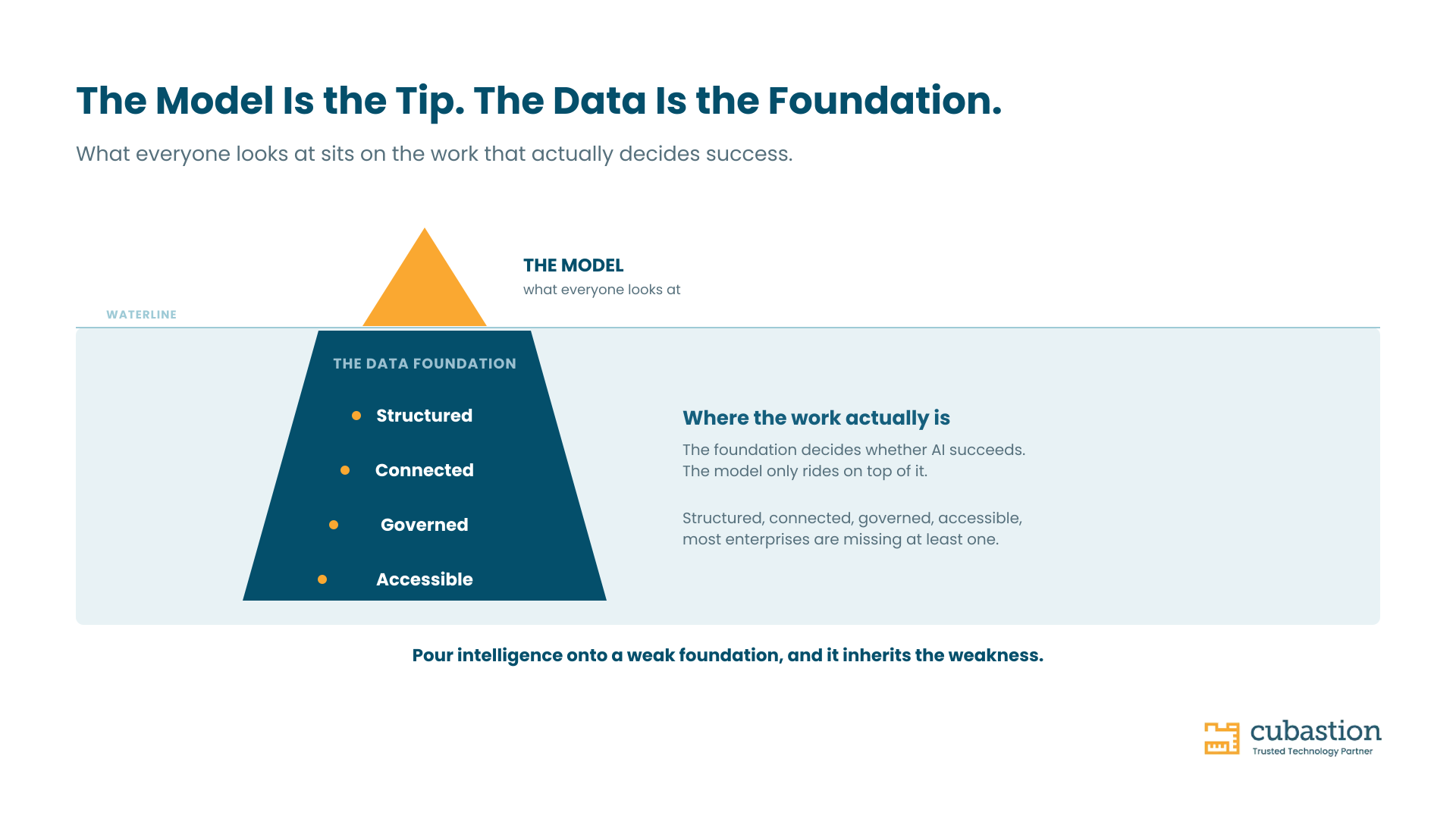
The models are extraordinary, and as the previous series argued, they are converging and commoditizing. That is precisely why they are rarely the differentiator, and rarely the problem. AI does not fail in isolation; it fails because the data it depends on is inaccurate, outdated, or poorly governed, and a better model cannot fix that. There is a structural reason the problem surfaced now. AI workloads expose data quality issues that traditional analytics quietly tolerated, and most enterprise data estates were built for transactional or analytical use, not for the retrieval and context that AI requires. The data that ran the business for decades is not, without significant work, the data that can power its AI. Pour intelligence onto a weak foundation and the intelligence inherits the weakness.
What AI-Ready Data Actually Means
Data readiness is often treated as a vague aspiration. It is in fact specific. AI-ready data has four properties. It is structured consistently, so that meaning is stable across sources rather than encoded differently in every system. It is connected, joined across the relevant systems so the AI has the context a decision actually requires, rather than a fragment of it. It is governed, with quality monitored and maintained and lineage traceable, so an output can be trusted and, increasingly, audited. And it is accessible, available at the speed and in the format AI systems need, which for production means quality signals measured in hours, not the quarterly audit cycles that analytics lived with. Most enterprises are missing at least one of the four, and the one most often ignored is the mountain of unstructured content, the documents, tickets, and transcripts, where much of the real knowledge lives. Readiness is not a single switch; it is these four properties holding together across the data an AI actually touches.

Figure 2. The four properties of AI-ready data.
Why So Few Are Ready
If data readiness is so decisive, why do so few have it? The reasons are consistent. Enterprises prioritize data quantity over quality, on the assumption that more data is always better, when unreliable data simply trains unreliable systems. They underestimate governance, treating it as administrative overhead rather than the thing that makes an output trustworthy. They rush to deploy on infrastructure that was never built for AI. And they fail to address legacy systems, where much of the data is trapped. The result is a widening gap between how many organizations deploy AI and how few have data ready to support it. It is no accident that the leading analyst trend monitor named data quality management the single most important data and analytics priority for 2026, ahead of new AI platforms and tools, or that Gartner expects a majority of AI projects lacking AI-ready data to be abandoned.
The Cost Compounds with Agents
If the data foundation mattered in the era of generative pilots, it matters far more in the era of agents, and this is the part most enterprises have not yet priced in. A generative model fed bad data produces a wrong answer, which a human usually catches before acting on it. An agent fed bad data takes a wrong action, autonomously, at machine speed, across live systems, and often no one catches it until the consequences arrive. The cost of a weak data foundation does not stay constant as autonomy increases; it compounds. This is also why regulators are moving: frameworks now expect enterprises to demonstrate data lineage and quality controls for any AI-influenced decision. As the enterprise hands more authority to AI, the quality and traceability of the data underneath it stops being a technical nicety and become a condition of operating safely.

Figure 3. Bad data is a wrong answer with generative AI, and a wrong action with agents.
Fix the Foundation First
The enterprises that cross the divide do one unglamorous thing before anything else: they fix the foundation. In practice that means auditing the data honestly to know what is actually there, establishing governance before launch rather than after an incident, modernizing the infrastructure so data can be connected and served at the speed AI needs, and monitoring quality continuously rather than in quarterly cycles. It also means a change in sequence and mindset. The organizations reporting real AI returns in 2026 are the ones that stopped launching new pilots and started repairing the substrate, because they learned that a model is only as good as the ground it stands on. Fixing data first is slower and less exciting than the next proof of concept. It is also the only thing that makes the proof of concept worth running.
Recommendations
Five priorities for building an AI-ready data foundation:
- Lead with data, not the model. Make data readiness the first question of any AI initiative, not an afterthought discovered in Q4.
- Assess honestly. Audit quality, structure, connectivity, and governance before committing to a build.
- Govern before you scale. Put quality monitoring and lineage in place early, so outputs can be trusted and audited.
- Serve data at AI speed. Modernize so data is connected and available in hours, not quarters.
- Prepare for autonomy. Raise the bar on quality and traceability now, because agents will act on whatever you give them.
Business Impact
The return on fixing the foundation is the difference between the enterprises stuck in pilot purgatory and the few whose AI reaches production and compounds. It is, quite literally, the dividing line the research keeps finding: the companies extracting value fixed their data first. A strong data foundation lifts the success rate of every AI initiative that follows, because each one draws on the same substrate rather than rediscovering the same problems. It is also the prerequisite for everything else this series will cover, the modernization, the integration, and the platform that together make an enterprise genuinely AI-ready. Data is not one workstream among many. It is the ground the rest is built on.
Conclusion
The quiet truth of enterprise AI in 2026 is that the model is rarely the problem. The data is. Very few enterprises have data that is truly ready, and weak foundations account for the majority of failed projects, a fact that only grows more consequential as autonomy rises. The work, as it turns out, was never mostly about AI. It was about the structured, connected, governed, accessible foundation the AI has to stand on. At Cubastion, this is where we start with enterprise leaders, building the data foundation that makes everything above it possible. The next piece looks at the systems that most often trap that data, and what it takes to modernize them. The intelligence is only ever as good as the ground beneath it.