


What Cubastion’s leadership assessment centre revealed: why strong technologists find leading hard, the 7 leadership competencies, and how to build them.
The Career Progression Assessment Centre at Cubastion has now wrapped up. It was one of the more comprehensive internal talent evaluations we have run in recent years, and it left us with a lot to think about, well beyond code quality or project delivery numbers.
This article isn’t about who got promoted. Rather, it’s about what we learned about our people, our culture, and the kind of leaders we hope to develop.
What We Set Out to Do
We did not design the Assessment Centre as a filter. We saw it more as a way for people to see themselves a little more clearly.
It had three rounds: a roleplay case study, a presentation, and a personal interview. Each candidate was observed on three dimensions: technical and functional competence, strategic and problem-solving ability, and leadership readiness. Four trained panellists evaluated every candidate independently, each bringing their own perspective and experience. We have written about the detailed assessment procedure in the article “Beyond The Appraisal”.
Together, the rounds gave us a full picture of where our talent stands today and where it could grow.
A Pattern Across the Panels
One theme that came across consistently this year among candidates was the strong technicality among our employees.

Most candidates arrived with solid technical foundations: exposure to several technologies, good delivery track records, and sound project management instincts. One panelist noted a candidate who had "learnt 3 new modules in 6 months and closed all 20 tickets." Another praised "excellent PM skill," and a third described a candidate as "technically sound and ready to take the role forward."
Alongside this technical strength, the assessment also pointed to an opportunity: leadership and communication skills were still at an earlier stage of development, and this is where the scores showed the most room to grow. This is a natural stage in a technology career, and anyone who has worked in technology consulting will probably recognise it.
The Technical Comfort Zone
In technology, depth tends to be rewarded early. The consultant who knows the platform best gets the harder tickets, and the person who can debug production at 2 AM earns people's trust. Technical mastery is what gets you noticed, and that is reasonable.
The assessment made one thing fairly clear, though: the skills that make someone a strong individual contributor are not quite the same as the ones that make an effective leader.
Panelists pointed to a similar set of gaps, independently and more than once:
- Convincing and influencing: Candidates understood situations well but found it hard to bring others along. One panelist observed that empathy was clearly present, and that the next step would be building the ability to convince others and drive change. Another noted that a more strategic outlook could be developed to broaden the thinking applied to a situation. Understanding a problem and resolving it through other people are different things.
- Strategic thinking: Several candidates leaned on theoretical approaches where panelists were hoping for real-world, structured thinking. Technology professionals are trained to look for the right answer, while leadership often involves situations that do not have a single right answer.
- Innovation: Innovation was an area with considerable scope for growth in most cases. Panelists noted that familiar, proven approaches were preferred, and that there is room to explore more innovative ways of addressing a concern. When you are the expert, it is natural to reach for what you know works. The next level asks a further question: what could work better.
- Communication and influencing style: A common point of feedback was tone and approach. Candidates who were technically authoritative sometimes came across as firm in people-facing scenarios, and greater flexibility in approach was seen as an area to develop. Confidence in your knowledge works best alongside openness in how you communicate.
- People management and emotional range: From developing talent to motivating a struggling team member, candidates found the interpersonal side of leadership harder to demonstrate. Several panelists observed candidates who focused on teamwork as participants rather than leading teams as owners.
What the Assessment Looks At
It is fair to ask why a technology consulting firm pays this much attention to these areas.
We have always believed that what we offer is, at its core, trusted partnership rather than software implementation. Trust, whether with clients, teams, or stakeholders, is built by people rather than platforms.
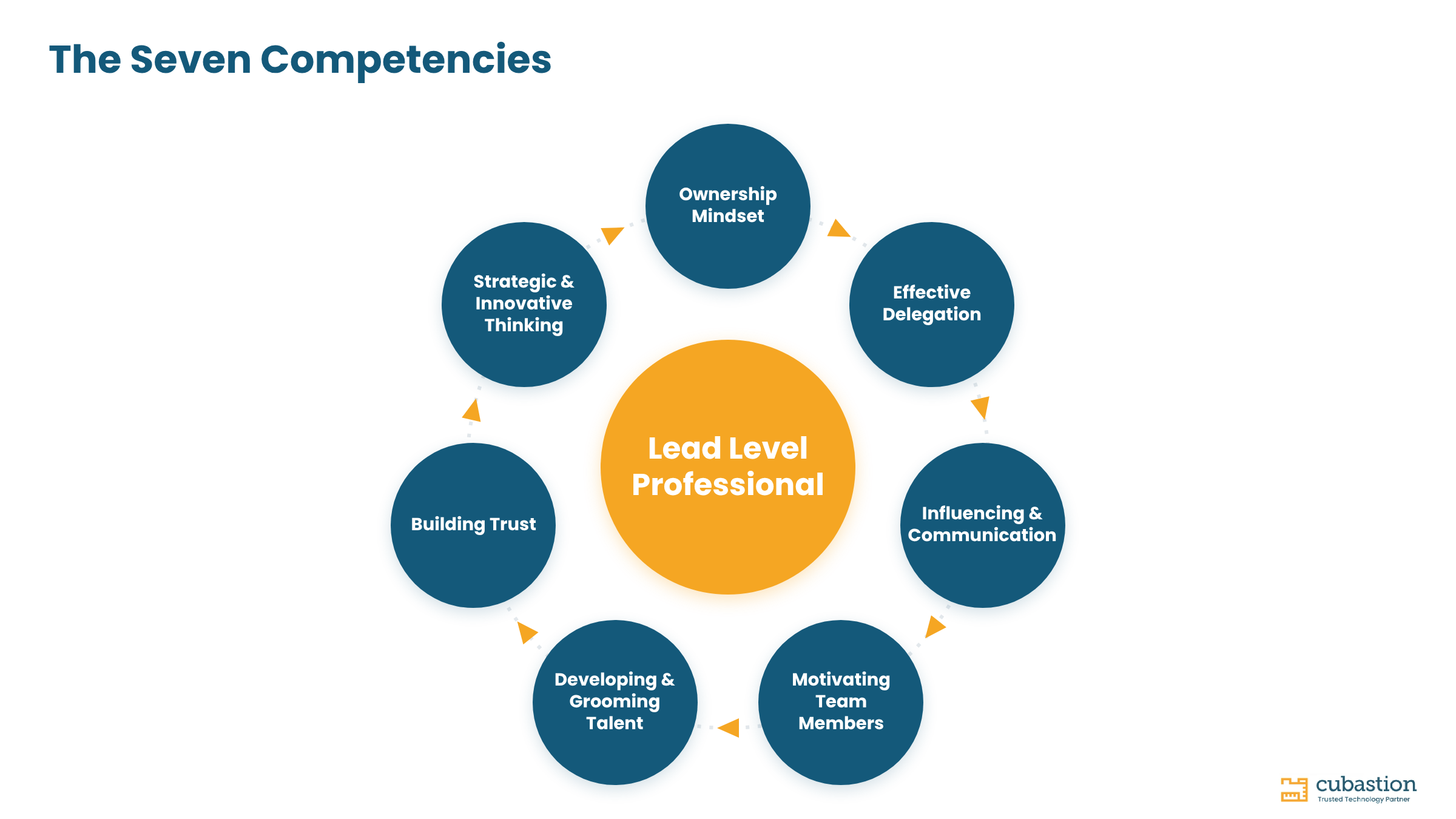
The Assessment Centre looks at seven leadership competencies that we consider important for a lead-level professional.

- Ownership mindset: Do you treat outcomes as yours, rather than only the tasks assigned to you?
- Effective delegation: Can you let go of execution while staying accountable for results?
- Influencing and communication skills: Can you move people, and not only inform them?
- Motivating and inspiring team members: Do people want to follow you, or do they simply report to you?
- Developing and grooming talent: Are you helping the people around you improve?
- Building trust: Do stakeholders, both clients and colleagues, have confidence in you?
- Strategic and innovative thinking: Are you solving today's problem, or also anticipating tomorrow's?
These are often called soft skills, though they are not easy to build. We assess them through structured, observed behaviour rather than self-reported claims on an appraisal form.
How This Differs from a Typical Promotion Review
Many organisations run promotion assessments, and most of them are conversations: a manager speaks with an employee, a form is filled in, and a decision is made.
Our approach is somewhat different, and intentionally so.
- Multiple evaluators, one candidate. Every participant was assessed by four independent panelists, which helps reduce halo effects, personal bias, and the limits of relying on a single working relationship.
- Behaviour over biography. The role play is not a quiz on your resume. It places you in a realistic and uncomfortable scenario, such as a difficult conversation with a team member or a challenging client situation, and observes how you respond under pressure.
- Presentation as a diagnostic. The presentation round shows how deeply a candidate has thought about their domain, whether they can turn complexity into clarity, and whether their confidence comes from knowledge or from performance.The interview as the integration. The personal interview brings together technical breadth, leadership maturity, organisational thinking, and the ability to describe a vision for the company's future and not only for one's own role.
Taken together, the three rounds and four panelists give a broader view than any single conversation is likely to.
What We Are Taking Forward
The Assessment Centre has ended, but the work that follows is only getting started.
For candidates recommended for promotion, the move into leadership is just beginning, and the panelists' feedback should help guide them.
For candidates who were not recommended this cycle, the feedback is not a final verdict. It is a set of development areas. Suggestions such as strengthening influencing capabilities and growing in confidence while leading a team each point to something specific that can be worked on. The distance between where someone is today and where they want to be is not a judgment. It is something that can be planned for.
For Cubastion as an organisation, the process reaffirmed something we care about: we want to build a community of leaders who happen to be technically excellent, rather than technically excellent people who happen to manage others.
A Closing Thought
The panelists who sat across from our candidates over the past few weeks offered something that is not common in professional life: honest, detailed, behavioural feedback, given with care and with the aim of helping each person grow.
One panelist said it simply about a candidate she believed in: "He has the potential, if he works on himself."
That line reflects the spirit of the exercise fairly well. Potential is the starting point, assessment is an honest look at where things stand, and growth is the choice that follows.
Cubastion does not evaluate its people in order to rank them. We do it to understand them, and then to invest in them.
That is what we value in this process, and why we think it is worth doing.