



Executive Story
A team builds an impressive agent in a week. A prompt, a capable model, a few API calls, and on stage it books the meeting, updates the record, sends the summary. The board is convinced; the budget is approved. Then it meets production. Fed real, messy inputs, it behaves inconsistently. When it makes a mistake, no one can see what it did or why. It has no limits on the actions it can take, no memory of what happened last time, and no way to be tested before it touches a live system. Within a month, the demo that dazzled is quietly shelved. This is the single most common story in enterprise AI right now, and it has one cause. The demo was the agent. What production requires is the stack, and the difference between the two is why, by industry estimates, the large majority of enterprise agents never ship.
Executive Summary
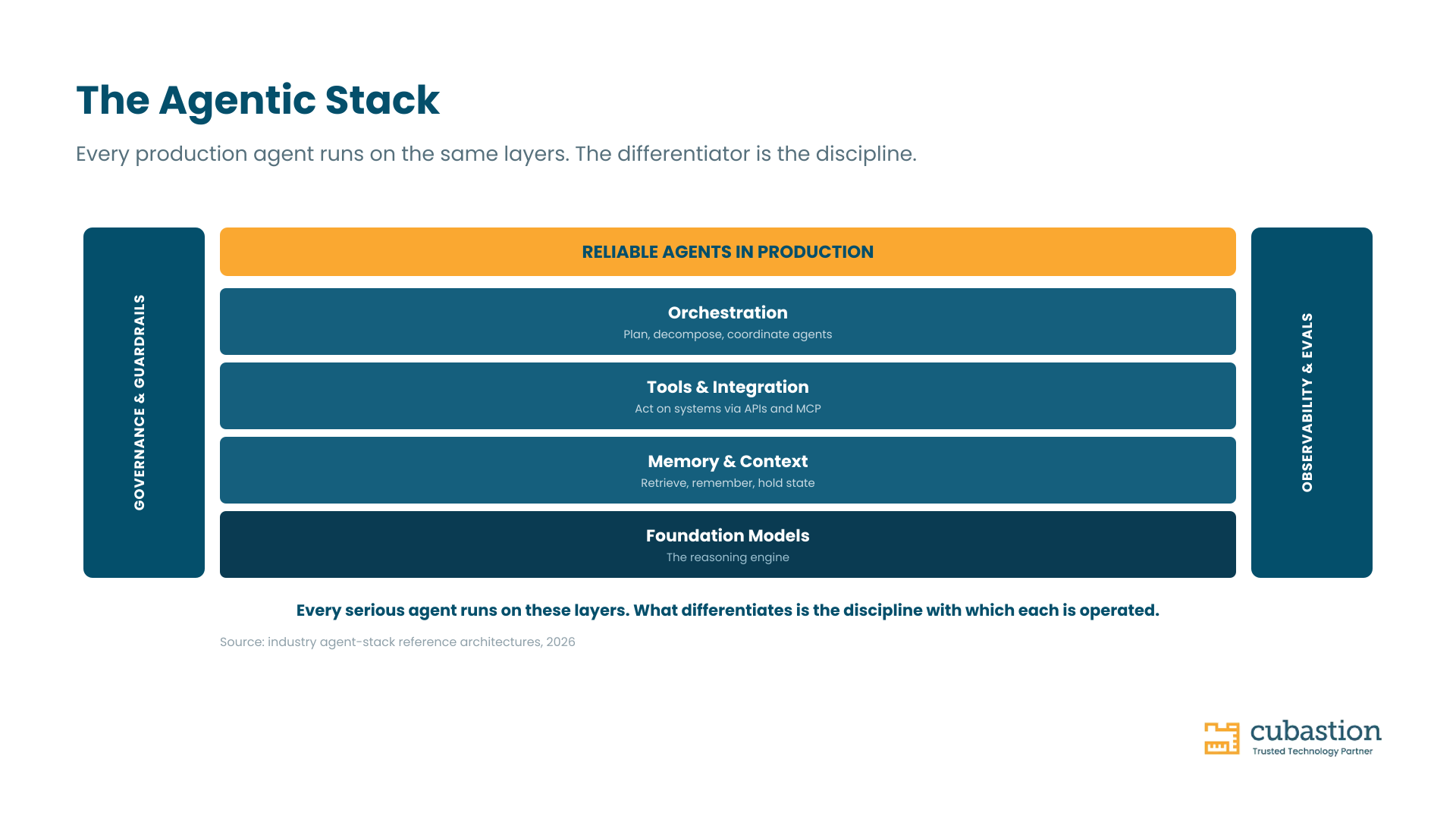
The previous article showed where agents create value. This one addresses the harder question that decides who captures it: how to build agents that actually run in production. The answer is architectural. Every serious production agent in 2026 sits on the same set of layers, a foundation model, memory and context, tools and integration, and orchestration, wrapped in two cross-cutting disciplines, governance and observability. The striking part is what this means for the model: it is one layer among many, and increasingly the easiest one. As one 2026 survey of the field put it, the stack is rarely the differentiator, because every serious vendor has roughly the same layers; what differentiates is the discipline with which each layer is operated. Building the agentic stack, not choosing the model, is the work that turns a demo into a dependable system.

Figure 1. The agentic stack: the layers behind a production agent.
Industry Context
For the past two years, enterprise AI conversations were about models: which one, how large, how capable. In 2026 the conversation has moved down the stack. The frontier models are extraordinary and, for most enterprise tasks, largely interchangeable, and the hard problems have shifted to everything around them. Practitioners now talk about needing a harness, not just a framework, reliability-first infrastructure that keeps an agent from falling over when production traffic arrives. This is a healthy correction. It moves the enterprise question from what a model can do in a demo to what a system can be trusted to do in production, which is the only question that determines whether an agent earns its place.
The Agentic Stack, Layer by Layer
It helps to separate two things that are often confused. The LLM stack serves model inference: the GPUs, batching, and routing that make a model respond. The agentic stack sits above it and governs what happens between the model and the real world. Every agent, however sophisticated, runs the same core loop, reason, act, observe, and the stack is the infrastructure that makes that loop run reliably when real traffic arrives.
Four layers form the core. The foundation model provides the reasoning, and mature systems route between several, using stronger models for planning and cheaper ones for routine steps. The memory and context layer gives the agent what it needs to know, through retrieval, state, and working memory; weak context is the single most common reason agents fail, so this layer matters more than its profile suggests. The tools and integration layer is how the agent acts, calling APIs, operating applications, and reaching enterprise systems through connectors and emerging standards such as the Model Context Protocol. And the orchestration layer plans the work, decomposing a goal into steps, managing state, and coordinating multiple agents where needed.
Two more concerns cut across all four. Governance and guardrails, now a discipline distinct from model-level safety, filter inputs and outputs, authorize and constrain tool calls, sandbox execution, and insert human checkpoints for high-risk actions. Observability and evaluation make behaviour visible and testable: tracing every action for audit, and running continuous evaluations, the layer with the widest gap between prototype and production, because most prototypes have none at all.
Prototype vs Production: The Model Is the Easy Part
This is why the demo-to-production gap is so wide. A prototype is a prompt, a model, and a few API calls, which is enough to produce something convincing in a controlled setting. A production system has to survive real variability: identity boundaries, compliance constraints, latency limits, changing data quality, and the simple fact that when something goes wrong, someone has to see it, own it, and fix it. A one-loop prompt workflow has almost no control plane for any of that.

Figure 2. A demo is a prompt and a model. Production is the whole stack.
The practical implication is liberating and uncomfortable at once. The model, the part that gets the attention, is the easy part, and it is commoditizing quickly. The hard, durable work is the engineering around it: the context that keeps it accurate, the guardrails that keep it safe, the observability that keeps it accountable, and the orchestration that keeps it coherent. A production agent is not an interface pattern. It is an engineered runtime.
Single Agent or Many?
One early architectural choice recurs: a single agent or several. A single agent is simpler, cheaper, and easier to observe, and it is the right default for most first deployments. As a workflow grows more complex, though, one agent can become a bottleneck for both reasoning quality and speed, and it becomes worth decomposing the work across specialized agents. A common and effective pattern is planner-executor-reviewer: a planner defines the steps, an executor performs the tool actions, and a reviewer checks the output against policy and task criteria.

Figure 3. Start with a single agent; move to a coordinated team when complexity demands it.
The multi-agent approach buys built-in quality gates and lets each role use the right model, a strong reasoner for planning, a cheaper model for routine transformation, a rule-based validator for safety-critical checks. It also adds coordination overhead and new failure modes, which is why it should be adopted when complexity demands it, not because the architecture diagram looks more impressive with more boxes.
A Map, Not a Checklist
The layers are real and, at scale, all of them are necessary, but they are a map, not a mandate. The failure pattern to avoid is adding layers because they exist: orchestration because agent graphs look serious, memory because every demo mentions personalization, multi-agent workflows because the diagram looks better. The result is a system doing a simple job wrapped in six layers, three vendors, and a retry strategy no one trusts. The discipline is the reverse. Add a layer when you can point to a specific failure it fixes: add memory when users keep repeating themselves, add orchestration when one model call cannot handle the workflow, add evaluation the moment real users can hit a failure you cannot see. Build the stack you need, not the one on the slide. Complexity that does not fix a failure is not sophistication; it is debt.
Recommendations
Five priorities for building an agentic stack that reaches production:
- Engineer a runtime, not a demo. Treat a production agent as a system with a control plane, not a prompt with ambitions.
- Invest in context and evaluation early. They are the layers with the widest prototype-to-production gap and the highest payoff.
- Centralize governance, observability, and tool access. A shared gateway prevents the fragmentation that cripples enterprise AI.
- Start single-agent; decompose only when needed. Add multi-agent orchestration to fix a real bottleneck, not for elegance.
- Treat the stack as a map. Add each layer to solve a named failure, and no sooner.
Business Impact
Getting the stack right is what converts the value identified in the previous article into value realized. It is the difference between a portfolio of stranded demos and a growing set of agents running reliably in production, and, because the layers are shared, each new agent costs less to build than the last. It also relocates competitive advantage. When every enterprise can access the same models, the model stops being the differentiator; the operational discipline of building, governing, and observing the stack becomes the moat. The enterprises pulling ahead are not the ones with a better model. They are the ones with a better stack, and the discipline to run it. Over time that discipline becomes an operating capability, the same shift the previous series described for AI as a whole, now playing out one layer deeper.
Conclusion
The agent is not the demo, and it is not the model. It is the stack, the layers of context, tools, orchestration, governance, and observability that turn a clever reasoning engine into a system an enterprise can trust with real work. That is unglamorous engineering, and it is precisely why it is defensible: models are converging, but the discipline to operate the stack is hard-won and compounding. At Cubastion, this is the layer we help enterprise leaders build, the production architecture beneath agents that last. Which leaves the question every board eventually asks, once the agents are running and the value is real: what does all of this actually cost, and what is the return? That is where the series goes next.