

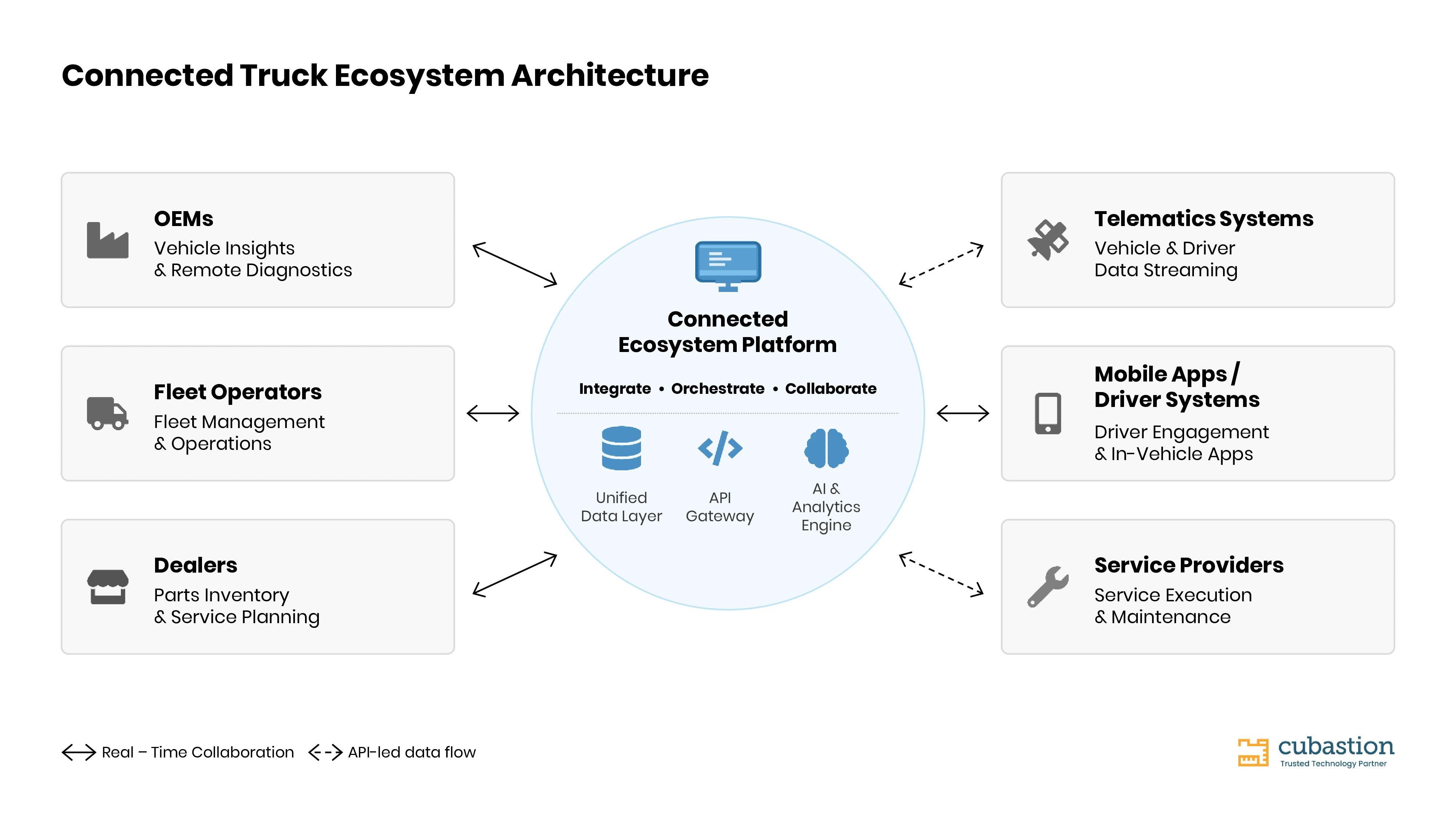

Learn how OEMs, fleets, and dealers can build a connected truck ecosystem with platform-driven, API-led architecture to cut downtime and boost efficiency.
The Shift from Connected Vehicles to Connected Ecosystems
The evolution of connected trucks is no longer limited to vehicle-level intelligence. It is now about building a connected ecosystem that links together OEMs, fleet operators, dealers, service providers, and digital platforms into a unified network. While connectivity has already improved visibility and operational efficiency, the next phase of transformation focuses on enabling seamless collaboration across stakeholders. This blog explores how a connected truck ecosystem functions, the challenges enterprises face while building it, and how platform-driven architectures can unlock end-to-end value across the commercial vehicle lifecycle.
How the Connected Truck Landscape Has Evolved
The first wave of connected truck innovation focused primarily on vehicle telemetry and fleet visibility, including location tracking, fuel consumption monitoring, driver behavior analysis, and maintenance indicators. These capabilities delivered significant operational benefits for fleet operators and OEMs.
However, most of these capabilities remained confined within individual systems. OEMs managed vehicle data, fleets handled operations, dealers managed servicing, and third-party providers delivered niche solutions. Despite the rise of connectivity, the ecosystem itself continued to operate in silos.
As digital transformation accelerates, commercial vehicles are no longer viewed as standalone assets. They are becoming part of a larger, data-driven network. This shift calls for a transition from isolated solutions to an integrated ecosystem model where data moves seamlessly across stakeholders and systems.

Key Challenges in Building a Connected Truck Ecosystem
Building a connected truck ecosystem is not only a technology challenge but also an organizational and architectural one. Enterprises commonly face the following barriers:
- Siloed Stakeholder Systems: OEMs, fleets, dealers, and service providers often operate on separate platforms with limited interoperability.
- Fragmented Data Ownership: Vehicle data, operational data, and service data are distributed across multiple systems, making it difficult to generate unified insights.
- Limited Real-Time Collaboration: Stakeholders lack shared visibility, which results in delayed decision-making and operational inefficiencies.
- Integration Complexity: Legacy systems and proprietary platforms create challenges in establishing seamless integrations.
- Absence of a Central Orchestration Layer: Most ecosystems do not have a centralized platform capable of coordinating actions, workflows, and decisions across participants.
As a result, enterprises are unable to realize the full potential of connected trucks, limiting outcomes to visibility instead of achieving end-to-end optimization.
Building a Platform-Driven Connected Ecosystem
The solution lies in developing a platform-driven connected ecosystem that enables seamless collaboration and orchestration across all stakeholders.
Core Principles of a Connected Truck Ecosystem
- Platform-Centric Architecture: Introduce a central platform that acts as the integration and orchestration layer between OEMs, fleets, dealers, and third-party providers.
- API-Led Connectivity: Enable interoperability across systems through standardized APIs that expose data and services efficiently.
- Unified Data Layer: Consolidate vehicle, operational, and service data into a common data model to support real-time insights.
- Role-Based Access and Collaboration: Provide each stakeholder with relevant and contextual access to data and workflows.
- AI-Driven Orchestration: Leverage AI to coordinate actions such as maintenance scheduling, route optimization, and service interventions across the ecosystem.
This approach transforms the ecosystem from a collection of disconnected systems into a cohesive and intelligent network.
Real-World Use Case: Ecosystem-Led Fleet Maintenance
A commercial vehicle OEM implements a connected ecosystem platform that integrates OEM systems, fleet management tools, dealer networks, and service providers.
When a vehicle within the fleet begins showing early signs of component wear through telematics data, the system goes beyond simply generating a maintenance alert. Instead, the ecosystem initiates a coordinated response.
The platform shares diagnostic insights with the fleet operator, identifies the nearest authorized service center, checks parts availability through dealer systems, and proactively schedules a service slot. Simultaneously, the fleet operations system adjusts route planning to minimize disruptions.
All stakeholders, including the OEM, fleet operator, dealer, and service provider, work with a shared view of the situation. A process that would traditionally require multiple manual interactions is executed seamlessly through the connected ecosystem.

Impact Observed:
- Reduced vehicle downtime through proactive maintenance
- Improved coordination between OEMs, dealers, and fleets
- Faster service turnaround times
- Enhanced visibility across the vehicle lifecycle
- Increased customer satisfaction and operational efficiency
This use-case demonstrates how a connected ecosystem moves beyond data visibility to enable actionable and orchestrated outcomes across stakeholders.
Business Outcomes Across the Ecosystem
A well-designed connected truck ecosystem creates value for every participant involved.
For OEMs
- Improved product performance insights
- Stronger dealer and fleet relationships
- New opportunities for service-based revenue models
For Fleet Operators
- Reduced operational disruptions
- Optimized maintenance and routing
- Improved asset utilization
For Dealers and Service Providers
- Better demand visibility
- Improved service planning and efficiency
- Enhanced customer engagement
For the Ecosystem as a Whole
- Real-time collaboration
- Data-driven decision-making
- Scalable and future-ready architecture
The ecosystem enables the industry to move from isolated optimization toward network-wide intelligence and operational efficiency.

Strategic Learnings for Enterprises
Building a connected truck ecosystem requires more than deploying technology. It demands a strategic transformation across the organization and its ecosystem partners.
- Think Ecosystem, Not Enterprise: Design solutions that address the needs of all stakeholders, not just internal systems.
- Prioritize Integration Early: API-first strategies are essential for enabling interoperability across platforms.
- Establish Clear Data Ownership Models: Define how data is shared, governed, and utilized across participants.
- Start with High-Value Use Cases: Focus initially on areas such as maintenance orchestration, routing optimization, and service coordination.
- Introduce Intelligence Gradually: Build strong data and integration foundations before layering AI-driven orchestration capabilities.
The Future of Connected Truck Ecosystems
Connected trucks were only the beginning. The real transformation lies in connecting the ecosystem around them.
Enterprises that move beyond isolated solutions and adopt platform-driven ecosystems will unlock the next wave of value, where vehicles, systems, and stakeholders operate as a unified and intelligent network.
Connect with Cubastion to design and build scalable connected truck ecosystems that deliver measurable business outcomes.