


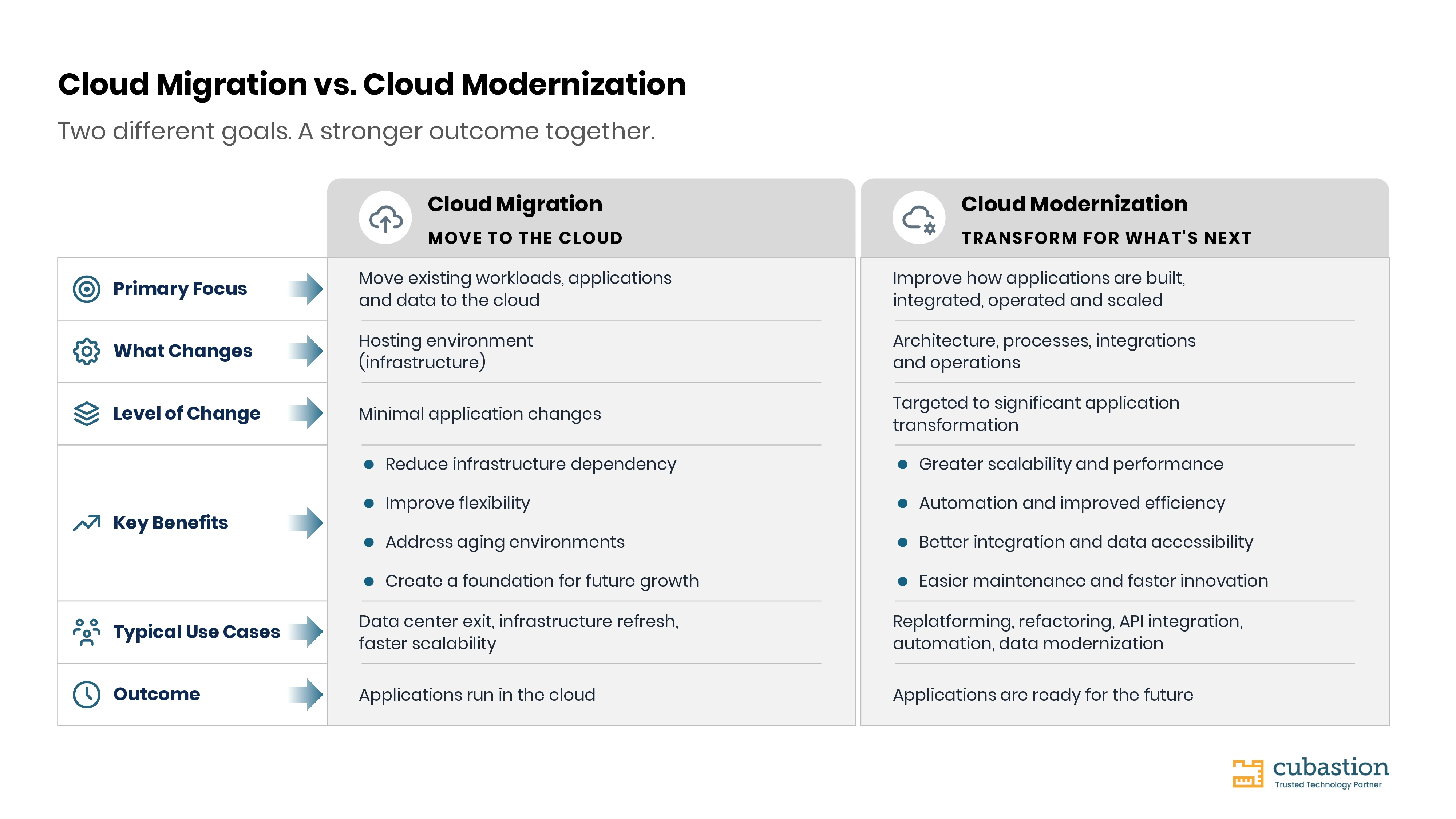

Moving enterprise applications to the cloud is no longer the end goal. For many organizations, it is only the beginning.
Cloud migration helps organizations move workloads away from traditional infrastructure and into a cloud environment. But simply moving an existing application without changing how it is designed, operated, integrated or maintained can leave many of the original limitations intact.
Cloud modernization goes a step further.
It uses the cloud as an opportunity to improve application architecture, automation, scalability, integration, performance and operational efficiency.
The distinction matters because enterprises can successfully complete a cloud migration and still end up operating an application that behaves much like it did before.
Migration changes where an application runs. Modernization changes how effectively it works.
Migration and Modernization: What's the Difference?
Although the terms are often used interchangeably, migration and modernization address different objectives.
Cloud Migration
Cloud migration is primarily about moving existing workloads, applications, data and infrastructure into a cloud environment.
It may involve minimal changes to the application itself.
Typical objectives include:
- Reducing dependence on physical infrastructure
- Improving infrastructure flexibility
- Moving away from aging data centers
- Increasing scalability
- Maintaining business continuity
- Creating a foundation for future transformation
Migration can therefore be the right first step, particularly when infrastructure has become a constraint.
Cloud Modernization
Modernization goes further.
It examines how the application is built, integrated, deployed and operated, and identifies where changes can create business or technical value.
Modernization may involve:
- Replatforming
- Refactoring
- Rearchitecting
- Containerization
- API-based integration
- Automation
- CI/CD
- Improved monitoring and observability
- Data modernization
- Process standardization
The objective is not simply to host an existing application somewhere new, but to make the application more scalable, maintainable, connected and adaptable.

Why Migration Alone Isn't Enough?
Consider a legacy enterprise application with manual processes, tightly coupled components and multiple integrations.
Simply moving it to the cloud may change the infrastructure, but the application can still have the same limitations.
- Before: Legacy Infrastructure → Legacy Application → Manual Processes → Complex Integrations
- After Migration: Cloud Infrastructure → Legacy Application → Manual Processes → Complex Integrations
- After Modernization: Cloud Platform → Modern Architecture → Automation → Integrated Systems → Better Visibility
This is why organizations should ask two questions:
1. Where should the application run?
2. How should the application operate in its new environment?
Choosing the Right Modernization Approach
Modernization does not mean rebuilding every application from scratch.
Different workloads require different levels of transformation.
- Rehost: Move an application to the cloud with minimal changes.
- Replatform: Move the application while making targeted improvements to the underlying platform.
- Refactor: Modify parts of the application to improve maintainability, performance, or scalability.
- Rearchitect: Fundamentally redesign the application's architecture.
- Retain: Keep an application where modernization or migration does not currently provide sufficient value.
- Retire: Remove applications or components that are redundant, obsolete, or no longer delivering business value.
The important point is that modernization should be selective. The objective is not to modernize everything. It is to identify where modernization will create measurable value.
From Cloud Migration to Modernization: The FORCE FDP
Cubastion's FORCE FDP transformation for Mitsubishi FUSO demonstrates how cloud migration can become part of a broader modernization initiative.
The project replaced a legacy dealer management environment with an Oracle Siebel-based platform deployed on Microsoft Azure for 7,500+ users.
But the transformation went beyond moving the application.
The new environment introduced:
- Multi-tenant architecture for scalable dealer operations
- API gateway for integration with surrounding systems
- Automation of testing and operational activitie
- Standardized application code
- Data migration and improved data accessibility
- Power BI dashboards for real-time analytics
The result was a cloud environment designed not just to host the application, but to support a more standardized and scalable operating model.
Business Impact
The FORCE FDP transformation demonstrates how modernization can create value beyond simply changing the hosting environment.
The transformation delivered:
- 50% reduction in computing requirements
- 60% fewer data issues during later go-live waves
- 66% faster validation through automated testing
- 25% fewer approval steps
- 52% reduction in document types
- 250K+ real-time Retail Finance transactions
- Zero business disruption during migration
- 258 branches using Power BI dashboards for real-time analytics
These outcomes demonstrate an important distinction; the benefit did not come from cloud migration alone. It came from combining migration with standardization, automation, integration, data modernization and a more scalable architecture.

Learning: A Practical Transformation Journey
A successful cloud transformation can be approached in four stages:
1. Assess: Understand applications, data, dependencies, integrations, and technical debt.
2. Migrate: Move workloads where cloud adoption delivers clear business and technical value.
3. Modernize: Prioritize areas where architecture, automation, integration, or data improvements can create measurable benefits.
4. Optimize: Continuously improve performance, scalability, security, operations and resource utilization.
The journey does not have to happen all at once. Modernization can be phased according to business priorities and application complexity.

How Cubastion Can Help
Cloud transformation requires more than infrastructure migration. It requires the right combination of cloud migration, application modernization, integration, automation and cloud-native engineering.
Cubastion helps enterprises modernize mission-critical applications and technology environments while focusing on scalability, business continuity and long-term transformation. Its capabilities span cloud migration, application modernization, containerization, DevOps, enterprise integration and cloud-native enablement.
The FORCE FDP transformation demonstrates this approach in practice, combining cloud deployment with architecture modernization, integration, automation and analytics to create a more scalable operating environment.
Ready to Move Beyond Cloud Migration?
Connect with a Cubastion Consultant to explore how you can modernize your enterprise applications and build a more scalable, connected and future-ready technology environment.