



Discover how digital transformation improves government project monitoring by aligning financial and physical progress, enhancing transparency, and enabling data-driven decisions.
Digital Transformation in Government Project Monitoring
A project can look financially healthy on paper and still tell a very different story on the ground.
Funds may have been released, bills processed, and expenditure recorded, while the actual work is progressing at a different pace.
The important question is therefore not just how much has been spent, but whether that financial progress reflects what is actually being delivered.
When financial and physical progress are viewed separately, it becomes difficult to understand whether a project is moving as planned, where gaps exist, and which projects need attention.
The real challenge is to connect money spent with work delivered.
Connecting Financial and Physical Project Progress
Large projects generate information across several stages:
Approval → Budget → Procurement → Execution → Billing → Payment → Monitoring
This information often sits across different teams and systems.
- Finance teams track expenditure.
- Project teams track execution.
- Field teams report physical progress.
- Management reviews consolidated reports.
- The challenge is bringing these views together into one project-level picture.
Why Financial and Physical Progress Differ in Government Projects

Consider a project with a sanctioned value of ₹10 crore.
- Financial progress: 60%
- Physical progress: 40%
The gap does not automatically mean something is wrong. It could result from advance payments, procurement schedules or project sequencing.
But it raises important questions:
- What has the ₹6 crore been spent on?
- Which project or activity does each bill relate to?
- Is the physical progress information current?
- Does the expenditure match the project's current stage?
- Which projects require closer review?
When these answers sit across different systems, teams often have to collect, compare and reconcile information manually.
For large project portfolios, this creates two problems:
- More time spent finding information.
- Less time available for acting on it.
The real problem is therefore not a lack of data.
It is a lack of connected project-level visibility.
How Digital Transformation Connects Financial Data, Project Progress and Field Evidence
A more effective approach is to make the project the common reference point.
1. Link financial transactions to the project
Connect: Sanction → Budget → Bills → Expenditure → Utilization
This makes it easier to understand where money has gone and against which project.
2. Bring physical progress into the same view
Track financial information alongside:
- Project status
- Milestones
- Physical progress
- Planned vs. actual execution
The aim is not to make financial and physical progress identical. It is to make meaningful differences visible.
3. Add field evidence
Reported progress can be supported through:
- Geo-tagged photographs
- Location validation
- Field remarks
- Progress updates
This creates a stronger link between reported status and what is happening at the project site.
4. Turn visibility into action
Once the information is connected, management can focus on:
- Projects showing unusual gaps
- Delayed progress
- Funding issues
- Missing updates
- Projects requiring intervention
The shift is from reporting every project to focusing attention where it matters.
Real-World Example: Digital Transformation of PMJVK Project Monitoring

The PMJVK Portal transformation for the Ministry of Minority Affairs is a practical example.
Earlier, project proposals were managed through the PMJVK Portal, while associated bills were raised through State IFMIS and processed through PFMS.
The financial transactions were not sufficiently connected to individual PMJVK projects, making project-level financial visibility difficult.
Cubastion's solution
Cubastion connected the project lifecycle through:
- Voucher & Sparsh module: Linked financial transactions to projects
- Nigrani Mobile App: Captured field progress through photos, remarks and geo-tagged updates, with geo-fencing to validate the project location.
- GIS monitoring: Brought project location and project information together
- Central dashboard: Combined financial history, physical progress and field evidence
This created a more complete view of each project instead of treating financial and physical information as separate records.
Measurable Improvements in Project Governance

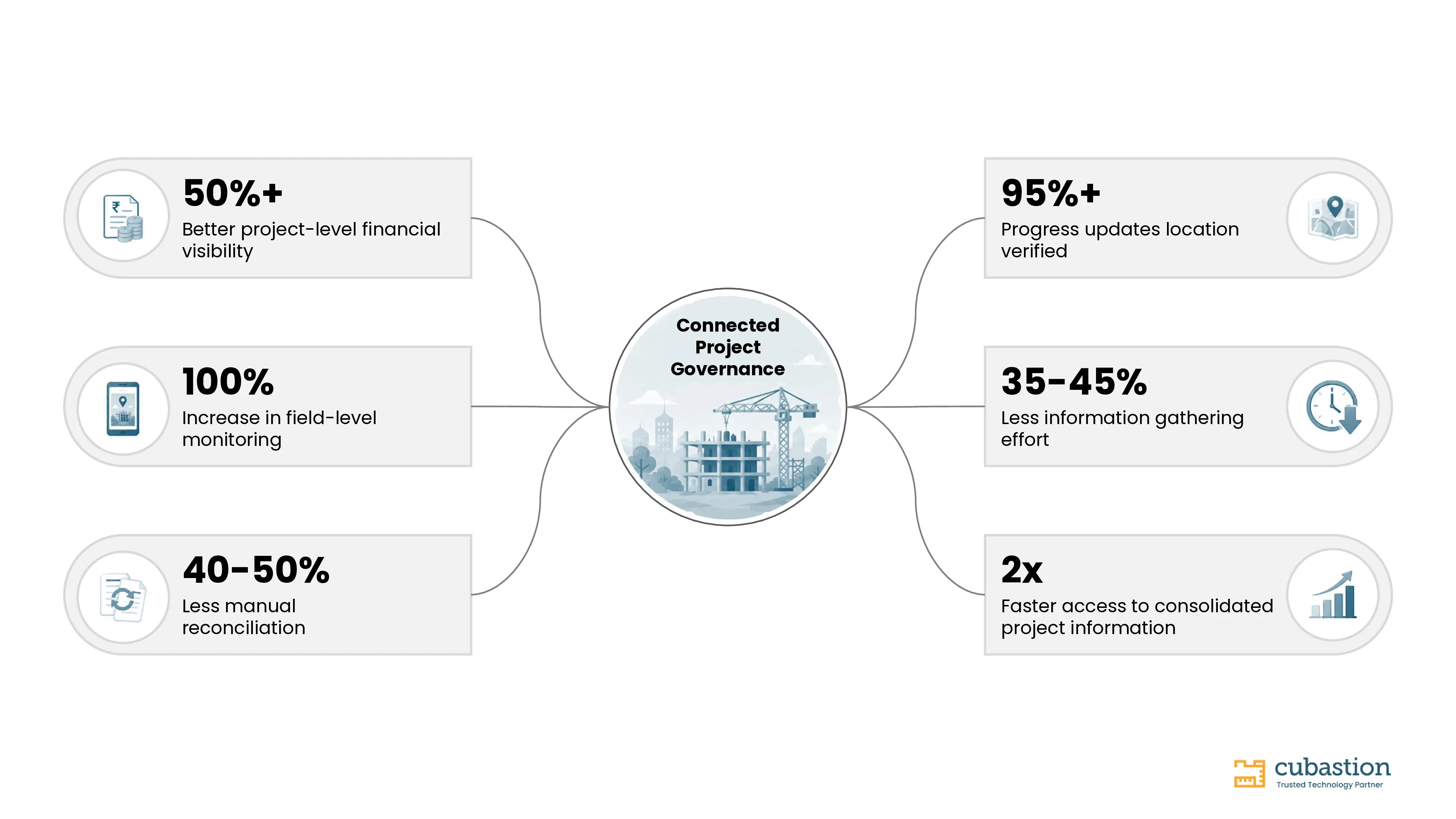
The MoMA engagement delivered measurable improvements:
- 50%+ better project-level financial visibility.
- 95%+ progress updates location verified.
- 100% increase in field-level monitoring.
- 35–45% less information-gathering effort.
- 40–50% less manual reconciliation.
- 2× faster access to consolidated project information.
Business Outcome
Connecting financial, project and field information created broader governance benefits:
- Greater transparency: Clearer visibility into project funding and expenditure.
- Stronger accountability: Clearer ownership from approval to field execution.
- Better fund utilization: Financial activity linked to approved projects and utilization.
- Evidence-based monitoring: Progress supported by location and field evidence.
- Earlier intervention: Projects requiring attention can be identified sooner.
- Stronger governance: A common view across Ministry, State, District and Field levels.
- Better decision-making: Management can act on a consolidated view rather than fragmented records.
From Tracking Expenditure to Digital Transformation in Project Governance
Financial progress is only one part of project performance.
The real value comes from connecting:
Funds → Projects → Physical Progress → Field Evidence → Outcomes
Digital transformation can help organizations move beyond fragmented systems and manual reporting toward more transparent, connected and experience-led governance.
Cubastion helps organizations connect fragmented systems and touchpoints to create better digital experiences and stronger business outcomes.
Connect with a Cubastion consultant today to explore your digital transformation journey.