



Why Automotive Digital Transformation Is Moving Beyond the Vehicle
The automotive industry has already entered the era of connected vehicles. Cars now generate and exchange data through telematics, sensors, mobile applications, infotainment systems, ADAS, cloud platforms, and over-the-air (OTA) updates. However, the next major opportunity is no longer limited to making the vehicle connected. It is about making the entire automotive enterprise connected.
Automotive manufacturers, dealers, suppliers, service networks, and customers operate across complex ecosystems. Sales, marketing, CRM, dealer management, after-sales service, supply chain, manufacturing, finance, and connected-car platforms often generate enormous amounts of data. When these systems remain disconnected, organizations struggle to turn data into actionable business intelligence.
The next phase of automotive digital transformation is therefore shifting from connected cars to connected enterprises, where vehicle data, customer information, dealer operations, business applications, and enterprise processes work together through integrated digital platforms.
From Digital Features to an Integrated Automotive Ecosystem
A connected enterprise enables automotive organizations to create a continuous flow of information across the customer and business lifecycle. A customer's interaction with a mobile application can inform CRM. Vehicle diagnostics can trigger a service notification. Service history can support personalized offers. Dealer data can improve demand forecasting, while real-time analytics can help management make faster decisions.
This convergence can help automotive businesses improve customer experience, operational efficiency, service responsiveness, and revenue opportunities while creating a foundation for AI-driven decision-making.
The Evolution from Traditional Vehicles to Software-Defined Mobility
Automotive digital transformation has progressed through several stages. Vehicles first became digitally enabled through electronic control units and embedded software. The emergence of telematics, connected-car platforms, mobile applications, and cloud computing then allowed vehicles to communicate with external systems.
Today, software-defined vehicles are accelerating this transformation further. Vehicle functionality can increasingly be monitored, updated, and enhanced through software. At the same time, customers expect seamless digital experiences across websites, mobile applications, dealerships, vehicles, and service centres.
This means automotive organizations are no longer managing only physical products. They are managing continuous digital relationships with customers and vehicles.
Why Enterprise Connectivity Is the Next Logical Step
While connected vehicles create valuable data, that data becomes significantly more useful when integrated with enterprise systems.
For example, vehicle diagnostic information can be connected to a Dealer Management System (DMS), CRM, inventory platform, and service management application. Instead of simply identifying a potential vehicle issue, the organization can determine whether the customer needs service, identify the nearest dealer, check spare-part availability, schedule an appointment, and notify the customer.
The value therefore comes not only from collecting data, but from connecting data, systems, and processes.
Fragmented Systems Are Limiting Automotive Organizations
Many automotive enterprises operate large technology ecosystems built over years. These may include CRM platforms, ERP systems, Dealer Management Systems, legacy databases, service applications, manufacturing systems, mobile applications, cloud platforms, and connected-vehicle solutions.
When these systems operate in silos, information becomes fragmented. Customer information may exist in CRM, vehicle information in telematics platforms, service history in DMS, and inventory information in separate systems.
This fragmentation makes it difficult to establish a unified view of the customer, vehicle, dealer, and business operation.
Legacy Architecture Creates a Barrier to Enterprise Connectivity
Legacy applications are another major challenge. Many organizations cannot simply replace their existing platforms because these systems support critical business operations.
A complete replacement can introduce significant cost, operational risk, data migration challenges, and business disruption. As a result, organizations need a modernization strategy that connects existing systems with modern digital platforms without interrupting core operations.
The challenge is therefore not simply "How do we adopt new technology?" but "How do we connect our existing technology ecosystem to create a modern enterprise?"
Build an API- and Cloud-Enabled Connected Enterprise Architecture
A connected enterprise begins with an architecture that allows different systems to communicate securely and reliably.
API-led integration can connect CRM, DMS, ERP, connected-vehicle platforms, mobile applications, analytics platforms, and other enterprise systems. Cloud platforms provide scalable infrastructure, while event-driven architecture enables real-time communication between applications.
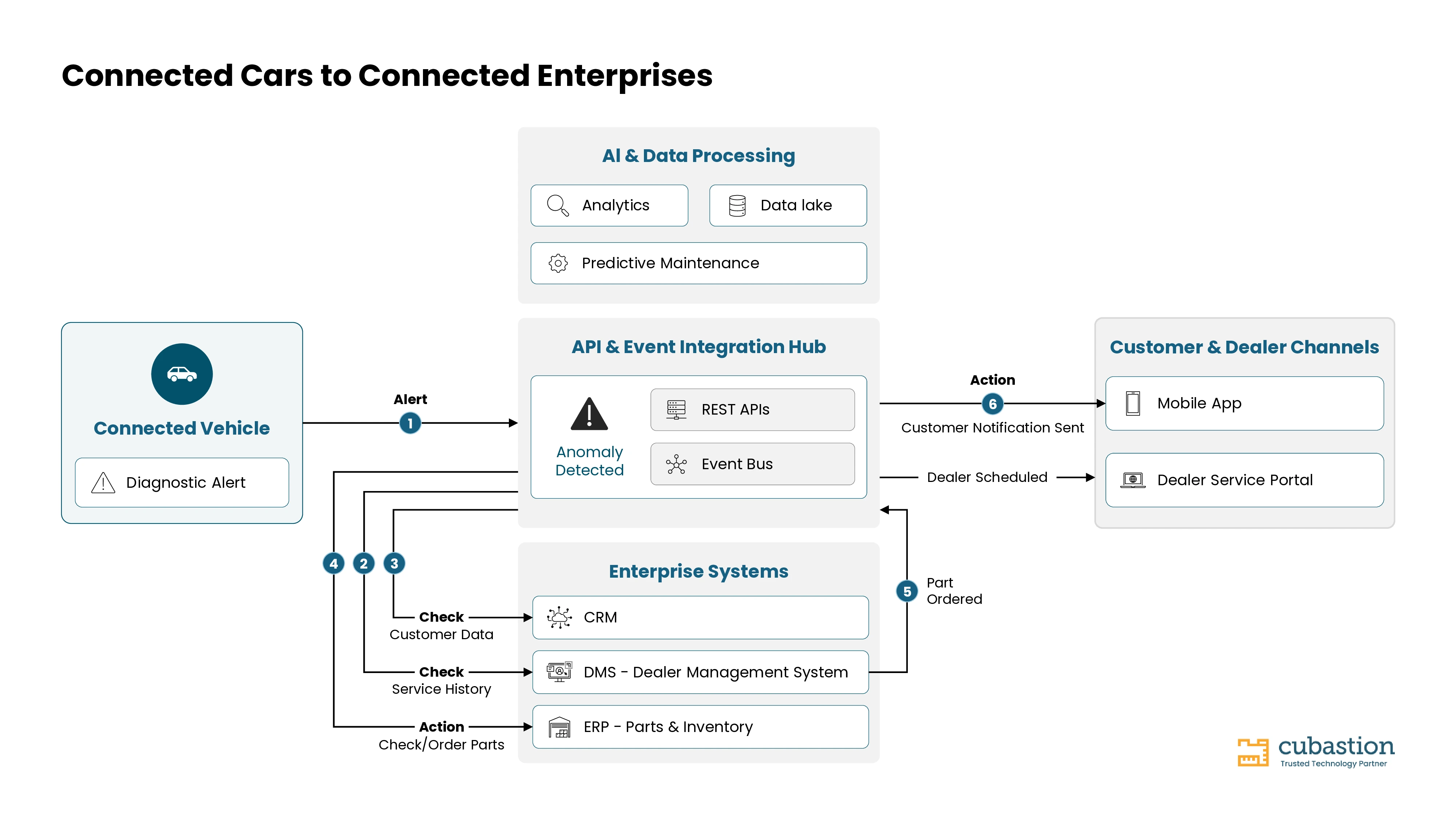
For example, when a connected vehicle generates a diagnostic alert, an event can flow through an integration layer and trigger actions across multiple systems, from creating a service opportunity in CRM to checking dealer capacity and notifying the customer. This transforms disconnected information into a coordinated business process.
The following diagram illustrates how an API- and event-driven architecture orchestrates vehicle data across the automotive enterprise:

Combine Data, AI, Automation, and Modernization
Enterprise connectivity should also create a foundation for advanced technologies such as Artificial Intelligence (AI), Generative AI, predictive analytics, and intelligent automation.
Instead of modernizing every legacy application simultaneously, automotive organizations can adopt a progressive modernization approach. APIs, microservices, integration layers, cloud services, and data platforms can gradually modernize the ecosystem while allowing critical legacy applications to continue operating.
The objective is not modernization for technology's sake. It is to create an architecture where data moves seamlessly, processes become intelligent, and decisions happen faster.
Automotive Example: Connecting Vehicle, Dealer, and Customer Data
Consider an automotive manufacturer with connected vehicles operating across multiple markets. Previously, a vehicle fault might have been detected by the vehicle's onboard systems but remained isolated within the connected-car platform. The customer would eventually need to identify the problem and contact a service centre.
In a connected-enterprise model, the diagnostic event can automatically move through the organization's digital ecosystem.
The connected vehicle sends the diagnostic information → the cloud platform processes the event → the integration layer connects it with CRM and DMS → the system identifies the customer's preferred dealer → spare-parts availability is checked → a service appointment can be recommended → the customer receives a notification through the mobile application.
The result is a connected service journey rather than a disconnected technical event.
From Individual Digital Initiatives to Measurable Business Outcomes
The same architecture can support other automotive use cases. Customer interactions across digital channels can be consolidated into CRM to enable more personalized engagement. Dealer performance data can support network optimization. Vehicle and service data can help identify recurring issues and improve predictive maintenance.
Manufacturing and supply-chain systems can also be connected with analytics platforms to provide greater visibility into demand, inventory, and operational performance.
The key proof point is that enterprise connectivity allows organizations to move from isolated digital initiatives toward end-to-end business processes.
A Unified View of the Customer, Vehicle, and Enterprise
The connected enterprise creates a more complete digital picture of the automotive ecosystem.
Organizations can bring together information from vehicles, customers, dealers, service operations, applications, and enterprise systems. This can help business teams make decisions using more complete and timely information.
For customers, this can translate into faster service, more relevant communication, seamless digital experiences, and proactive support.
For automotive organizations, it can support better operational visibility, improved process efficiency, stronger customer engagement, and new digital revenue opportunities.
Creating an Enterprise Ready for AI and Future Mobility
The long-term benefit extends beyond today's use cases. A connected enterprise creates the data and integration foundation required for future technologies.
As AI agents, predictive analytics, autonomous technologies, software-defined vehicles, and mobility platforms continue to evolve, organizations with connected systems will be better positioned to adopt them.
The enterprise effectively becomes an extension of the connected vehicle—creating a continuous digital ecosystem from vehicle to customer to dealer to enterprise.
Connectivity Is More Valuable Than Technology Adoption Alone
One of the most important lessons from automotive digital transformation is that implementing individual technologies does not automatically create transformation. An organization can deploy AI, cloud, IoT, CRM, analytics, and mobile applications and still operate inefficiently if these technologies remain disconnected. The real value comes from integrating these capabilities around business processes and customer journeys.
Modernization Should Be Continuous, Not a One-Time Project
Automotive enterprises should also view modernization as an ongoing journey rather than a single technology replacement exercise.
A practical approach is to prioritize high-value business processes, identify integration gaps, modernize critical components progressively, and establish a scalable architecture that can accommodate future technologies.
The goal is to create an enterprise that can adapt continuously without repeatedly rebuilding its technology foundation.
Is Your Automotive Enterprise Ready for the Connected-Everything Era?
Connected vehicles are generating more data than ever, but the competitive advantage comes from what automotive organizations do with that data.
The next phase of digital transformation will belong to organizations that connect vehicles, customers, dealers, applications, data, and business processes into one intelligent ecosystem.
If your organization is still operating with fragmented applications, disconnected data, or legacy platforms that limit innovation, now is the time to evaluate your digital architecture.
Turn Connected Vehicles into Connected Business Outcomes
The journey does not require replacing every legacy system at once. With the right modernization, integration, cloud, API, data, and AI strategy, automotive enterprises can progressively transform their technology landscape while continuing to run critical business operations.
Ready to move from connected cars to a connected enterprise? Start by identifying the systems, data, and customer journeys that need to work together and build a modernization roadmap that turns connectivity into measurable business value.