



In today’s modern world, data moves faster than we realize. Most of the company’s core decisions are based on the dashboards and reports built on basic binary data. However, what people don’t realise is that the data itself might be outdated. So, by the time the teams decide, they never realise they’re concluding it based on dated material.
It might seem like a slight miscommunication or a mishap, but this is the exact thing that separates organisations from being top of their food chain to just another company. The problem today isn’t lack of data. It’s the delay between what’s happening in the business and when that information becomes available for decision-making.
Timing Issues with Data
Every organisation I've worked with has more data than it knows what to do with. There are hundreds of dashboards and reports with analytics teams constantly generating insights.
Yet somehow, decisions are always delayed causing the opportunity to slip away. Issues are identified only after they’ve already impacted the business. Because collecting data isn’t the hard part anymore. The real challenge is how quickly that data turns into action.
How the Old Model Looks Like
We probably see this pattern play out more times than we would like:
- Something changes in the business on a Monday
- Data gets collected and sits in batches through the week
- An analyst spends the next few days preparing a report
- Leadership finally reviews it in a Friday meeting or sometimes even the following week
- Decisions are made, actions are assigned
- By the time anything happens, 10–14 days have already passed since the original event
This makes your data old, and you feel like just trying to catch up instead of steering the ship. Time is money and it’s never been truer in this scenario. The more time you lose, the more irrelevant the data you collected becomes.
What Real-time Analytics Brings to the Table
Organisations invest in better tools, faster dashboards, real-time charts on big screens to get more reports, more metrics, more visibility. And yet, nothing really changes.
Real-time analytics isn't about speed for its own sake. It's about redesigning who gets what information, when, and what they're empowered to do with it.
That means three fundamental shifts instead of changing the primary technical one.

Shift 1: From reporting to sensing
In the old model, you would go looking for insights on a schedule. In the new model: insights come to you: the moment they matter.
1. Instead of weekly reports, you set up continuous signals that surface anomalies automatically
2. Instead of analysts building decks, decision-makers get live alerts when something needs attention
3. Instead of reviewing the past, you're responding to the present
The organisations that get this right don't have more analysts. They have better-designed information flows.
Shift 2: From centralised to distributed decisions
who in your organisation sees the data and who has the authority to act on it?
In most companies, these two groups are completely different people.
1. A customer success manager spots a churn signal but must escalate it up three layers before anyone acts
2. A warehouse supervisor sees a supply issue but waits for the weekly ops meeting to raise it
3. A frontline team feels the problem first, but the data only reaches the people who can decide days later
Real-time analytics only works when the person closest to the problem has both the information and the authority to respond.
Shift 3: From data literacy to decision literacy
We've spent years teaching people to read dashboards. We haven't spent nearly enough time teaching people to act on them.
Decision literacy is different from data literacy. It's the ability to:
1. Make a call when the data is good, but not perfect
2. Know when a signal is meaningful and when it's noise
3. Move fast without waiting for certainty that will never fully arrive
4. Own the outcome, not just the analysis
This is the rarest and most valuable skill in a data-rich organisation. And almost nobody is deliberately building it.

The Human Barriers
The biggest barriers to real-time analytics are not technical. They are human:
- Data hoarding: In many organisations, data is power. Real-time analytics requires radical transparency, and that can feel threatening in cultures built on information asymmetry
- Analysis paralysis: More data can lead to slower decisions. When leaders wait for the perfect dataset before committing, real-time information becomes noise rather than signal
- Lack of trust: When data quality is inconsistent, or past analytics projects have failed to deliver, scepticism sets in. Building trust requires as much attention to governance and credibility as it does to infrastructure
Strategies to adapt
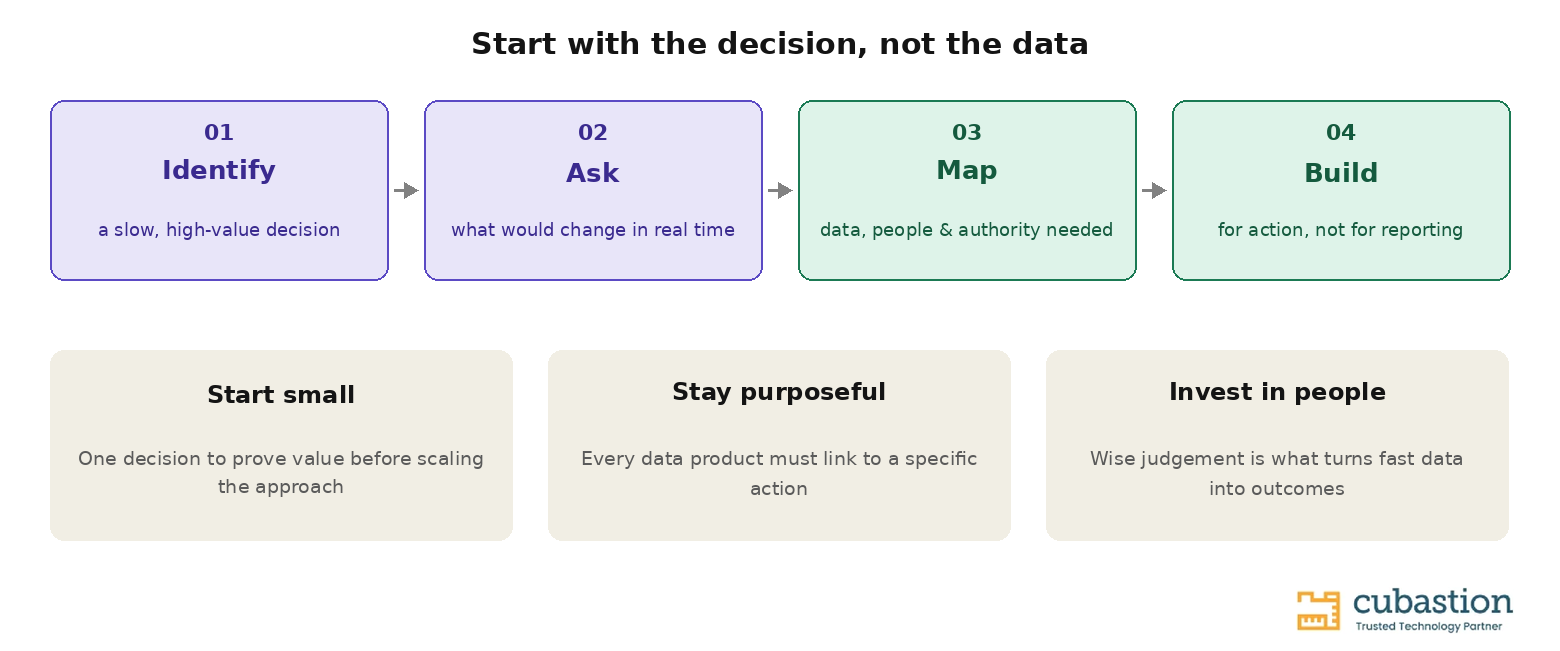
Most organisations try to solve this by buying a new platform. That's the wrong first step.
Start here instead:
- Pick one decision that is currently slow, where being faster would create real, measurable value. A real operational decision where speed directly impacts revenue, customer experience, cost, or risk. As an example, spotting failed ETL/data pipeline loads before business users notice broken reports.
- Ask the honest question, what would we do differently if we had this information in real time? Real-time data only matters when it changes behaviour. As an example, if customer complaints spike in one region, who responds? If an workflow fails at 2 AM, who gets alerted and how quickly can recovery happen?
- Trace the data backwards, what do we need, who needs to see it, and who needs to be empowered to act? Start from the action, not the source systems.
One real-time decision, done well, is worth more than ten dashboards nobody acts on.

The bottom line
The gap between data and decisions isn't a technology gap but rather a design one. Close that gap, and you don't just get better analytics but a fundamentally more responsive, more competitive organisation.
The data is already there. The question is whether your organisation is designed to use it — before the moment passes.