



On the morning of August 1, 2012, a trading firm called Knight Capital deployed new software to its automated trading system. A dormant piece of old code was accidentally reactivated, and within forty-five minutes the system had flooded the market with millions of unintended orders, buying and selling at a speed no human could follow or stop. By the time engineers shut it down, the firm had lost roughly 440 million dollars, more than its entire annual profit, and it never recovered its independence. The technology worked exactly as instructed. That was the problem. An autonomous system, granted authority without adequate controls, did not make a small mistake slowly. It made an enormous one at machine speed. As enterprises hand growing autonomy to AI, Knight Capital is not a historical curiosity. It is a preview.
Executive Summary
This series began with a paradox, moved to where AI creates value, and then to the operating model that captures it. It ends where the next wave of both value and risk now sits: autonomy. Agentic AI does not just recommend; it plans and acts, often faster than anyone can supervise. That capability is where much of the coming return lies, and it is also where a single ungoverned decision can scale into an incident. The answer is neither to withhold autonomy nor to wrap everything in red tape. It is a trust architecture: grant autonomy in proportion to risk, and surround it with transparency, guardrails, oversight, monitoring, and accountability. Done well, governance is not the brake on autonomy. It is what makes autonomy safe enough to scale.

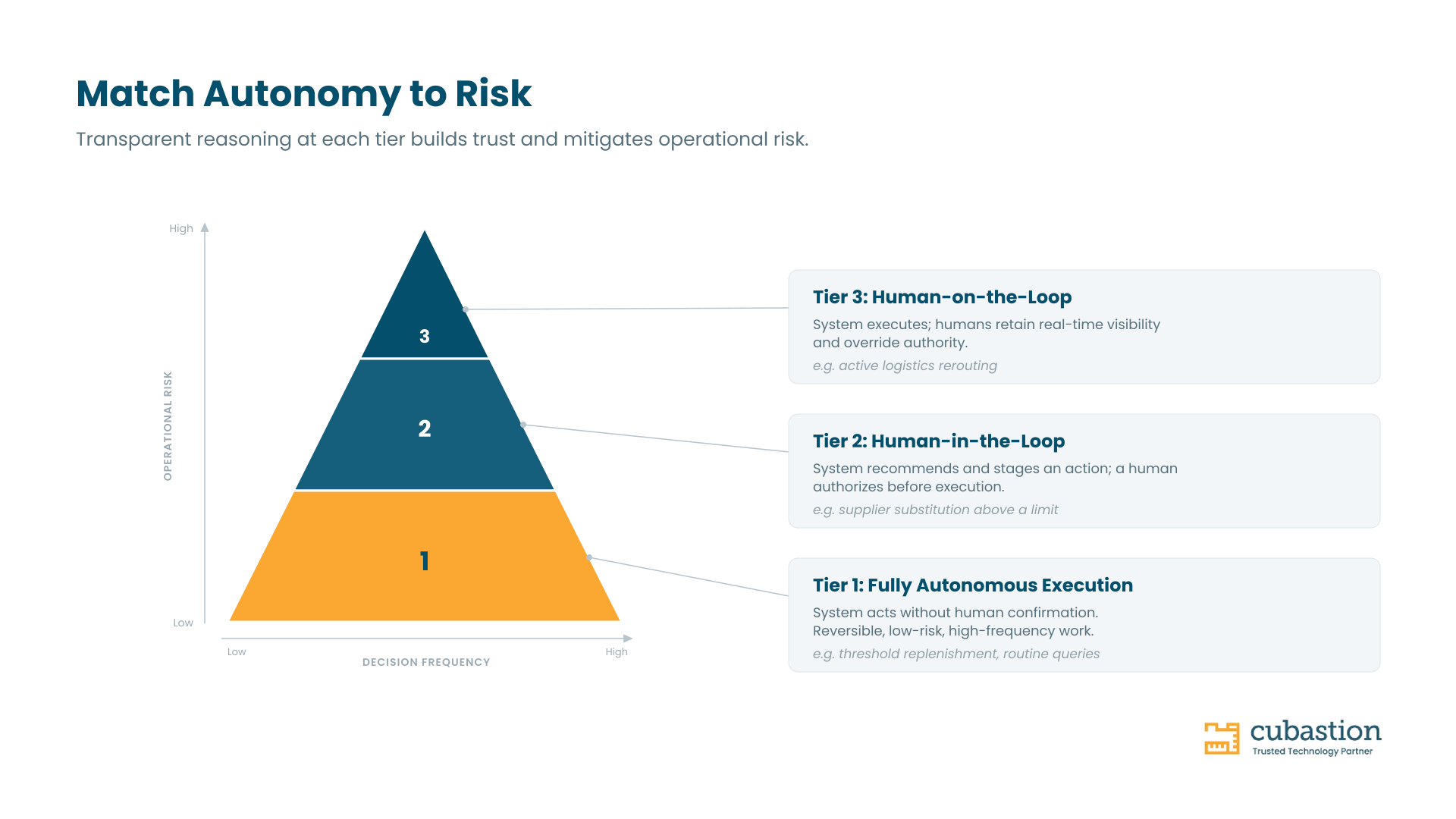
Figure 1. Match autonomy to risk: a tiered governance architecture.
Why Autonomy Changes the Governance Problem
Most enterprise governance was built for a world in which humans made every consequential decision and AI merely advised. Agentic AI breaks that assumption. An agent plans, calls tools, and acts, sometimes handing work to other agents, and it does so at a speed that compresses the window to catch an error toward zero. The consequences of a weak control no longer accumulate gradually; they arrive all at once. The market is already moving: Gartner projects that 40 percent of enterprise applications will include task-specific AI agents by the end of 2026, up from less than 5 percent a year earlier, and it expects more than 40 percent of agentic projects to be cancelled by 2027, with inadequate risk controls among the leading causes. Yet governance has not kept pace. By one industry estimate, roughly 72 percent of enterprises deploy agentic systems with no formal oversight or documented accountability. Autonomy also opens a new attack surface: agentic systems can be manipulated through crafted inputs designed to hijack their decisions, a threat traditional governance was never built to contain. The gap between what agents can do and what enterprises can control is widening, and that gap is precisely where trust is lost.
Match Autonomy to Risk: A Tiered Model
The foundational principle of governing autonomy is simple to state and easy to get wrong: autonomy is a spectrum set by risk, not a single switch. Not every decision deserves the same freedom, and a one-size-fits-all policy either over-constrains low-risk agents or under-protects high-risk ones. A tiered model resolves this. At Tier 1, fully autonomous execution, the system acts without human confirmation, appropriate for low-risk, high-frequency, reversible decisions such as threshold-based replenishment or answering routine queries. At Tier 2, human-in-the-loop, the system recommends and stages an action, but a human authorizes it before execution, the right posture for consequential, less frequent decisions such as a supplier substitution above a value limit. At Tier 3, human-on-the-loop, the system executes while humans retain real-time visibility and the authority to override, suited to fast-moving, higher-risk operations such as live logistics rerouting. The tier is assigned by classifying each use case on operational risk and decision frequency. Autonomy is earned, decision by decision, not granted wholesale, and because risk is not static, a tier is revisited as a use case evolves rather than fixed once at launch.
The Trust Architecture
Whatever the tier, autonomy is made safe by the same set of controls, and modern governance enforces them in the system itself rather than in a document. Five components matter most. Transparent reasoning makes each decision inspectable, so an action can be understood and challenged. Guardrails and least-privilege permissions bound what an agent may do; following the principle security researchers call least agency, an agent receives only the minimum access its task requires, with tool use whitelisted and enforced at runtime, because a guardrail an agent can reason its way around offers no protection. Human oversight preserves a real intervention point, an approval gate or a kill switch, not a rubber stamp. Continuous monitoring watches behaviour in real time, since periodic audits cannot govern a system making thousands of decisions a day. And accountability logs every action with full lineage and assigns a named owner, because autonomy must never eliminate accountability. Crucially, authority must travel with the task: when one agent hands work to another, the second agent's scope must be bounded, not widened.

Figure 2. The five controls that turn autonomy into trusted autonomy.
Governance Is a Dial, Not a Brake
The most common objection to governance is that it slows things down. The evidence points the other way. IBM's 2025 research found that most organizations, some 63 percent, still lack AI governance initiatives, and that those running high volumes of unmonitored, ungoverned AI face data-breach costs averaging 670,000 dollars more than their governed peers. Meanwhile, enterprises with mature governance deploy faster and with fewer production incidents, because guardrails remove the manual review loops, the post-incident cleanups, and the organizational hesitation that surround every deployment when no one is sure the system will behave. Governance is best understood as a dial rather than a brake. Turned too low, autonomy deploys blind and a single failure poisons trust. Turned too high, it strangles every use case in approvals and the program freezes. Set proportionately, it is the thing that lets autonomy move.

Figure 3. Governance is a dial: proportionate control is what lets autonomy scale.
The Regulated and Agentic Edge
Two forces raise the bar further. Regulation is arriving in force, from the EU AI Act to the NIST AI Risk Management Framework and the OWASP guidance for agentic applications, and unmonitored autonomous systems increasingly carry legal as well as reputational exposure. In regulated industries, the traceability and auditability that governance provides are not optional, and central control of high-risk autonomy is the safest posture. Agentic systems also demand controls their predecessors did not: a distinct machine identity for every agent, sandboxed testing with clear rollback plans, runtime enforcement outside the model, and, increasingly, guardian agents that monitor and can halt other agents, since humans alone cannot supervise autonomy at scale. The through-line is consistent. As autonomy rises, oversight cannot stay manual. It must be engineered.
Recommendations
Five priorities turn the principle into practice:
- Classify before you deploy. Map every agent and use case to operational risk and impact and assign an autonomy tier accordingly.
- Grant least privilege. Give each agent the narrowest access and toolset its task requires and bound its scope at every handoff.
- Enforce at runtime, not on paper. Put guardrails in the platform where an agent cannot reason around them, not in a policy no one reads.
- Instrument everything. Log every action with full lineage, monitor continuously, and keep a working kill switch and escalation path.
- Name an accountable owner. Every autonomous system needs a human answerable for its behaviour, in production and to the regulator.
Business Impact
The return on governing autonomy well is measured in both incidents avoided and speed gained. On the downside, the cost of getting it wrong is now quantified, in higher breach costs, in cancelled agentic programs, and, at the extreme, in the Knight Capital outcome. On the upside, governance is what converts caution into confidence: it is the reason a well-governed enterprise can grant more autonomy, not less, and move faster while doing so. This closes the loop the series opened. Adoption depends on trust, and at the frontier of autonomy, trust is manufactured by architecture, not by hope. The enterprises that treat governance as a capability rather than a compliance checkbox are the ones that will grant autonomy with confidence while their competitors hesitate.
The Series in Review
Across four articles, the argument has been a single one. Enterprises are investing enormously in AI and capturing far too little, because value comes from conversion, not acquisition. That value is real but concentrated, and capturing it starts with a map of where AI actually pays. Turning that map into results requires an operating model, the system that reliably moves AI from pilot to production. And scaling the most powerful form of AI, autonomy, requires a trust architecture that grants freedom in proportion to risk. Investment, value, operating model, governance: four moves, one discipline. The enterprises that master it will not merely adopt AI. They will compound its advantage while their peers are still buying capability they cannot yet use. At Cubastion, this is the work we do with enterprise leaders, from the first value map to the operating model and the governance that lets it scale safely. The tools are ready. The question, as it always was, is whether the enterprise is.