


Discover how government examination system modernization improves digital services through legacy application integration, workflow automation, enhanced security, and better candidate experiences.
From Traditional Examination Systems to Integrated Digital Services
Government examination authorities manage a wide range of activities, including candidate registration, application processing, admit cards, examination scheduling, results, and candidate support. As the number of applicants grows, traditional systems often struggle to deliver fast, reliable, and seamless services.
Legacy applications may operate independently, with disconnected databases and manual processes that make information sharing difficult. Modernizing these systems through application integration, workflow automation, data analytics, and secure infrastructure can help government organisations improve operational efficiency and deliver a better candidate experience.
The objective is not simply to replace old technology. It is to create an integrated digital ecosystem that makes examination services more accessible, reliable, and easier to manage.
The Growing Need for Examination Technology Modernisation
Government examinations involve multiple stages, large volumes of candidate data, and strict operational timelines. Candidates may interact with several digital platforms during registration, payment, admit card access, examination updates, and grievance resolution.
When these services operate through separate applications, information can become fragmented and administrative coordination more difficult.
Legacy systems often continue to support essential operations, but they may lack the flexibility and integration required to meet changing demands. Modernization helps organizations build on existing technology while making services more scalable, connected, and responsive.
Fragmented Applications and Disconnected Data
Examination-related information is often spread across registration portals, payment systems, examination platforms, and helpdesk applications. When these systems do not communicate effectively, administrators may need to reconcile records manually, increasing effort and the possibility of errors.
Scalability and Performance Challenges
Application deadlines, admit card releases, and result announcements can generate sudden spikes in website traffic. Systems that are not designed to handle these peaks may experience slow response times or service disruptions, affecting large number of candidates.
Manual Processes and Inconsistent Candidate Experience
Application verification, payment reconciliation, and grievance management can involve repetitive manual work. At the same time, candidates may struggle to find accurate information across different websites, notifications, and support channels.
These challenges highlight the need for connected systems, automated workflows, and consistent communication.
Security and Limited Operational Visibility
Examination platforms handle sensitive personal and examination-related information. Outdated components, weak access controls, and inadequate monitoring can increase security risks.
Administrators also need a consolidated view of application volumes, pending grievances, system performance, and examination readiness to make timely decisions.
Solution
Modernising Legacy Applications Through a Phased Approach
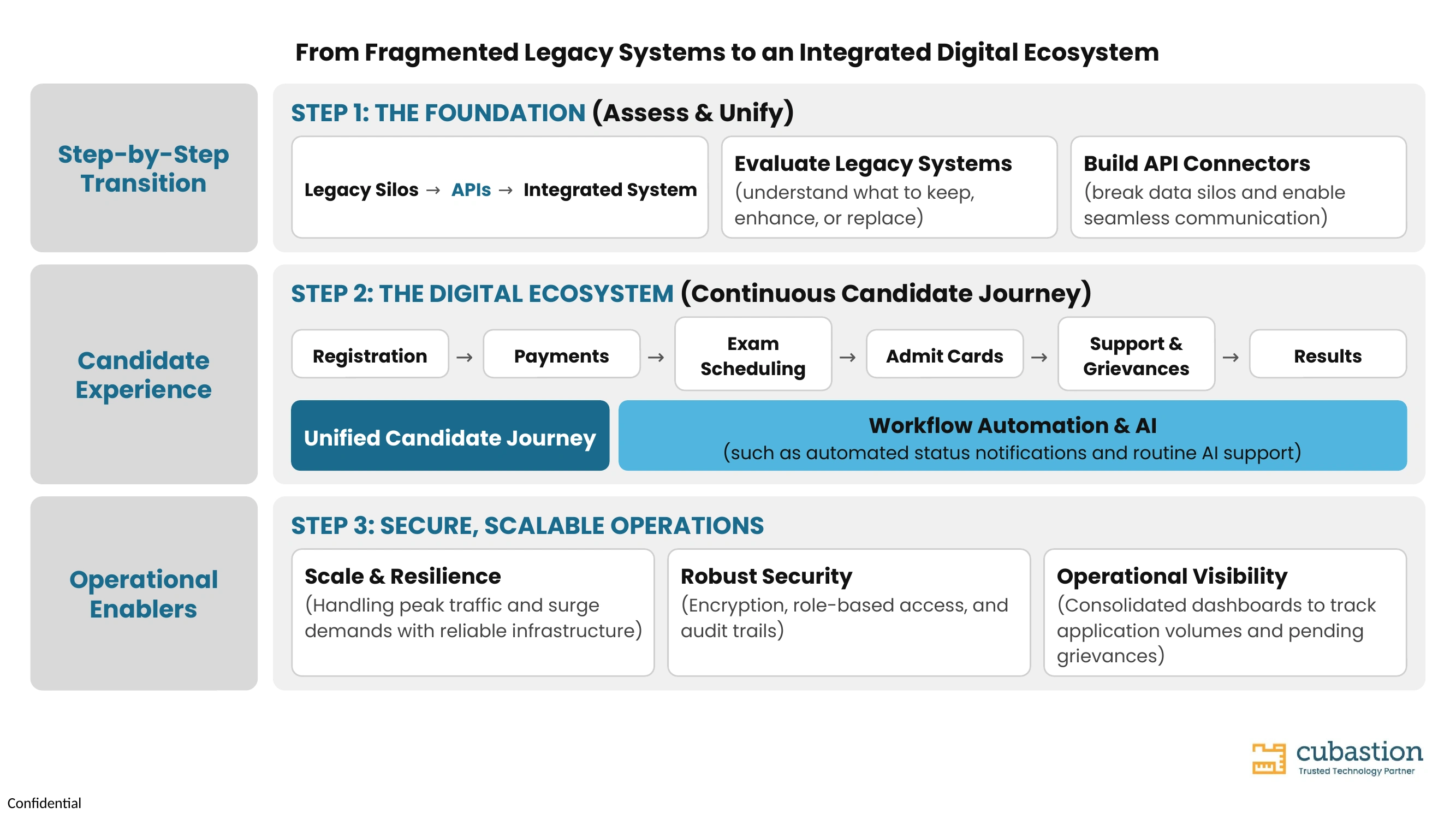
Modernization begins with assessing existing applications, databases, and operational bottlenecks to determine what to retain, enhance, or replace. Rather than an abrupt system overhaul, a phased transition minimizes disruption by first bridging isolated legacy silos through secure API connectors. This foundation enables organizations to unite the candidate lifecycle, from registration through to results, into a continuous, automated workflow, supported by resilient infrastructure, strict access controls, and real-time operational visibility. The architectural blueprint below illustrates this transition toward an integrated examination ecosystem:

Creating an Integrated Examination Management Ecosystem
A modern examination platform should connect the major stages of the candidate journey, including:
- Candidate registration and application submission.
- Payment processing and reconciliation.
- Examination scheduling and centre information.
- Admit card generation and access.
- Candidate support and grievance management.
- Results and post-examination services.
Application programming interfaces (APIs) can help these systems exchange information securely without requiring every application to be replaced. This creates a more consistent experience for candidates and improves coordination between administrative and technical teams.
Automating Workflows and Repetitive Tasks
Workflow automation can simplify activities such as checking mandatory fields, identifying missing documents, sending application updates, and routing grievances to the appropriate teams.
Generative AI can further support candidate services by answering routine questions using approved information sources and helping support executives understand and resolve enquiries.
However, sensitive decisions involving eligibility, disputed applications, or examination-related exceptions should follow established rules and appropriate human review.
Strengthening Infrastructure, Security, and Analytics
Modern examination platforms need reliable infrastructure to manage peak demand. Performance monitoring, load balancing, backup systems, and disaster recovery arrangements can help improve availability and service continuity.
Security measures such as encryption, role-based access controls, audit logs, and regular security testing are equally important.
Operational dashboards can bring together information on application volumes, unresolved grievances, payment discrepancies, and system performance. This allows administrators to identify bottlenecks earlier and allocate resources more effectively.
Managing Change and Continuous Improvement
Technology alone cannot deliver successful transformation. Teams need clear responsibilities, standard operating procedures, structured training, and defined escalation processes.
Regular performance reviews and candidate feedback help organisations identify gaps and improve services continuously.
Result
Applying Modernisation to Government Examination Services
Consider a hypothetical government examination authority that manages applications, payments, admit cards, and grievances through separate systems. During a major recruitment cycle, it experiences a rise in candidate enquiries and delays in resolving payment discrepancies.
By integrating application and payment information, automating status notifications, and introducing a centralised grievance workflow, the authority could improve information visibility and reduce repetitive manual work.
Candidates would have clearer access to application updates, while administrators could identify pending cases and coordinate corrective action more efficiently.
Measuring the Impact
To confirm whether modernisation delivers tangible service improvements, authorities evaluate performance shifts against established operational baselines. The comparison below highlights the operational transformation of this hypothetical scenario alongside key metrics tracked across system efficiency and candidate experience:

The success of modernisation should be measured through practical indicators such as:
- Application processing time.
- Payment reconciliation discrepancies.
- Candidate enquiry resolution time.
- Reduction in repetitive helpdesk queries.
- Platform availability during peak periods.
- Number of pending grievances.
- Candidate satisfaction.
These improvements should be validated using actual operational data and compared against established baselines. The objective is not simply to deploy new technology, but to demonstrate meaningful improvements in service delivery.
Outcome
A Better Candidate Experience and More Efficient Operations
An integrated digital ecosystem can make it easier for candidates to access information, track applications, receive notifications, and raise grievances. Consistent communication and accessible interfaces can reduce confusion and unnecessary follow-ups.
For examination authorities, connected systems and automated workflows can reduce manual effort, improve data consistency, and provide better visibility into operational performance.
Building a Foundation for Future Digital Services
A modular technology architecture allows organisations to introduce new services and improve existing applications without rebuilding the entire system.
The same approach can support other government services, including recruitment administration, document processing, and public grievance management.
With appropriate security, governance, and ongoing maintenance, modernization can help government organizations build more adaptable and citizen-centric digital services.
Learning
Modernization Is More Than Technology Replacement
Successful transformation begins with understanding existing processes and identifying the problems that affect candidates and administrators. Replacing an application without improving its underlying workflow may simply reproduce the same challenges.
Integration, Security, and Measurable Outcomes Matter
Connected systems, accurate data, and secure information exchange are essential for reliable digital services. Security, privacy, and accessibility must be considered throughout implementation.
Most importantly, organizations should evaluate modernization through measurable outcomes rather than the number of technologies deployed. Defined performance indicators, pilot implementations, and continuous monitoring help ensure that investments deliver practical value.
The future of government examination technology lies in combining reliable systems, efficient processes, and a consistent focus on candidate needs.
Ready to Reimagine Government Examination Technology?
Government organizations need digital platforms that can manage complex examination operations while delivering reliable and accessible services to candidates.
Cubastion helps organizations explore application modernization, system integration, workflow automation, digital platform development, and ongoing application support.
The journey can begin with an assessment of existing systems, integration gaps, and opportunities for improvement, followed by a practical roadmap aligned with operational priorities.
Talk to Cubastion to explore how legacy system modernization and integrated digital platforms can help build more efficient, secure, and candidate-centric government examination services.