



Why AI Is Becoming the Growth Engine for Modern Automotive Dealerships
The automotive retail industry is experiencing a profound digital transformation. Customers today expect personalized buying experiences, instant responses to inquiries, seamless online-to-offline interactions, and proactive after-sales support. However, many dealerships continue to rely on disconnected systems, manual processes, and reactive decision-making, limiting their ability to meet evolving customer expectations.
Artificial Intelligence (AI) is changing this landscape by enabling dealerships to make faster, smarter, and more customer-centric decisions throughout the ownership journey. From identifying high-intent buyers and automating lead qualification to predicting vehicle service requirements and improving customer retention, AI is transforming dealerships into intelligent, data-driven enterprises.
This article explores why traditional dealership operations struggle to keep pace with modern customer expectations, how AI addresses these operational challenges, and what measurable business outcomes automotive organizations can achieve by embedding AI across sales, marketing, and after-sales operations.
From Traditional Dealership Operations to Intelligent Customer Lifecycle Management
Automotive dealerships have invested significantly in digital platforms such as Dealer Management Systems (DMS), Customer Relationship Management (CRM) solutions, marketing automation tools, and connected vehicle technologies. While these investments have digitized many operational processes, they often function independently, resulting in fragmented customer experiences and limited visibility across the customer lifecycle.
Most dealerships continue to operate with:
- Manual lead qualification and prioritization
- Static marketing campaigns with limited personalization
- Reactive service scheduling based on fixed maintenance intervals
- Disconnected customer data across sales, service, finance, and marketing platforms
As customer journeys become increasingly digital and data-driven, dealerships require systems that can not only process information but also interpret customer intent, predict future needs, and recommend intelligent actions in real time.
Artificial Intelligence introduces this capability by transforming operational data into actionable insights, enabling dealerships to optimize decision-making from the first customer interaction through long-term ownership.
Why Traditional Dealership Models Struggle to Meet Modern Customer Expectations
Despite adopting digital technologies, many dealerships continue to face operational inefficiencies that impact both revenue growth and customer satisfaction. First, dealerships receive large volumes of customer inquiries from websites, social media, online marketplaces, and marketing campaigns, but sales teams often spend considerable time pursuing low-quality leads while high-intent prospects experience delayed responses.
Second, customer engagement remains largely generic. Promotional campaigns frequently overlook customer preferences, purchase history, or ownership stage, resulting in lower engagement and reduced conversion rates.
Third, sales follow-ups and service reminders depend heavily on manual processes, increasing the likelihood of missed opportunities and inconsistent customer communication.
Fourth, inventory planning is often based on historical trends rather than predictive demand analysis, leading to stock imbalances and slower inventory turnover.
Finally, after-sales engagement remains reactive. Most dealerships contact customers only before scheduled maintenance rather than proactively anticipating service needs based on vehicle usage and customer behavior.
Collectively, these challenges reduce operational efficiency, weaken customer loyalty, and limit dealership profitability.
Embedding AI Across the Entire Automotive Customer Journey
Artificial Intelligence serves as an intelligent decision-support layer that enhances dealership operations without replacing existing CRM or DMS platforms. By connecting customer, vehicle, sales, service, and operational data, AI enables dealerships to make smarter decisions across the entire customer lifecycle.
AI continuously analyzes these data points to understand customer intent, identify opportunities, predict future needs, and recommend the most appropriate action at each stage of the journey.

Figure 1: AI-powered decision-support layer across the automotive customer journey
Key AI Capabilities
AI can support dealerships across multiple stages of the customer journey:
- Intelligent Lead Scoring: Prioritizes high-potential prospects based on engagement and purchase intent.
- Personalized Vehicle Recommendations: Recommends relevant vehicles, offers, and accessories based on customer preferences and behaviour.
- AI-Assisted Sales Guidance: Supports sales teams with recommendations on follow-up timing, financing, cross-selling, and next-best actions.
- Predictive Inventory Forecasting: Uses regional demand, seasonality, and historical sales patterns to optimize vehicle inventory.
- Automated Service Engagement: Triggers personalized service reminders based on vehicle health, mileage, service history, and ownership behavior.
- Customer Retention Models: Identifies potential churn risks and recommends targeted engagement strategies to improve retention.
- Unified Customer Intelligence: Integrates CRM, DMS, workshop management, finance, and connected vehicle data to create a comprehensive customer profile.
Rather than automating isolated tasks, AI connects intelligence across dealership functions, enabling teams to make more informed decisions, deliver more personalized customer experiences, and improve operational efficiency.
How AI Is Delivering Measurable Results Across Automotive Dealership Operations
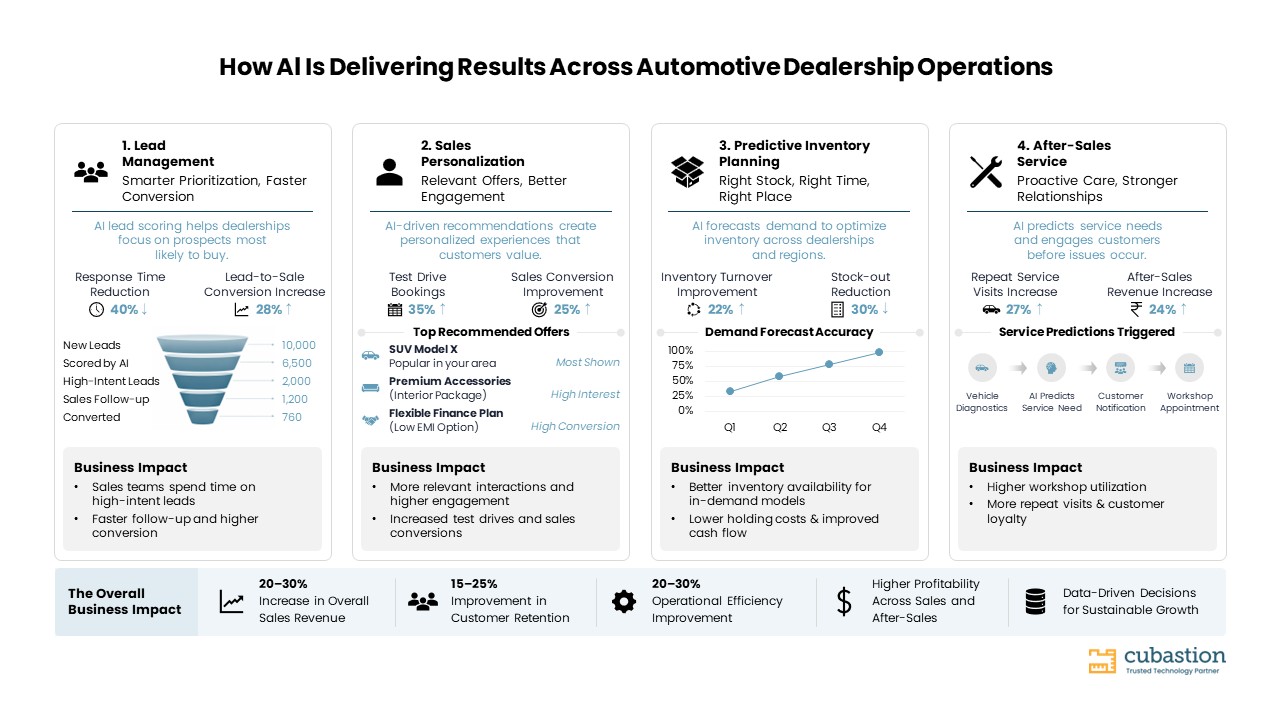
AI’s value becomes most visible when it is applied across critical dealership operations. By combining customer, vehicle, sales, inventory, and service data, AI enables dealerships to identify opportunities earlier, make more informed decisions, and take timely action. The following examples illustrate how these capabilities translate into measurable improvements across the automotive customer and operational lifecycle.

Figure 2: AI-driven impact across sales, customer engagement, inventory, and after-sales operations
1. Lead Management: Prioritizing Customers Most Likely to Purchase
A leading automotive dealership network implemented AI-powered lead scoring to analyze customer inquiries from websites, digital campaigns, dealership portals, and social media channels. By evaluating browsing behavior, financing preferences, previous interactions, and engagement history, AI identified high-intent prospects and automatically prioritized them for immediate follow-up.
Result: Faster lead response times, improved sales productivity, and significantly higher lead-to-sale conversion rates.
2. Sales Personalization: Recommending the Right Vehicle at the Right Time
AI-enabled CRM platforms analyzed customer preferences, previous vehicle ownership, budget, family requirements, and digital interactions to recommend personalized vehicle models, financing plans, accessories, and exchange offers.
Instead of generic promotional campaigns, customers received highly relevant recommendations aligned with their purchasing intent.
Result: Higher customer engagement increased test-drive bookings, and improved vehicle sales.
3. Predictive Inventory Planning: Aligning Stock with Market Demand
Automotive dealerships integrated AI with inventory management systems to forecast demand based on seasonal buying patterns, regional preferences, promotional campaigns, and historical sales performance.
This enabled dealerships to optimize vehicle allocation across locations while reducing excess inventory and stock shortages.
Result: Improved inventory turnover reduced holding costs, and higher vehicle availability.
4. After-Sales Service: Transforming Reactive Maintenance into Predictive Customer Care
AI analyzed vehicle mileage, service history, warranty information, connected vehicle diagnostics, and customer behavior to predict upcoming maintenance requirements before scheduled service dates.
The system automatically generated personalized service reminders, recommended maintenance packages, optimized workshop appointments, and forecast spare parts demand.
Result: Higher workshop utilization, increased repeat service visits, stronger customer retention, and greater after-sales revenue.
What Automotive Dealerships Achieve with AI
When AI is embedded across dealership operations, organizations realize benefits that extend far beyond operational automation.
Key business outcomes include:
a) Higher lead conversion through intelligent customer prioritization.
b) Faster customer response times across digital channels.
c) Personalized buying experiences that improve customer satisfaction.
d) Increased sales productivity through AI-assisted decision-making.
e) More accurate inventory forecasting and stock optimization.
f) Higher workshop efficiency and after-sales profitability.
g) Improved customer retention through predictive engagement.
h) Stronger visibility into customer behavior across the entire ownership lifecycle.
i) Better strategic decision-making supported by real-time insights.
Ultimately, AI enables dealerships to transition from reactive operations to proactive, customer-centric business models.
Key Takeaways for Automotive Leaders
Artificial Intelligence is no longer simply a technology initiative, it is becoming a strategic capability that shapes how automotive dealerships compete in an increasingly digital marketplace.
Key learnings include:
a) AI creates value across the entire customer lifecycle, not just individual business functions.
b) Personalized engagement significantly improves customer acquisition and retention.
c) Predictive analytics enables proactive sales and service decisions.
d) Unified customer data is essential for delivering consistent customer experiences.
e) The highest business impact comes from integrating AI with existing CRM, DMS, and dealership operations rather than replacing them.
As customer expectations continue to evolve, dealerships that successfully combine AI with human expertise will be better positioned to deliver exceptional customer experiences, improve operational efficiency, and achieve sustainable long-term growth.
Build the AI-Powered Dealership of the Future
Artificial Intelligence is no longer a future investment, it is becoming a strategic necessity for automotive dealerships looking to improve customer acquisition, streamline operations, and maximize lifetime customer value. The dealerships that successfully integrate AI across lead management, sales, inventory planning, and after-sales service will be better positioned to deliver personalized experiences, improve operational efficiency, and stay ahead in an increasingly competitive market.
If your dealership or automotive organization is facing challenges such as low lead conversion, fragmented customer data, inconsistent follow-ups, or reactive after-sales operations, now is the time to rethink how AI can transform your customer journey.
At Cubastion, we help automotive enterprises design and implement AI-powered CRM and dealership solutions that integrate seamlessly with existing platforms. From intelligent lead management and personalized customer engagement to predictive after-sales service and data-driven decision-making, our solutions enable dealerships to enhance customer experiences while achieving measurable business outcomes.
Partner with Cubastion to build a smarter, AI-driven dealership that is ready for the future of automotive retail.