



Why AI-Powered CRM Is Redefining Customer Engagement and Retention
Customer relationship management has traditionally focused on collecting customer information, tracking interactions, and enabling teams to manage relationships from a centralized platform.
However, modern customer journeys are no longer linear. Customers interact with organizations across websites, mobile applications, social media, call centres, service teams, dealers, and physical locations. Every interaction generates valuable behavioural data. Yet, in many enterprises, this data remains fragmented across multiple systems and is often analysed only after an issue has already occurred.
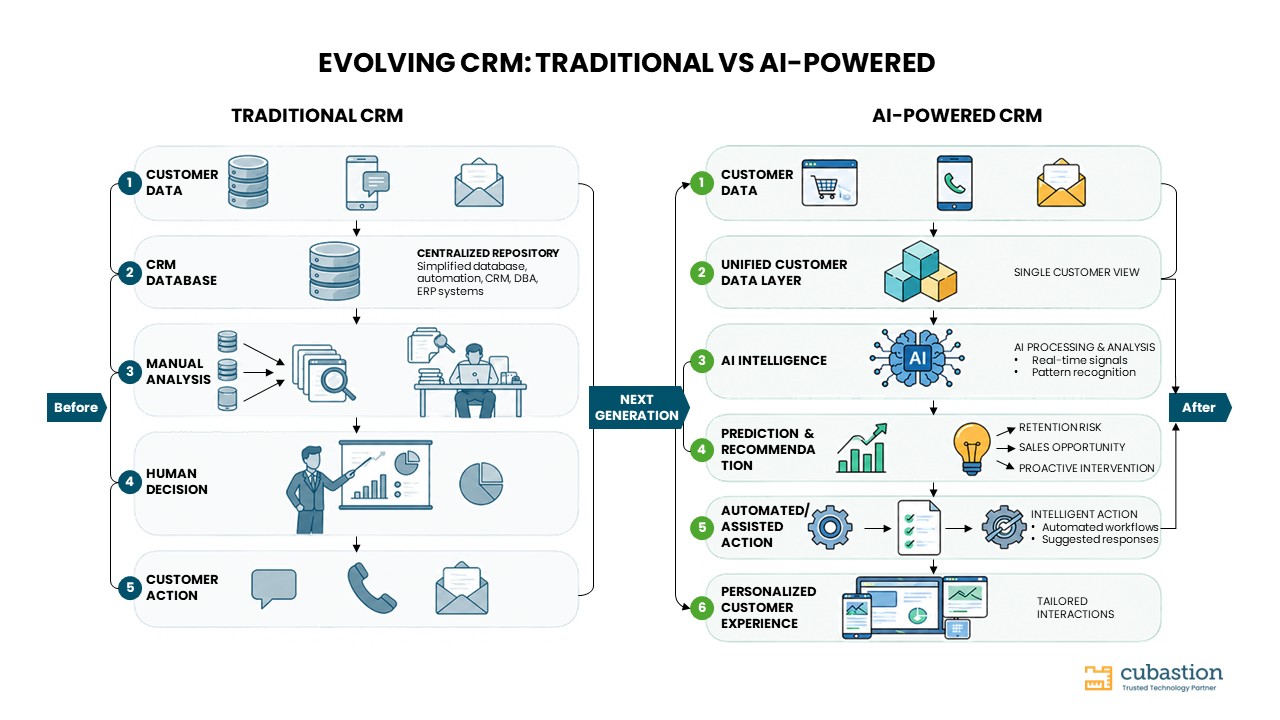
Traditional CRM systems provide visibility into what happened. AI-powered CRM introduces the ability to understand what is happening now and what is likely to happen next.
By combining unified customer data with artificial intelligence, predictive analytics, machine learning, generative AI, and intelligent automation, AI-powered CRM systems can continuously analyse customer behaviour, identify emerging needs, predict potential churn, and recommend the next best action. The result is a shift from reactive relationship management to proactive customer intelligence.
This article explores why traditional CRM models struggle to deliver personalized engagement at scale, how AI-powered CRM transforms customer data into actionable intelligence, and what measurable business outcomes enterprises can achieve when CRM evolves from a system of record into an intelligent decision-support platform.
From Customer Data Management to Intelligent Relationship Management
CRM platforms were originally designed to centralize customer information. Organizations invested in:
- CRM platforms
- Customer databases
- Marketing automation systems
- Customer service platforms
- Business intelligence dashboards
- Enterprise resource planning systems
These systems significantly improved visibility into customer interactions. Teams could access customer profiles, purchase histories, service records, complaints, and communication records from structured databases. However, the intelligence layer often remained separate from the CRM itself. Employees still had to manually analyse customer information, identify patterns, determine customer priorities, and decide what action to take next.
As customer interactions became increasingly digital and multi-channel, this approach became difficult to scale. A customer may interact with a business through several touchpoints within a single day. They may browse a product, contact customer support, open an email, use a mobile application, and complete a transaction.
Individually, these interactions may appear unrelated. When analysed collectively, however, they can reveal important signals about customer intent, satisfaction, engagement, and future behaviour.
AI-powered CRM introduces continuous intelligence into this ecosystem. Instead of simply storing customer data, the system continuously analyses behavioural signals and generates actionable insights. A customer who has historically been highly engaged but suddenly stops interacting can be identified as a potential retention risk. A customer showing increased activity around a particular product can be identified as a potential sales opportunity. A customer experiencing repeated service issues can be prioritized for proactive intervention.

The CRM evolves from a passive record of customer history into an intelligent system capable of supporting real-time decisions.
To address traditional operational bottlenecks and meet modern customer expectations, organizations must fundamentally rethink the role of their customer technology stack. Moving beyond the limitations of manual analysis and fragmented data requires stepping back to understand how CRM systems originated, how they reached their current limitations, and how modern technology is reshaping them.
Why Traditional CRM Struggles to Deliver Personalized Engagement at Scale
The challenge facing enterprises is not a lack of customer data. In fact, most organizations have more customer data than ever before. The challenge is converting this data into timely, intelligent, and coordinated action.

1. Fragmented customer information
Customer data often exists across CRM systems, marketing platforms, service applications, websites, mobile applications, call centres, and enterprise systems. When these systems operate in silos, employees lack a complete view of the customer. This creates disconnected experiences and forces customers to repeat information across different interactions.
2. Reactive customer engagement
Traditional CRM systems primarily record past interactions.
They can show what a customer purchased, when a complaint was raised, or when the last interaction occurred.
However, they may not automatically identify that the customer is becoming disengaged or is likely to require intervention.
Organizations often react only after a customer has already complained, churned, or moved to a competitor.
3. Manual analysis and decision-making
Employees spend significant time reviewing customer data, identifying trends, prioritizing follow-ups, and determining the next action.
At scale, manual analysis becomes slow and inconsistent. The same customer may receive different levels of attention depending on which employee or department handles the interaction.
4. Generic customer communication
Without intelligent customer insights, businesses often rely on broad segments and predefined campaigns.
This can result in:
- Irrelevant communication
- Poorly timed offers
- Repetitive messages
- Missed engagement opportunities
Customers increasingly expect businesses to understand their individual context. Generic engagement is no longer sufficient.
5. Missed early indicators of churn
Customer churn rarely occurs without warning. Declining engagement, repeated complaints, reduced usage, negative feedback, and delayed transactions can all represent early warning signals.
However, these signals are often distributed across different systems. Without AI-powered analysis, organizations may fail to identify the pattern until the customer has already decided to leave.
The consequences are measurable: lower engagement, rising churn, inefficient customer service operations, missed sales opportunities, and declining customer lifetime value.
AI-Powered CRM as an Intelligent Customer Decision Layer
AI-powered CRM transforms customer relationship management from a system that records interactions into an intelligent platform that continuously interprets them.
An AI-powered CRM can:
- Consolidate customer information from multiple systems.
- Analyze behavioural and transactional signals.
- Identify customer intent and engagement patterns.
- Predict potential churn.
- Recommend next-best actions.
- Personalize customer communication.
- Automate repetitive workflows.
- Support employees through AI copilots.
- Escalate complex decisions to human teams.
The objective is not to replace human relationships, it is to provide employees with the intelligence required to make faster, more relevant, and more informed decisions.
Architectural Framework for AI-Powered CRM as an Intelligent Customer Decision Layer is as follows:

1. Creating a Unified Customer View
The foundation of AI-powered CRM is the ability to create a unified view of the customer. Data from multiple sources can be integrated into a common customer intelligence layer, including:
- CRM records
- Transaction history
- Service interactions
- Website behaviour
- Mobile application activity
- Call centre conversations
- Email engagement
- Customer feedback
- Complaint history
This enables organizations to move from fragmented data to a customer 360 view.
2. Predicting Customer Churn
AI models can analyse multiple customer signals to identify potential churn risk.
These may include:
- Declining engagement
- Reduced purchase frequency
- Negative sentiment
- Unresolved complaints
- Increased service interactions
- Reduced product usage
Instead of waiting for a customer to leave, organizations can identify customers requiring proactive intervention. The system can generate risk scores and prioritize customers based on urgency and business value.
3. Delivering Contextual Personalization
AI-powered CRM enables organizations to move beyond basic customer segmentation. Instead of sending the same message to an entire customer group, AI can analyse individual context.
The system can determine:
- What the customer may currently need.
- Which product or service may be relevant.
- Which channel should be used.
- When the customer should be contacted.
- What type of message is most appropriate.
Personalization becomes contextual rather than simply demographic.
4. Recommending the Next Best Action
One of the most valuable capabilities of AI-powered CRM is intelligent action recommendation. Based on customer data and business rules, the system may recommend:
- Contact the customer
- Schedule a follow-up
- Provide additional support
- Offer a relevant product
- Escalate a complaint
- Suppress promotional communication
- Initiate a retention workflow
This allows employees to focus less on searching for information and more on acting on insights.
5. Supporting Employees with AI Copilots
AI-powered CRM can also assist employees during customer interactions. An AI copilot can:
- Summarize previous customer interactions
- Identify key customer concerns
- Search CRM information
- Recommend responses
- Generate follow-up communication
- Suggest next steps
This improves employee productivity while creating more consistent customer experiences.
AI-Powered CRM in the Automotive Sector: From Customer Data to Proactive Engagement
The automotive industry demonstrates how AI-powered CRM can transform customer engagement and retention across a complex customer ecosystem. Automotive customers interact with manufacturers, dealerships, service centres, mobile applications, websites, and customer support teams throughout the customer lifecycle.
The customer journey spans key phases including initial vehicle discovery, direct enquiries, hands-on test drives, final purchase, vehicle delivery, routine servicing, active warranty management, logged complaints, and eventual repeat purchases. However, critical data throughout these steps often remains siloed across disconnected systems and stakeholders.
An AI-powered CRM brings these fragmented interactions together into a single, unified profile that integrates foundational ownership data, including vehicle ownership information and comprehensive purchase history. It continuously captures direct engagements across touchpoints by tracking dealer interactions, test drive activity, ongoing service history, and active warranty information. Additionally, the platform enriches this profile with sentiment and behavioural signals by logging customer complaints, real-time mobile application activity, and individual communication preferences.
AI can then identify patterns across the customer journey. For example, if a customer is approaching a scheduled service milestone, the system can identify the opportunity and trigger a personalized service reminder. If a customer has raised multiple complaints or experienced repeated service issues, the system can identify increased dissatisfaction risk and recommend proactive intervention.
If a customer is approaching a potential vehicle upgrade cycle, the system can identify purchase intent and recommend a targeted engagement strategy. The value lies in connecting individual signals into a broader customer context. Instead of waiting for a customer to initiate contact, the organization can identify potential needs and act proactively.
Measurable Enterprise Impact
When CRM evolves from a system of record into an intelligent customer decision layer, enterprises achieve more than operational efficiency.
Key outcomes include:
- More personalized customer interactions
- Faster identification of customer needs
- Earlier detection of churn risk
- Improved employee productivity
- Reduced manual analysis
- More consistent customer experiences
- Better coordination across departments
- Improved customer lifetime value
Most importantly, organizations move from reactive customer management to anticipatory engagement. Instead of asking: “What happened with this customer?” Teams can begin asking: “What is likely to happen next and what should we do about it?” AI-powered CRM does not eliminate the complexity of customer relationships. It enables organizations to manage that complexity intelligently.
- Key Strategic Takeaways - AI-powered CRM represents a broader transformation in how enterprises manage customer relationships.
- Customer data must become actionable- Collecting customer information is no longer enough. The value lies in converting data into timely decisions.
- Engagement must become predictive - Organizations should identify customer needs and risks before they become visible through complaints, churn, or lost opportunities.
- Personalization requires context- Effective personalization depends on understanding the customer's current behaviour, history, intent, and relationship with the organization.
- AI must connect to execution - Insights have limited value if they remain inside dashboards. AI recommendations must influence real business workflows.
- Human expertise remains essential - AI should augment employees by providing intelligence, recommendations, and context while allowing humans to manage complex or sensitive decisions.
- Integration determines enterprise value - The greatest impact is achieved when CRM, customer data, AI models, business workflows, and engagement channels operate as a connected ecosystem.
Enterprises that successfully combine customer intelligence with intelligent execution will be better positioned to build stronger, more relevant, and more enduring customer relationships.
Move from Reactive CRM to Intelligent Customer Engagement
AI-powered CRM is no longer limited to advanced analytics or experimental artificial intelligence initiatives. It is becoming a strategic capability for organizations looking to improve customer engagement, reduce churn, and increase customer lifetime value.
If your organization is struggling with fragmented customer data, generic engagement, delayed customer response, or limited visibility into churn risk, it may be time to rethink how CRM intelligence is being used.
Start with a focused use case, such as churn prediction, customer service intelligence, next-best-action recommendations, or personalized engagement.
Establish clear business objectives, integrate relevant customer data, define governance guardrails, and connect AI insights directly to operational workflows.
At Cubastion, we help enterprises assess CRM maturity, identify high-impact AI opportunities, and design intelligent customer engagement solutions that integrate with existing CRM and enterprise ecosystems.