



From Traditional Support to AI-Powered Citizen Services
Government services increasingly operate at a massive scale, serving millions of citizens and candidates across digital platforms, mobile applications, examination portals, helpdesks, and service centres. As the volume of queries continues to grow, traditional support models can struggle to deliver fast, consistent, and personalized assistance.
Generative AI offers a new approach to government service delivery. By combining conversational AI, knowledge management, natural language processing, retrieval-augmented generation (RAG), and workflow automation, government platforms can provide citizens with faster access to accurate information while reducing the operational burden on support teams.
For candidates participating in large-scale recruitment examinations, for example, Generative AI can help answer questions about registration, application status, eligibility, examination schedules, admit cards, document requirements, results, and other frequently requested information.
Building More Accessible and Responsive Government Services
The opportunity goes beyond chatbots. Generative AI can become an intelligent service layer connecting citizens, government applications, support teams, and backend systems. When implemented with appropriate security, governance, human oversight, and data protection controls, AI can help government organizations move from reactive support to proactive and context-aware service delivery.
The Growing Complexity of Digital Government Services
Digital transformation has fundamentally changed how citizens interact with government. Applications that were once handled through physical offices or manual processes are increasingly delivered through web portals, mobile applications, APIs, digital identity systems, and centralized platforms.
Large government programs may involve millions of users, multiple application journeys, numerous service modules, and geographically distributed operations. This creates a significant requirement for reliable and scalable candidate and citizen support.
A candidate may need assistance at different stages of the journey, from account creation and application submission to examination, document verification, results, and subsequent processes. Even when the underlying systems function correctly, users may struggle to understand what action they need to take. This creates an important opportunity for Generative AI.
Why Generative AI Is Relevant
Traditional FAQs and rule-based chatbots generally depend on predefined questions and responses. They work effectively for simple, predictable queries but can become restrictive when users ask questions in natural language or combine multiple issues in a single interaction.
Generative AI can understand the intent behind a question and generate a contextual response using approved information sources. For example, instead of searching through multiple pages to understand an application requirement, a candidate could ask:
“I have submitted my application but have not received my confirmation. What should I check?”
An AI-powered service could guide the candidate through the relevant steps based on the approved process and available information.
High Query Volumes and Repetitive Support Requirements
Large-scale government programs can generate substantial volumes of candidate and citizen queries. Many of these queries are repetitive but still require support personnel to respond.
Questions may include:
- How do I register?
- What documents are required?
- When will the admit card be available?
- How can I correct my application?
- Where can I check my application status?
- What should I do if I forgot my credentials?
- What is the process after the examination?
When support teams spend significant time addressing repetitive questions, their capacity to handle complex or exceptional cases is reduced.
Information Fragmentation and Communication Gaps
Government service information can also be distributed across notifications, circulars, FAQs, portals, application systems, helpdesk documents, and operational guidelines. For citizens, finding the correct information can therefore become difficult.
Another challenge is consistency. If different support channels provide different interpretations of the same process, users may become confused and repeatedly contact the helpdesk. The challenge is not simply providing more information. It is providing the right information, through the right channel, at the right time.
Generative AI as an Intelligent Candidate Support Layer
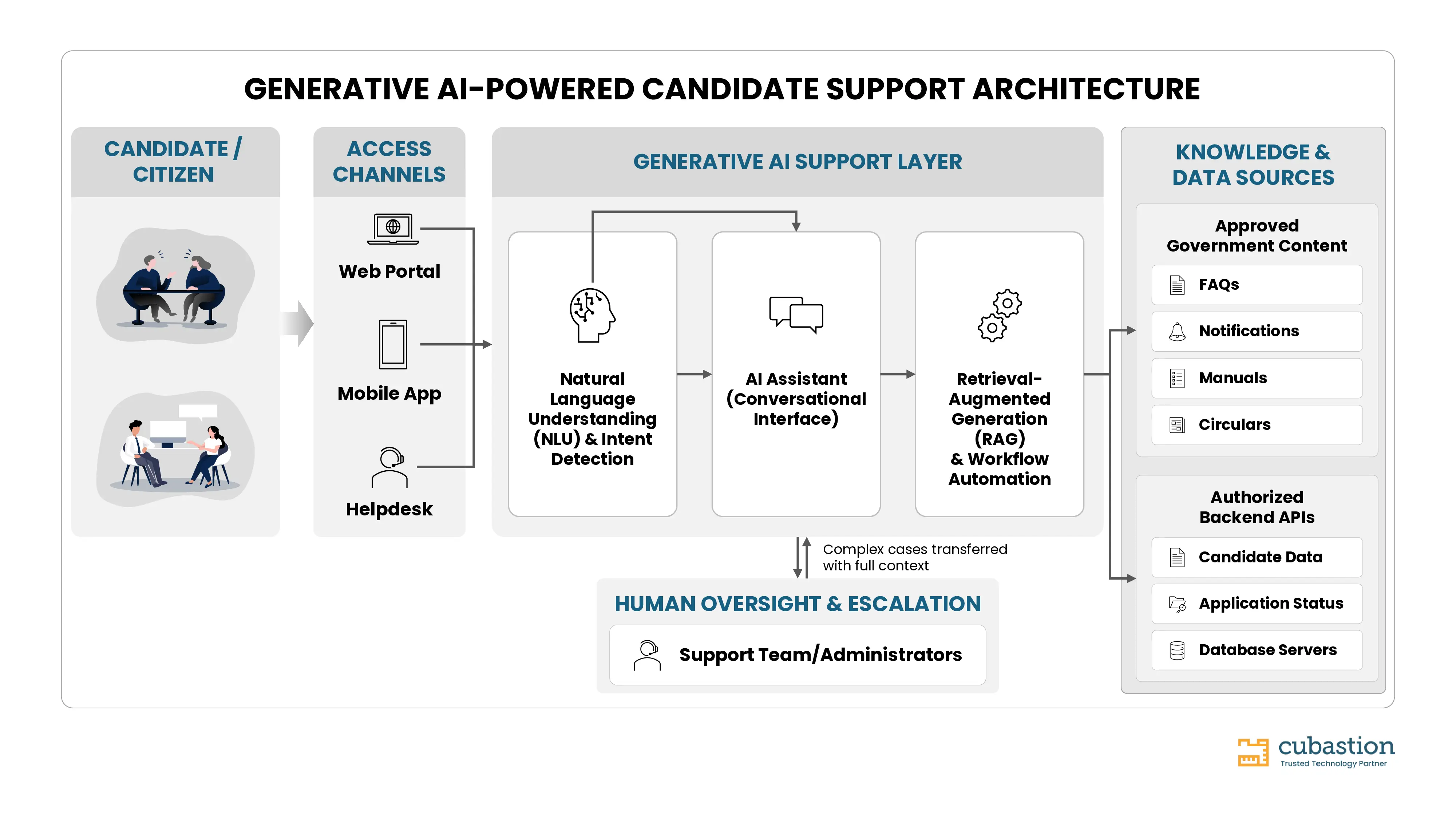
A Generative AI-powered support layer can sit on top of existing government applications and knowledge repositories. Rather than replacing existing systems, the AI layer can connect users with approved information and services through conversational interactions. Where required, the AI can also integrate with authorized backend APIs to retrieve relevant information such as application status or service availability.
Retrieval-Augmented Generation (RAG) is particularly useful because responses can be grounded in approved and current government documents rather than relying solely on the model's general knowledge.
The diagram below illustrates this end-to-end architecture, showing how the Generative AI support layer securely bridges candidate access channels with verified government knowledge repositories and backend systems:

From FAQs to Intelligent Service Delivery
Generative AI can support several areas of government service delivery:
- Candidate Assistance: Answer questions related to registration, eligibility, applications, examinations, admit cards, results, and documentation.
- Multilingual Support: Enable citizens to interact using commonly spoken Indian languages, improving accessibility.
- Application Guidance: Provide step-by-step assistance during online application and service processes.
- Helpdesk Assistance: Summarize user issues and provide support executives with recommended responses.
- Knowledge Management: Convert large collections of circulars, FAQs, manuals, and process documents into an intelligent searchable knowledge base.
- Proactive Communication: Provide contextual notifications and reminders regarding important service milestones.
- Human Escalation: Transfer complex, sensitive, or unresolved cases to human support teams with the conversation context intact.
The objective should not be “AI everywhere.” The objective should be better service outcomes through responsible AI adoption.
Applying Generative AI to Large-Scale Examination Services
Consider a government organization responsible for conducting recruitment examinations and providing digital services to millions of candidates across the country.
Such an organization may operate candidate portals, examination systems, mobile applications, helpdesk services, admit-card platforms, application modules, and multiple supporting digital systems.
During a major recruitment cycle, candidate queries can increase significantly. A Generative AI-powered candidate support solution could act as the first layer of assistance.
For example, a candidate could ask:
“My application has been submitted, but I cannot find information about my examination centre. What should I do?”
The AI assistant could identify the intent, retrieve the relevant approved information, explain the applicable process, and direct the candidate to the appropriate portal or support channel.
Similarly, candidates could ask questions about application corrections, examination schedules, eligibility conditions, document requirements, or admit-card availability.
Measuring the Impact
The effectiveness of such a solution can be measured through operational and service-level indicators such as:
- Reduction in repetitive helpdesk queries
- Faster response times
- Increased first-contact resolution
- Reduced support-agent workload
- Improved candidate self-service
- Consistency of information across channels
- Higher availability of support outside traditional working hours
- Better identification of recurring candidate issues
To visualize these outcomes, the chart below illustrates the shift in workload and key performance metrics when transitioning to an AI-enabled support model.

The most important proof point is not simply the number of AI conversations. It is whether candidates can complete their journeys with less friction, fewer support interactions, and greater clarity.
A More Scalable Candidate Experience
Generative AI can enable government organizations to support a much larger user base without increasing support operations at the same rate. Instead of every candidate requiring assistance from a human executive, routine queries can be handled automatically while support teams focus on complex cases, exceptions, grievances, and issues requiring human judgment.
This creates a scalable service model where technology handles volume and people handle complexity.
Better Government Service Delivery
The broader impact extends beyond examination services. The same approach can be applied to government schemes, public grievance systems, citizen portals, document services, licensing, taxation, education, healthcare administration, and other digital public services.
Over time, government organizations can evolve toward an AI-enabled service ecosystem where citizens interact with services through simple conversational interfaces rather than navigating multiple complex systems.
However, implementation must include strong controls around privacy, cybersecurity, data access, model governance, auditability, and human oversight.
AI Success Depends on the Foundation
One of the biggest lessons from enterprise AI adoption is that Generative AI cannot compensate for poor-quality information. Government organizations need structured, accurate, updated, and governed knowledge sources. Policies, notifications, FAQs, process documents, and service information must be maintained properly so that AI systems can provide reliable responses.
The technology layer is therefore only one part of the transformation. Data, processes, security, governance, and user experience are equally important. AI can handle repetitive questions, summarize information, identify patterns, and guide users through standard processes. Human teams can focus on exceptions, complex cases, decision-making, grievances, and situations requiring empathy or discretion.
The future of government service delivery is therefore not simply about deploying chatbots. It is about creating intelligent, accessible, secure, and citizen-centric digital services.
As governments continue to expand digital public infrastructure, Generative AI can become an important layer connecting citizens with information and services. When implemented responsibly, it has the potential to make large-scale government operations more responsive while making the citizen experience simpler, faster, and more accessible.
Ready to Transform Government Service Delivery with Generative AI?
Generative AI can help government organizations move beyond traditional helpdesks and static FAQs toward intelligent, scalable, and citizen-centric service delivery.
Our team helps organizations identify high-impact AI use cases, design secure Generative AI architectures, build AI-powered candidate and citizen support solutions, integrate enterprise data and government knowledge sources, and establish the governance required for responsible AI adoption.
Whether the goal is to reduce support volumes, improve candidate experience, enable multilingual assistance, or create intelligent access to government services, we can help turn the opportunity into a practical, production-ready solution.
Talk to our AI experts today to explore how Generative AI can transform your candidate support and government service delivery.