


Legacy systems are the top barrier to enterprise AI. Learn how to cut technical debt and modernize without rip-and-replace using the strangler fig pattern.
Executive Story
A CIO is handed an ambitious AI agenda and opens the budget to fund it. The problem is immediate. Roughly 80 percent of the money is already committed, not to anything new, but to keeping decades-old systems running. Whatever AI the board wants has to come from the sliver that remains, and even that runs into a wall: the core systems that hold the company's data have no modern interfaces, no current documentation, and no safe way to change. When the team costs out connecting them to AI, they discover the maintenance they have paid for years would have covered a migration three years ago, and did not. This is the trap millions of enterprises are now in. The previous article argued that AI fails on a weak data foundation. This one goes a layer deeper, to the legacy systems that hold most of that data and, increasingly, form the ceiling on what AI can do at all.
Executive Summary
Legacy systems are the single biggest barrier to enterprise AI. In Deloitte's research, 68 percent of organizations name them the primary obstacle to adopting AI and emerging technology. The reason is structural: AI needs modern interfaces, usable data, and infrastructure that legacy estates were never built to provide. Meanwhile, those estates consume the budget that could fund the future, with 60 to 80 percent of IT spend going to maintenance, and technical debt amounting to 20 to 40 percent of the technology estate by McKinsey's estimate. The answer is not the rip-and-replace rewrite most leaders dread, which is slow, risky, and often just relocates the debt. It is incremental modernization, and in 2026, AI itself has become one of its most powerful accelerants.

Figure 1. Legacy systems cap AI ambition. Technical debt holds the budget hostage.
Industry Context
For years, modernization was the project every technology leader postponed. In 2026 the postponement stopped being free. IDC predicts that 65 percent of Global 2000 CIOs will hit critical performance bottlenecks this year if they do not address the technical debt in their core architectures, and the pressure is no longer only technical. Legacy drives a talent crisis, because the best engineers do not want to spend their careers maintaining systems no one fully understands, and it has become a competitive one, as rivals who modernized move faster on exactly the AI initiatives that legacy blocks. What changed is not that legacy got worse, but that AI raised the cost of living with it. The ceiling was always there; now everyone can see it.
The Legacy Ceiling
Why do legacy systems block AI so decisively? Because modern AI has concrete requirements, and legacy estates meet almost none of them. AI integration needs application programming interfaces that AI services can call, data in formats machine-learning pipelines can ingest, infrastructure that can handle the compute and latency of model inference, and deployment pipelines that can test and monitor AI-enhanced features. A closed, monolithic system built for batch processing a decade ago offers none of these. The problem sharpens as enterprises move toward agents. As the agentic series established, an agent acts on the world by calling tools and systems through their interfaces. A system with no interface is simply invisible to an agent, impossible to read from or act upon. Legacy is therefore not a background inconvenience. It is a hard ceiling on how far AI, and especially autonomous AI, can reach, and a ceiling is not something you raise by buying a better model. It is something you have to break.
The Tech-Debt Trap
Legacy also starves AI of funding, through a mechanism finance team routinely underestimate. Technical debt, the accumulated cost of deferred modernization, compounds quietly, and its interest is paid in the maintenance budget. McKinsey finds that for large organizations, technical debt can consume 40 to 50 percent of the entire IT investment, and industry surveys put total losses from unmodernized systems at around 370 million dollars a year for the average enterprise. The result is what practitioners call a starvation cycle: the more legacy an enterprise carries, the less budget is left for anything new. As one analysis put it bluntly, if more than half your project spend goes to keeping the lights on, you are not funding a roadmap, you are paying interest. Every year of deferral makes the eventual modernization larger and the room for AI smaller.
Why Rip-and-Replace Fails
Faced with this, the instinct is often to tear the old system out and build a clean new one. For a live business, this is usually the wrong move. A big-bang rewrite is expensive, slow, and high-risk: it asks an organization to run two worlds at once and then bet everything on a single cutover. It frequently fails outright; Gartner predicts that more than 70 percent of mainframe-exit projects in 2026 will founder, many on over-hyped expectations of AI doing the work. And even when a rewrite succeeds technically, it often just moves the technical debt from an old system into a new one. The lesson the market has learned, repeatedly and expensively, is that you cannot modernize a business-critical system by switching it off.
Modernize Without Rip-and-Replace: The Strangler Fig
The pragmatic alternative has a memorable name: the strangler fig pattern, after the tree that grows around a host and gradually replaces it. Instead of replacing a legacy system in one move, you build new capabilities alongside it and route work to them piece by piece, usually behind an API facade that wraps the old system. Over time, more runs on modern components and less on the legacy core, until the old system can finally be retired, having been displaced rather than switched off. Its great virtue is safety: the software keeps running throughout, so a mistake is contained to one capability instead of threatening the whole company. It is no accident that both major cloud providers publish the strangler fig as a standard, low-risk modernization pattern. Modernization becomes a series of survivable steps rather than one unsurvivable leap.

Figure 2. The strangler-fig pattern: wrap, replace one capability at a time, then retire.
How AI Changes Modernization
Here is what makes 2026 genuinely different. AI has attacked the two most expensive parts of modernization, understanding old code and rewriting it. Modern tooling can map an undocumented codebase, explain what decades-old logic actually does, generate tests that pin down current behavior, and accelerate translation into modern languages, work that used to consume the majority of a modernization budget. McKinsey reports generative AI cutting modernization timelines by 40 to 50 percent and technical-debt costs by around 40 percent, and AI now accounts for roughly a third of enterprise modernization investment. The honest caveats matter, though. On large, mature codebases, AI can slow experienced engineers rather than speed them, and AI-generated code can quietly add new debt of its own. AI is a powerful accelerant for modernization, not a magic rewrite button, and treating it as the latter is exactly how those mainframe-exit projects fail.
The Modernization Roadmap
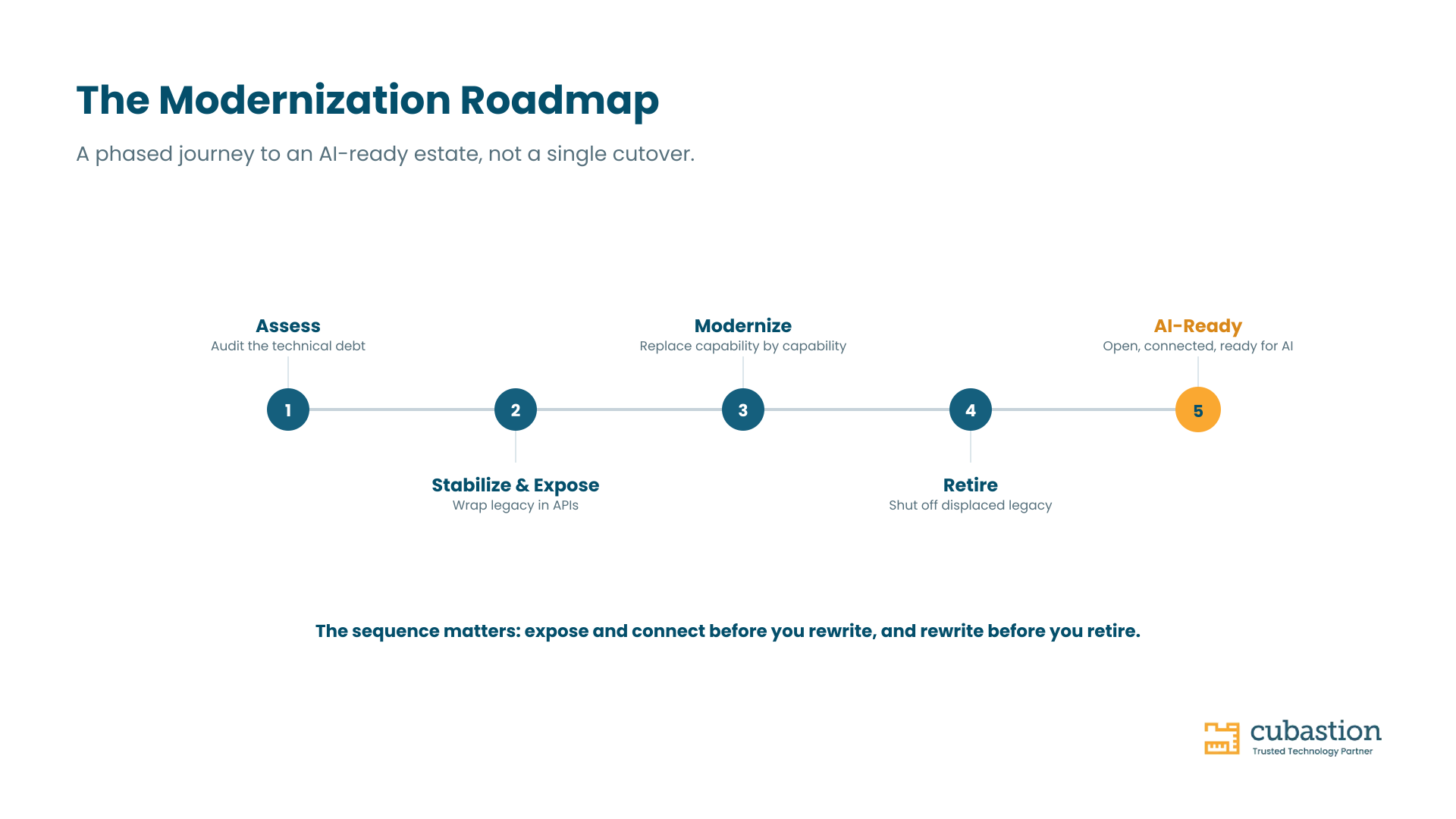
A sound modernization program follows a recognizable path. It begins with an honest technical-debt audit to understand what exists and what it is costing, because most of the debt accumulated silently and no single person fully understands the estate. It then stabilizes the system and exposes it through APIs, which both unlocks immediate value and creates the facade the strangler pattern needs. From there it modernizes incrementally, capability by capability, prioritized by business value and AI-readiness, before retiring the legacy components that have been displaced. The destination is an estate that is open, interoperable, and ready to feed and be acted upon by AI. The sequence matters: exposing and connecting comes before rewriting, and rewriting comes before retiring.

Figure 3. Modernization is a phased journey, not a single cutover.
Recommendations
Five priorities for breaking the legacy ceiling:
- Audit the debt first. Quantify what legacy is costing and where it blocks AI, before committing to any approach.
- Reject the big-bang rewrite. For business-critical systems, modernize incrementally rather than betting on a cutover.
- Lead with APIs. Expose legacy through interfaces so data can flow and AI, and agents, can reach it.
- Use the strangler fig. Replace one capability at a time behind the facade, keeping the system running throughout.
- Let AI accelerate, not decide. Use AI to map and migrate legacy, with human judgment and clear-eyed expectations.
Conclusion
Legacy is the quiet ceiling beneath which most enterprise AI ambitions are trapped, not because the ambition is wrong, but because the systems underneath cannot support it. Breaking it is not a cost center; it is what unlocks everything above it, and it has been shown to cut maintenance costs by 40 to 74 percent while freeing the budget that maintenance consumes. The way through is not the dramatic rewrite but the disciplined, incremental one: audit the debt, expose through APIs, replace capability by capability with the strangler fig, and let AI accelerate the work. The data foundation cannot be built while the data is trapped in closed systems, and the agents of the future can only act on an estate that exposes itself to them. At Cubastion, this is core to what we do, modernizing the systems enterprises depend on so their data, their integration, and their AI can finally move. The next article turns to the connective tissue that modernization exposes, and AI requires: the integration that lets systems, and agents, actually work together.