


Learn how legacy system modernization helps enterprises improve operational efficiency, system reliability, and integration. Explore practical modernization strategies, cloud-based solutions, and how Mitsubishi FUSO transformed dealer operations using Oracle Siebel CRM and Microsoft Azure. Discover how Cubastion helps businesses modernize legacy applications and build a scalable foundation for digital transformation.
Why Legacy System Modernization Matters for Business Growth
Legacy systems often remain central to business operations long after their original purpose has been served. They support critical processes, store business data and connect essential applications. However, as business needs evolve, these systems can become difficult to maintain, integrate and scale.
The challenge is not simply that older technology needs an upgrade. It is that legacy system limitations can slow business processes, restrict innovation and affect customer experience.
For enterprises, legacy system modernization is about more than replacing outdated technology. It is about ensuring existing systems can support changing business demands, connected operations and long-term growth.
Why Enterprises Struggle with Legacy Systems
Many enterprises have built their technology environments over several years. Different applications support different functions, and integrations are added as new requirements emerge.
Over time, this creates complex technology landscapes where systems may use different data formats, integration methods and operating processes.
Common challenges include:
- Growing maintenance effort: Older applications require increasing effort to support and maintain.
- Limited integration: Connecting legacy applications with modern platforms can be complex and time-consuming.
- Performance and reliability issues: System instability and slow processing can interrupt critical business operations.
- Scalability constraints: Existing architecture may struggle to accommodate increasing workloads or expanding operations.
- Reduced business agility: Changes that should be straightforward can require extensive development, testing and coordination.
These issues often develop gradually. However, their combined impact can make it difficult for organizations to respond quickly to business and customer needs.
Legacy System Challenges: How Outdated Technology Impacts Business Performance
The real cost of legacy technology extends beyond maintenance expenses. When systems cannot support business requirements effectively, the consequences affect operations, decision-making and customer experience.
- Operational inefficiency: Manual workarounds and repeated data handling increase effort and create opportunities for errors.
- Disconnected business processes: When applications do not exchange information reliably, employees may lack a consistent view of customers, transactions or operational activities.
- Higher support burden: Recurring incidents consume IT resources that could otherwise support improvements and new initiatives.
- Slower transformation: Integrating new capabilities becomes more difficult when existing systems have limited flexibility or depend on complex interfaces.
- Business continuity risks: Unsupported technology, inconsistent performance and limited monitoring can increase operational risk.
Without a clear modernization strategy, enterprises may continue investing in systems that are increasingly difficult to adapt to changing business needs.

Legacy Application Modernization Strategy: A Practical Framework for Enterprises
Legacy system modernization does not always require replacing every existing application. The right approach depends on the system's business value, technical limitations, integration dependencies and future requirements.
A structured modernization strategy should focus on five priorities.
- Assess the existing landscape: Identify critical applications, recurring issues, support limitations and dependencies across systems.
- Prioritize business-critical constraints: Focus first on problems affecting reliability, operational efficiency, scalability or customer experience.
- Modernize the architecture: Evaluate suitable options such as application upgrades, cloud migration, containerization or targeted redevelopment.
Strengthen integration: Connect enterprise applications through well-defined APIs and integration frameworks to improve data exchange and reduce fragmentation. - Improve ongoing operations: Introduce effective monitoring, performance optimization, automation and structured application support.

For organizations running Oracle Siebel CRM, this may involve modernizing the deployment architecture, improving integrations or optimizing application performance while preserving valuable existing business capabilities.
The objective is to create a technology environment that is easier to maintain, more reliable and better aligned with business priorities.
Legacy Modernization in Practice: The FORCE 2.0 Example
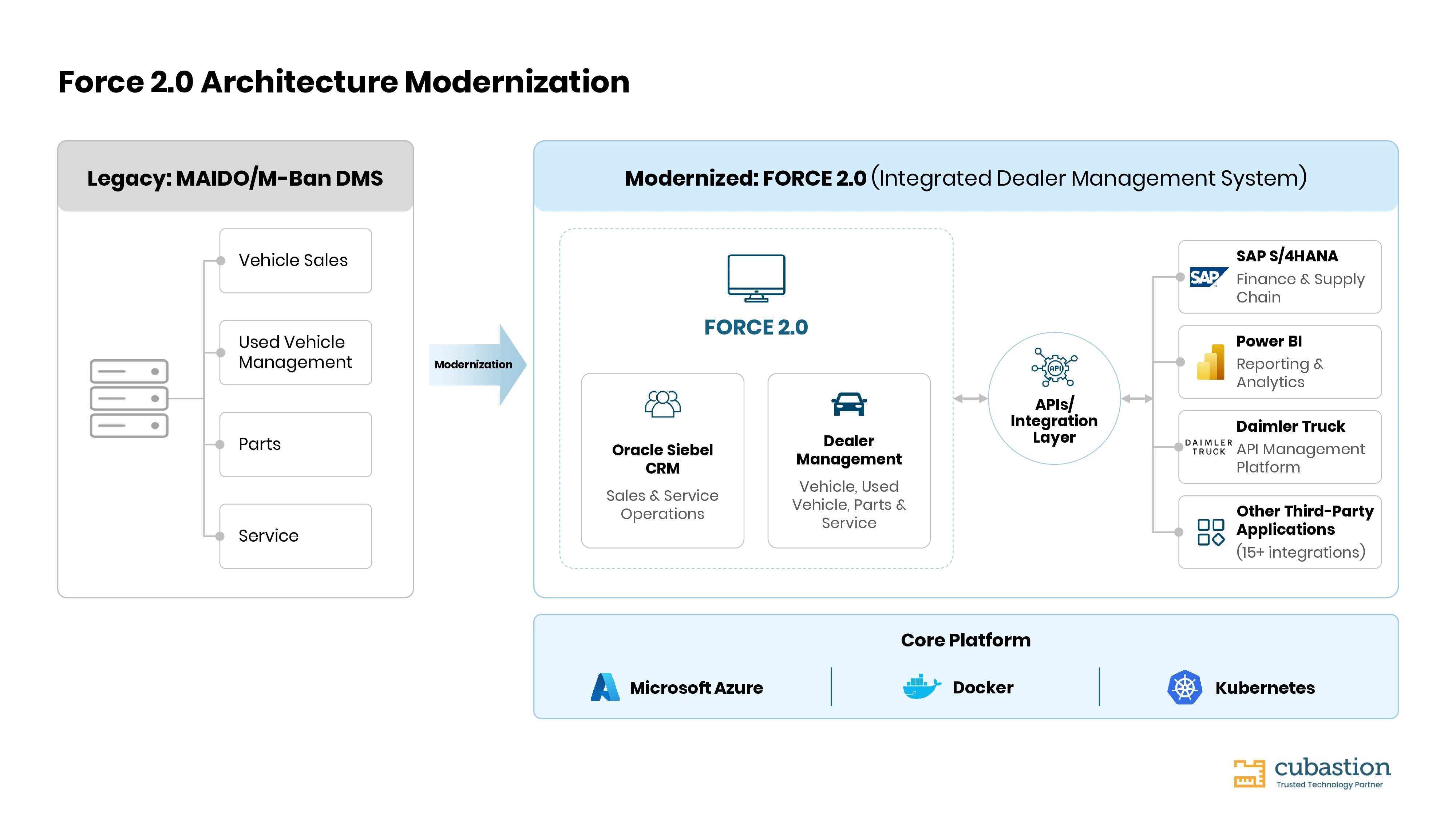
Mitsubishi FUSO Truck and Bus Corporation (MFTBC) relied on its legacy MAIDO/M-Ban Dealer Management System (DMS) across five Sales Centres and more than 250 dealer branches. With support for the existing system scheduled to end in 2028, modernization became an important priority.
Cubastion supported the transition through FORCE 2.0, an integrated Dealer Management System designed to connect key dealership operations.
Key aspects of the modernization included:
- Integrated business operations: Brought together vehicle sales, used vehicle management, parts and service.
- Oracle Siebel CRM: Supported CRM and service operations within the platform.
- Cloud-based architecture: Used Microsoft Azure with Docker and Kubernetes.
- Enterprise application integration: Connected more than 15 third-party applications, including SAP S/4HANA and Power BI, through the Daimler Truck API Management Platform.

Results reported for the engagement:
- 100% system uptime maintained
- 2 high-priority incidents per year, against a target of no more than 5
- 24.15% year-over-year reduction in lower-priority incidents
- 15.04% year-over-year reduction in service requests
- A single synchronized deployment across all Sales Centres in six months, with no disruption to business operations
The example demonstrates how legacy system modernization can improve integration, strengthen operational stability and create a more connected foundation for business growth.
Business Benefits of Legacy System Modernization
A well-planned modernization initiative can deliver benefits across the organization:
- Improved operational efficiency: Reduces manual workarounds and makes business processes more consistent.
- Greater system reliability: Helps minimize disruption to critical applications and business operations.
- Better integration: Enables more dependable information exchange between applications and business functions.
- Faster business response: Makes it easier to implement changes and accommodate evolving requirements.
- Stronger customer experience: Supports more consistent service when employees and systems can access reliable, connected information.
The scale of these benefits depends on the starting environment, modernization scope and effectiveness of implementation.
Modernize Your Legacy Systems with Cubastion
Successful legacy system modernization creates value beyond the initial technology upgrade. It helps enterprises establish a more adaptable technology foundation, improve visibility across business processes and make better use of existing application investments.
It can also create the conditions needed to introduce new digital capabilities without adding unnecessary complexity to an already fragmented environment.
The goal is not simply to maintain older systems for longer. It is to ensure the technology landscape continues to support business priorities as they evolve.
Connect with a Cubastion consultant today to explore your digital transformation journey.