



Why Legacy Modernization Is Becoming Critical for Automotive Enterprises
Automotive companies are operating in an increasingly digital environment. Connected vehicles, mobile applications, digital dealerships, AI, real-time analytics, cloud platforms, and software-defined vehicles are changing how automotive businesses engage customers and manage operations.
Yet behind these modern experiences, many automotive organizations continue to depend on legacy CRM, Dealer Management Systems (DMS), ERP platforms, databases, and tightly coupled applications developed years or even decades ago.
The challenge is not simply that these systems are old. The real challenge is that they continue to support critical business processes, making a complete replacement risky and disruptive.
Legacy modernization provides a practical path forward. Instead of replacing everything at once, automotive enterprises can modernize systems incrementally using APIs, cloud technologies, microservices, integration platforms, data modernization, and phased migration strategies.
This article explores why legacy automotive systems create business challenges, how organizations can modernize them without disrupting operations, and what outcomes automotive enterprises can achieve through a structured modernization approach.
From Legacy Platforms to Modern Automotive Ecosystems
Over the years, automotive organizations have built technology environments around individual business requirements. Dealer management, customer relationship management, vehicle servicing, warranty, inventory, finance, manufacturing, and supply-chain operations have often evolved as separate systems.
As new digital capabilities emerged, these systems were connected through additional integrations rather than completely replaced. This has resulted in complex technology ecosystems where modern applications often depend on older platforms for critical data and processes.
For example, a dealer may use a modern customer-facing application while customer history, vehicle information, service records, or warranty information continues to reside in legacy systems.
At the same time, the automotive industry is moving toward connected and software-defined vehicles, requiring stronger integration between vehicles, cloud platforms, enterprise applications, dealerships, and customer-facing services.
This creates a new modernization requirement. Organizations need to move from fragmented, tightly coupled architectures toward more connected, scalable, and API-driven ecosystems without compromising the business processes that already work.
Legacy modernization therefore becomes less about replacing old technology and more about creating a bridge between existing investments and future digital capabilities.
Why Legacy Systems Are Holding Automotive Businesses Back
Legacy systems become a business challenge when they prevent organizations from responding quickly to changing customer and operational requirements.
First, system dependencies create complexity. A change in one application can affect multiple connected systems, making even small enhancements difficult and time-consuming.
Second, data remains fragmented. Customer information, vehicle history, service records, inventory data, warranty information, and dealer information may exist across multiple databases and applications.
Third, legacy systems can limit innovation. Launching a new mobile application, digital dealership capability, analytics solution, or AI use case may require extensive changes to older applications and integrations.
Fourth, scalability becomes a concern. Legacy platforms may not have been designed for the volume of real-time data generated by connected vehicles, digital channels, mobile applications, and increasingly complex customer journeys.
Finally, business disruption is a major modernization risk. Automotive systems often support mission-critical operations. Replacing a system completely can interrupt dealership operations, service processes, customer interactions, billing, inventory management, or other revenue-generating activities.
The result is a difficult trade-off: Organizations need to modernize but cannot afford to disrupt the business while doing so.
Modernization Without Business Disruption
The most effective approach is to modernize legacy systems incrementally rather than adopting a high-risk “rip-and-replace” strategy. A structured modernization strategy can include the following five key components:

1. Assess the Existing Technology Landscape
Modernization should begin with understanding the current environment. Organizations should map applications, databases, integrations, business processes, dependencies, technical debt, performance limitations, and security risks. This helps identify which systems should be retained, rehosted, refactored, rebuilt, replaced, or retired.
The objective is to create a modernization roadmap based on business value and technical priorities, rather than modernizing technology simply because it is old.
2. Introduce APIs and Integration Layers
APIs can provide a bridge between legacy systems and modern applications.
Instead of allowing every new application to directly interact with a legacy database, an API layer can expose required data and functionality in a controlled and reusable manner.
3. Gradually Introduce Microservices
Large, tightly coupled applications can be gradually decomposed into smaller services. For an automotive organization, individual capabilities such as customer management, service appointments, warranty, inventory, notifications, and payments can potentially be separated and modernized independently.
This allows organizations to replace individual components without replacing the entire platform.
4. Modernize Data and Cloud Infrastructure
Data modernization is equally important. Legacy databases can be integrated with modern data platforms to enable better reporting, analytics, AI, and real-time decision-making. Similarly, suitable workloads can gradually move to cloud infrastructure to improve scalability, flexibility, monitoring, and integration with modern digital services.
The goal should not be to move everything to the cloud immediately. Instead, organizations should evaluate workloads individually and determine the most appropriate modernization approach.
5. Use Phased Migration and Continuous Testing
Business-critical automotive systems should be migrated through controlled stages.
A typical approach can be:
Build → Test → Run in Parallel → Validate → Pilot → Gradual Rollout → Decommission
Automated testing, monitoring, rollback mechanisms, data validation, and phased releases help organizations reduce operational risk. This allows the business to continue operating while modernization progresses in the background.
At Cubastion, modernization can be approached by integrating modern technologies with existing enterprise ecosystems, helping organizations introduce new capabilities while protecting critical business processes and investments.
How Automotive Companies Can Modernize Legacy Systems
Consider an automotive OEM operating a large network of dealerships. The organization relies on a legacy Dealer Management System to manage important functions such as customer information, vehicle inventory, service appointments, warranty, and dealer operations.
The system is stable and deeply embedded in business operations, but its architecture makes it difficult to integrate with newer mobile applications, CRM platforms, analytics tools, and digital dealer services. A complete replacement would require significant investment and could disrupt dealer operations. Instead, the OEM introduces an API and integration layer around the existing DMS.
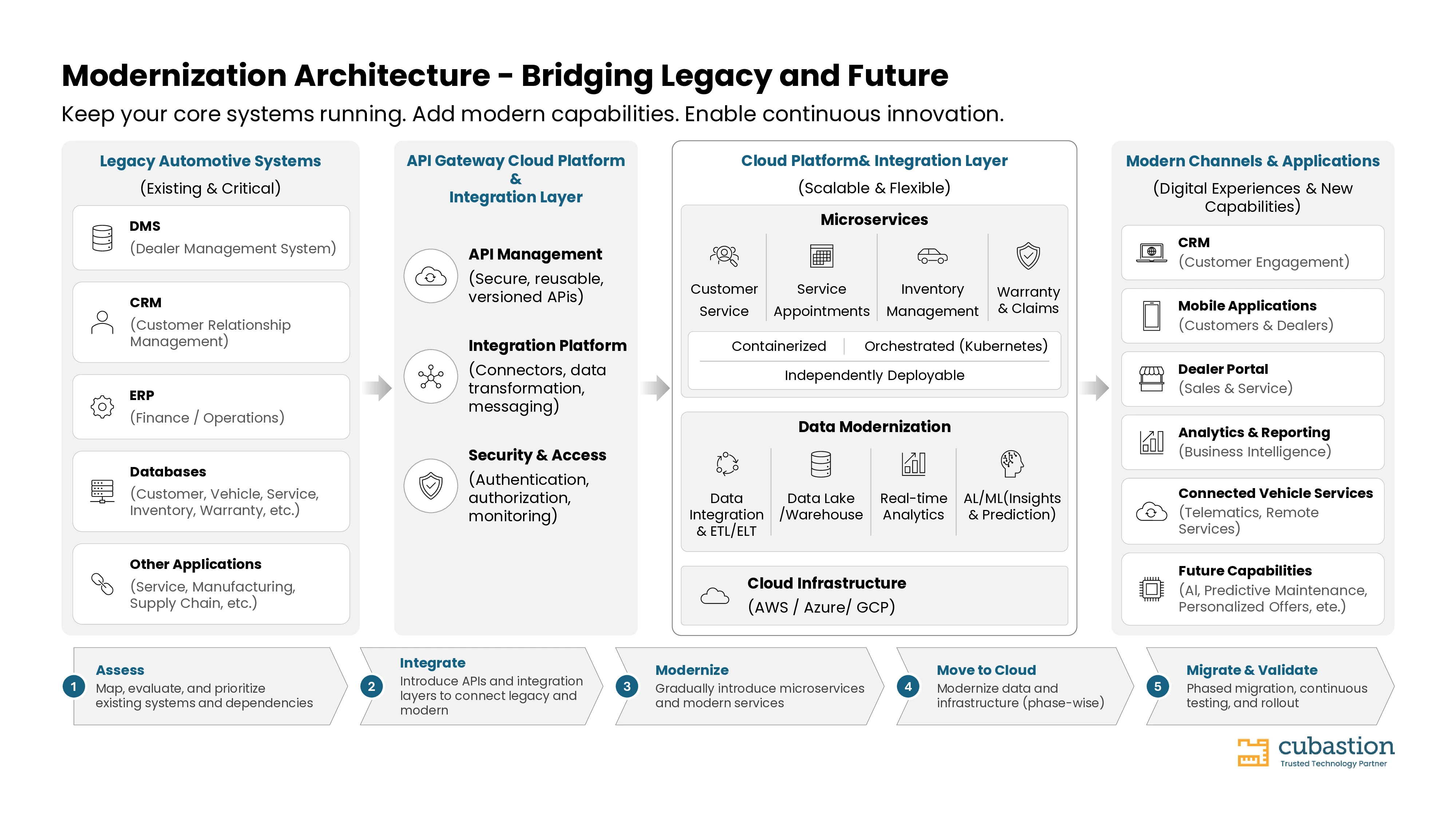
The modernization architecture could evolve as follows:

The organization first exposes selected DMS capabilities through APIs. It then develops modern services for areas such as service appointment management, customer notifications, inventory visibility, and analytics.
The legacy DMS continues to handle critical transactions while the new capabilities operate alongside it. Over time, individual functions can be migrated from the legacy platform to modern services.
For example, the organization could first modernize service appointment management, followed by customer notifications, inventory visibility, and eventually other high-value functions. This creates a gradual modernization path rather than forcing the organization to replace the entire DMS at once.
Result: The automotive organization gains greater integration flexibility, faster digital innovation, improved data accessibility, and a lower-risk path toward replacing legacy components while core dealership operations continue running.
This model can also support future capabilities such as AI-powered customer engagement, predictive service recommendations, connected vehicle services, and real-time dealer analytics.
1. What Automotive Enterprises Achieve Through Modernization - When legacy modernization is executed strategically, automotive organizations can achieve benefits that extend beyond technology upgrades.
2. Faster digital innovation - Modern APIs, cloud services, and modular architectures make it easier to introduce new applications and digital services without repeatedly modifying large legacy systems.
3. Improved customer experience - Modernized systems can connect customer journeys across websites, mobile applications, dealerships, service centres, and connected vehicle platforms.
4. Better data accessibility - Integrating fragmented legacy systems can create a more consistent view of customers, vehicles, service history, inventory, and dealer operations.
5. Greater scalability - Modern architectures can scale more effectively as transaction volumes, connected vehicles, digital interactions, and data requirements increase.
6. Reduced operational risk - Phased modernization avoids the risks associated with replacing a mission-critical automotive platform in a single transformation.
7. Stronger foundation for AI- AI initiatives require accessible, reliable, and connected data. Modernizing legacy integrations and data environments creates a stronger foundation for predictive analytics, intelligent automation, and AI-powered customer experiences. Most importantly, organizations can modernize their technology landscape without sacrificing business continuity.
Key Takeaways for Automotive Leaders
Legacy modernization should not be treated as a technology replacement exercise. It should be approached as a business transformation program focused on improving agility, customer experience, operational efficiency, and long-term scalability.
Key learnings include:
- Modernization does not mean replacing everything: Existing systems may continue delivering value and can be modernized gradually.
- Integration comes before replacement: APIs and integration layers can connect legacy platforms with modern applications while creating a path toward future migration.
- Business continuity must remain a priority: Phased migration, parallel testing, monitoring, and controlled releases can significantly reduce disruption.
- Data modernization is critical: Modern applications and AI initiatives depend on reliable, accessible, and integrated data.
- Prioritization drives ROI: Organizations should first modernize components that create the greatest business impact or represent the greatest operational constraint.
- Modernization should prepare the organization for the future: The target architecture should support cloud, APIs, analytics, AI, connected services, and the evolving software-defined automotive ecosystem.
The objective is not simply to make legacy technology newer. The objective is to make the entire automotive business more agile, connected, scalable, and ready for continuous innovation.
Modernize Your Automotive Technology Without Disruption
Legacy systems do not have to become a barrier to digital transformation.
For automotive enterprises, the right modernization strategy can preserve existing investments while gradually introducing modern architectures, APIs, cloud platforms, data capabilities, automation, and AI.
The real question is not “How do we replace our legacy systems?”
It is:
“How do we modernize the systems that matter most without disrupting the business?”
If your organization is dealing with legacy CRM, DMS, ERP, integration, data, or customer-facing platforms, now is the time to evaluate where modernization can create the greatest business impact.
At Cubastion, we help automotive organizations assess legacy environments, design modernization roadmaps, integrate modern technologies, and introduce new digital capabilities while minimizing disruption to existing operations.
Ready to modernize your automotive technology landscape? Connect with Cubastion to explore a phased modernization strategy designed around your systems, business priorities, and growth objectives.