


Siebel CRM now ships monthly updates, Redwood UX and AI Connectors, with Oracle support to 2037. See why upgrading beats replacing it.
Ten years ago, the case for replacing Siebel CRM wrote itself. The interface looked dated, it ran only in Internet Explorer, and every upgrade was a multi-year project. Many organizations concluded that a new, friendlier CRM was the only way forward.
That case has quietly expired. The Siebel of 2026 ships a feature update every month, runs a Redwood interface on desktop, tablet and phone, exposes its business logic to AI agents through governed connectors, and is backed by Oracle Premier Support through at least 2037. For organizations already running it, the better question is no longer whether to leave, but how much of the modernization they want is already one upgrade away.
Why customers wanted out, and what has changed
The complaints were legitimate. Through the 2000s and early 2010s Siebel depended on ActiveX controls in Internet Explorer, offered little on mobile devices, integrated through heavy SOAP and EAI layers, and released major versions years apart. Customizations made each upgrade slower and costlier, so many estates froze on old releases and fell further behind.
Oracle has since answered those objections one by one.

Past objections to Siebel and the release that answers each
Read the left column as the replacement business case of a decade ago and the right as the product available today. Open UI, from 8.1.1.9, removed the browser lock-in, and the old high-interactivity client was retired entirely by Innovation Pack 2016. Redwood UX then brought the interface in line with Oracle's cloud applications, first on desktop and in 2026 on tablet and phone. The monthly update model, with this year's Repository update and resume capability, addresses the upgrade burden that drove so many replacement decisions.
What changed in 2026
Between January (26.1) and September (26.9), Oracle shipped nine monthly Siebel updates. Each looks incremental on its own; together they move the product on four fronts.

Siebel CRM 2026 updates by area, with the release number under each feature
Start with the last column. Each update this year has made the next one cheaper to absorb, and that is what keeps the other three within reach instead of parked in a future upgrade programme.
Three of these features carry the most business weight:
- Siebel AI Connectors (26.7) give agents, copilots and autonomous workflows governed access to existing Siebel capabilities, including your own configured logic, without building a custom integration layer.
- TM Forum Open API integration (26.9) links Siebel Communications to Oracle OSM and BRM through TMF 622 and TMF 666, replacing the older AIA-based integration.
- Repository update (26.1) applies only attribute-level changes during a monthly update and preserves customer configuration; 26.9 adds the ability to resume an interrupted update from its last completed step.
How the pieces fit
The design principle behind these releases is simple: keep the system of record where it is and open it up.

The modern Siebel landscape: three ways in, one system of record
Everything above the core is new or newly modernized; the core is what your teams have refined for years. An AI agent checking warranty eligibility, a dealer portal configuring a vehicle bundle and a field engineer on a phone all run on the same rules and data, without re-implementing that logic anywhere else.
Why replacing Siebel is often redundant
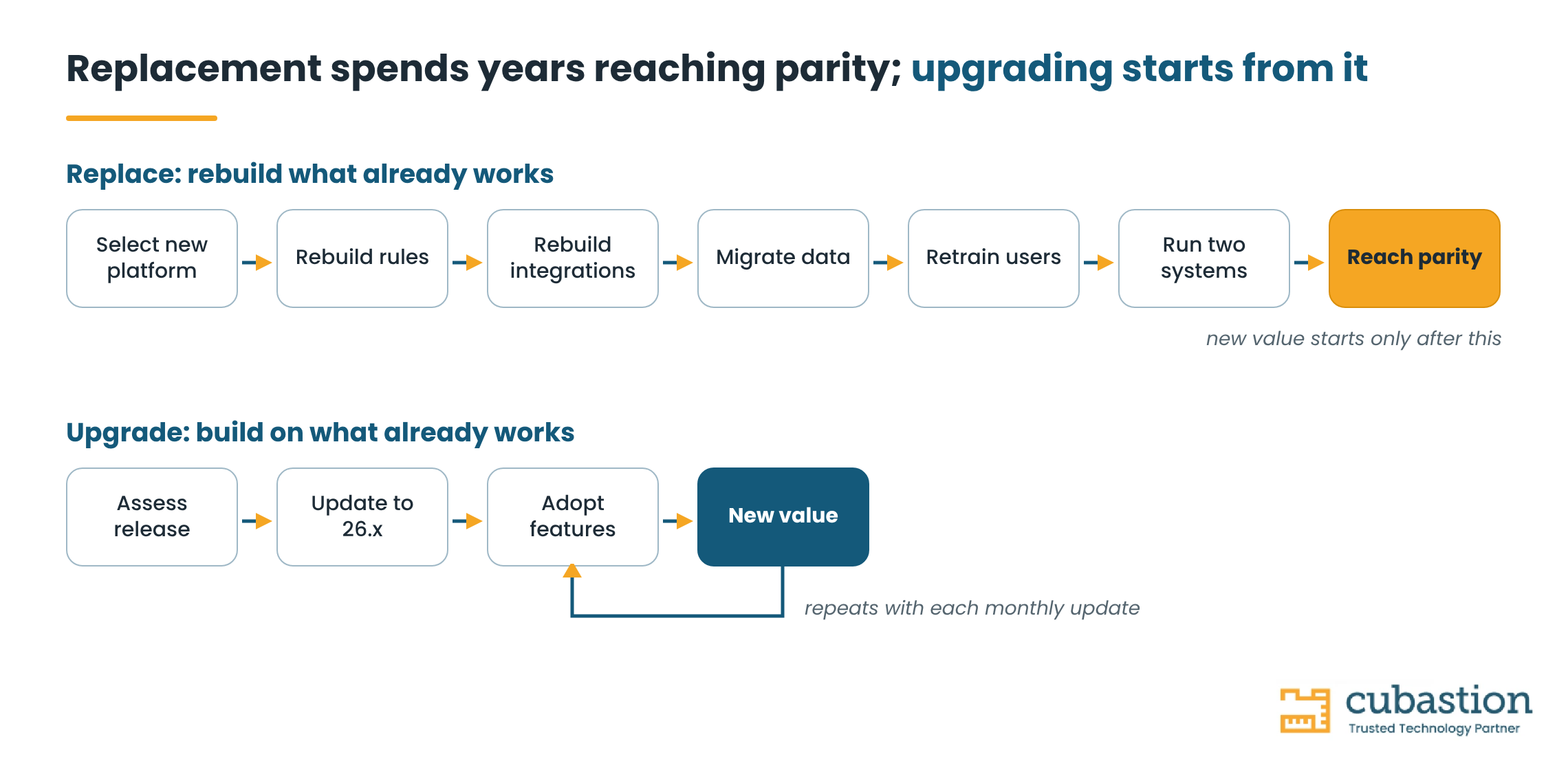
A replacement programme spends its first years recreating what the business already has. An upgrade starts from that point and builds on it.

Replace path vs upgrade path (steps only, no durations implied)
For most established Siebel estates, seven reasons make a replacement redundant:
- No deadline forces the move. In March 2026 Oracle extended Premier Support for Siebel CRM through at least 2037, the eighth consecutive renewal of a rolling ten-year commitment. Any migration can be judged on value, not on a support cliff.
- The configured logic is the asset. Pricing rules, eligibility checks, dealer and service workflows and years of edge cases live in the Siebel repository. A new platform must rediscover and rebuild each one before it delivers anything new.
- AI no longer needs a new platform. AI Connectors, the RAG framework and Sales Assistant let agents use the logic you already trust.
- Integrations can be modernized in place. REST APIs, Open Integration with mapping to canonical models, and TMF Open APIs replace brittle point-to-point links without replacing the system behind them.
- Staying current is now routine. Repository update, online schema changes, pre-update assessment reports and resumable updates turn the monthly update into an operational task, not a project.
- Security depends on being current, not on being new. Oracle's quarterly Critical Patch Updates regularly include Siebel fixes. A recent 26.x estate receives them; one frozen while a replacement is debated does not.
- Users keep their processes. Redwood UX changes how Siebel looks on every device without changing the business processes people know. A replacement changes both.
What this looks like in practice
At Cubastion we have taken this path with clients in automotive, telecom, engineering and consumer durables, including estates that started as far back as Siebel 8.1.1.9. In each case below, Siebel stayed the system of record and was modernized around its existing logic.

The pattern matches the upgrade path drawn above: the effort went into new capability, not into rebuilding what already worked.
When replacement does make sense
Upgrading is not the right answer for every estate. A replacement deserves serious study when Siebel handles little beyond standard contact and opportunity management, when the business model has changed so much that most configured logic is obsolete, or when the organization has chosen a single SaaS suite for reasons that go beyond CRM.
Some realities of Siebel also remain and should be costed honestly. It is customer-managed software rather than SaaS, so someone must run the infrastructure and apply updates. It carries annual support fees. Experienced Siebel skills are scarcer than they were. And heavily scripted legacy customizations still need clean-up during an upgrade. These are operating choices, not product defects, but a credible plan names them.
Even where replacement is the right call, it is better made from a current release. A 26.x estate is easier to assess, easier to extract data from, and safer to run through a long transition than one several years behind.
Where to start
Begin with a plain inventory: which release you run today, how far it is from 26.9, and which of this year's features map to problems your business already has. That exercise usually shows that the modernization people hoped a new platform would bring is already available, one upgrade away, without discarding the logic that took years to build.