



Why Customer Service Must Evolve for the AI Agent Era
Customer service is undergoing a fundamental transformation. For decades, organizations optimized support operations through process standardization, workforce expansion, and incremental technology improvements. Today, the emergence of AI agents is reshaping how customer service is delivered, managed, and scaled.
As enterprises adopt AI-powered service platforms such as Salesforce AgentForce, the focus is shifting from simply improving agent productivity to redesigning entire service operating models. Organizations that continue to rely on traditional support structures risk slower response times, rising operational costs, and inconsistent customer experiences.
This article explores why customer service operations must evolve for the AI agent era and how enterprises can build service models designed for intelligent, scalable, and customer-centric support.
From Contact Centers to Intelligent Service Operations

Traditional customer service models were built around human agents handling customer interactions through predefined workflows and support channels.
While this approach has served organizations well, modern customers increasingly expect:
- Faster resolutions
- Personalized experiences
- 24/7 support availability
- Consistent interactions across channels
At the same time, support teams face growing pressure to manage increasing case volumes while controlling operational costs.
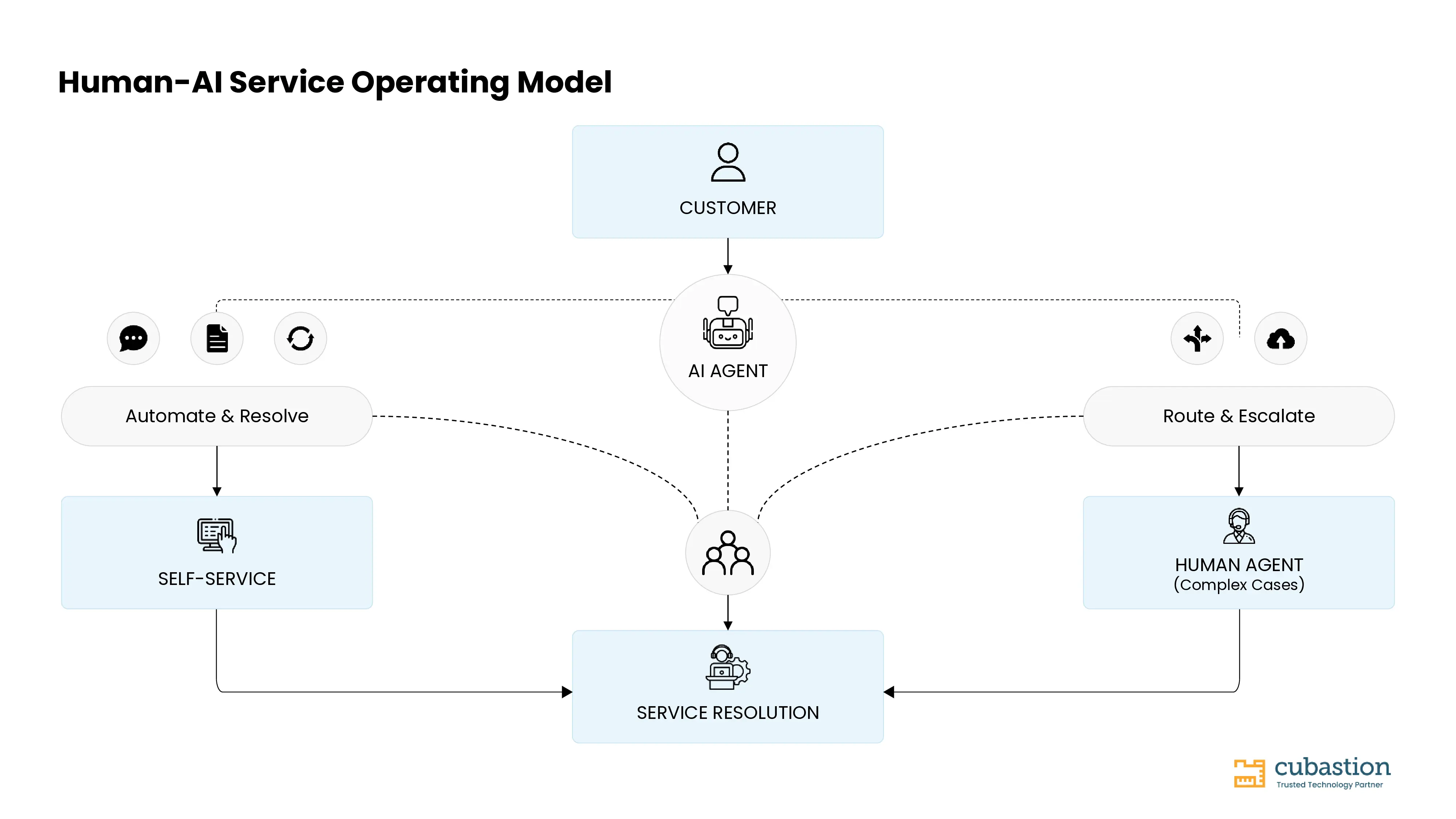
AI agents are emerging as a key enabler of this transformation by automating routine interactions, supporting service representatives, and orchestrating workflows across customer service operations.
The result is a shift from agent-centric support models to intelligent service ecosystems where humans and AI work together.
Why Traditional Customer Service Models Are No Longer Sufficient
1. Rising Customer Expectations: Customers expect immediate and personalized support experiences regardless of channel or time of engagement.
2. Increased Operational Complexity: Support teams are managing larger volumes of customer requests while navigating fragmented systems, growing knowledge bases, and increasing service demands.
3. Escalating Service Costs: Scaling customer support through workforce expansion alone is becoming increasingly expensive and difficult to sustain.
4. Inefficient Resource Allocation: Highly skilled service representatives often spend significant time resolving repetitive and low-value requests that can be automated.
Without operational redesign, organizations may struggle to realize the full value of AI investments.
Building a Customer Service Operating Model for the AI Agent Era

1. Reimagine Service Workflows: Organizations should identify repetitive and rule-based activities that can be automated using AI agents, allowing service teams to focus on complex customer needs.
2. Create Human-AI Collaboration Models: The future of customer service is not AI replacing humans, it is AI augmenting human capabilities. Organizations should define:
- AI-owned tasks
- Human-owned tasks
- Escalation workflows
- Exception management processes
3. Modernize Knowledge Management: AI agents are only as effective as the knowledge they can access. Enterprises should establish:
- Centralized knowledge repositories
- Governance controls
- Content maintenance processes
- Real-time information accessibility
4. Implement Continuous Service Intelligence: Customer service leaders should continuously monitor:
- Customer satisfaction
- Resolution quality
- Escalation rates
- AI performance
- Operational efficiency
This enables ongoing optimization of both human and AI-driven service operations.
5. Build Trust Through Responsible AI
- Transparency, governance, and human oversight remain essential as AI agents become more involved in customer interactions.
- Organizations should ensure that AI-driven decisions remain explainable, secure, and aligned with customer expectations.
How AI Agents Are Transforming Customer Service Operations
Consider a large enterprise customer service organization handling thousands of support requests daily across multiple channels.
In a traditional support model, customer inquiries are routed to service agents regardless of complexity. Service representatives spend significant time answering repetitive questions, searching knowledge bases, updating case records, and routing requests to the appropriate teams. This often results in longer response times, inconsistent customer experiences, and rising operational costs.
In an AI-enabled service model powered by Salesforce AgentForce, routine inquiries such as order status checks, warranty information, appointment scheduling, account updates, and basic troubleshooting are handled by AI agents. These agents can access enterprise knowledge bases, retrieve relevant information, and resolve common requests without human intervention.
When a request requires judgment, exception handling, or complex problem-solving, the AI agent automatically routes the case to the appropriate service representative along with conversation history, customer context, and recommended next actions.
This allows human agents to focus on higher-value interactions while AI manages repetitive tasks at scale.
As a result, organizations can improve response times, increase service capacity, enhance customer experiences, and enable service teams to operate more efficiently without relying solely on workforce expansion.
Business Outcomes of AI-Enabled Service Operations

Organizations that redesign customer service operations for the AI agent era can achieve:
- Faster response and resolution times
- Improved employee productivity
- Better customer experiences
- Increased service scalability
- Reduced operational costs
- More efficient knowledge utilization
Most importantly, organizations can deliver higher-quality support without relying solely on workforce expansion.
Key Lessons for Customer Service Leaders
The future of customer service is not defined by AI technology alone.
Success depends on redesigning operating models, workflows, governance structures, and employee roles to support effective human-AI collaboration.
Organizations that treat AI as an operating model transformation initiative rather than a standalone technology deployment will be better positioned to achieve sustainable business value.
Building the Future of Customer Service with Cubastion
The AI agent era presents a unique opportunity for organizations to rethink how customer service is designed and delivered.
While technologies such as Salesforce AgentForce provide powerful capabilities, achieving long-term value requires more than technology implementation. It requires reimagining customer service operations, governance, workforce models, and customer engagement strategies.
At Cubastion, we help enterprises design AI-enabled service operating models that improve efficiency, strengthen customer experiences, and support scalable growth. From strategy and operating model transformation to AI adoption and governance, we help organizations build the foundations for the future of customer service.