


Discover how Salesforce Dynamic Plans use AI to adapt case resolution as customer issues evolve. Learn how enterprises can improve service workflows through reliable data, system integration, business controls, and AI-powered customer service with Cubastion.
When Customer Issues Change, Should Service Workflows Change Too?
Customer service issues rarely follow a fixed path. A routine enquiry can become a technical investigation when new information arrives. Yet many service teams still depend on predefined checklists that require representatives to reassess the next steps manually.
This can lead to repeated investigations, longer resolution times, and inconsistent customer experiences.
Salesforce is addressing this challenge with Dynamic Plans in Service Assistant, part of its Winter ’27 release. The capability updates AI-guided resolution steps as case information and conversations evolve, helping representatives respond to changing circumstances.
Why Traditional Service Workflows Fall Short
Standard workflows work well for predictable issues. Problems arise when new evidence changes what a representative needs to do next.
For example, an automotive service case may begin with a reported engine fault. A diagnostic code or details of a previous repair may later change the investigation required.
With a static checklist, the representative must interpret the new information and decide how to proceed. Across a large dealer network, these additional steps can increase handling time and create inconsistent resolution practices.
The challenge is not standardization itself. It is keeping resolution guidance relevant as the situation changes.

How Salesforce Dynamic Plans Work
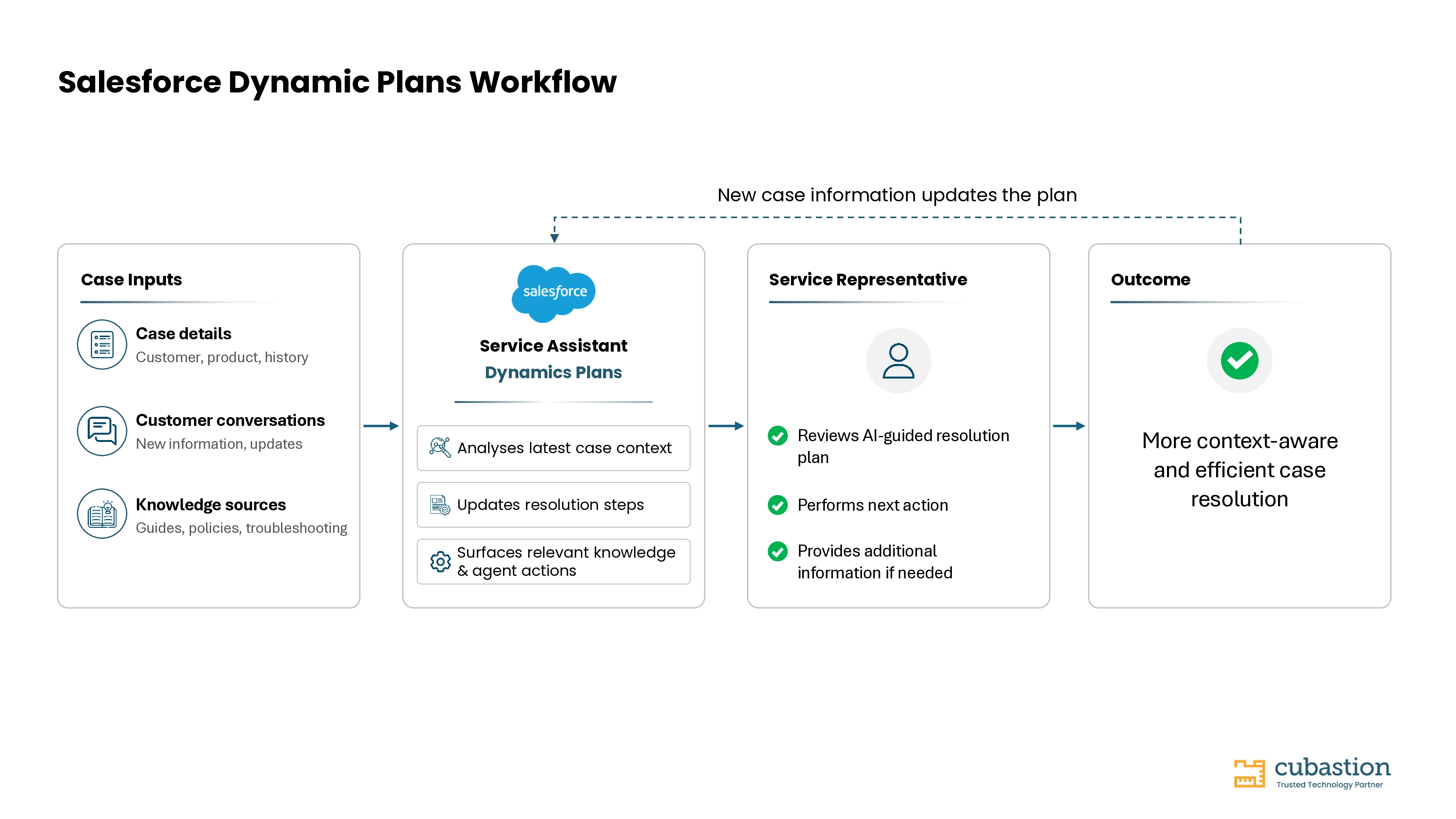
Salesforce Service Assistant uses Dynamic Plans to provide step-by-step resolution guidance based on current case information and configured knowledge sources.
Unlike static guidance plans, Dynamic Plans can update their steps as new information arrives. They can also surface relevant knowledge and available Agentforce actions within the service workflow.
This gives service representatives three practical advantages:
- Context-aware guidance: Resolution steps reflect evolving case information.
- Relevant knowledge: Representatives can access applicable knowledge articles and case context while investigating an issue.
- Action-oriented support: Available Agentforce actions can be surfaced within relevant steps for representatives to review and execute.
The capability does not guarantee that every case will be resolved automatically. Results depend on the quality of available data, configured instructions, relevant actions, and the complexity of the issue.

Automotive After-Sales: A Practical Example
Consider a dealer reporting a recurring vehicle fault.
Initially, the representative reviews the complaint and vehicle details. The dealer then provides a diagnostic trouble code and confirms that an earlier repair did not resolve the issue.
This new information may change the next investigation step. A Dynamic Plan can update its guidance using the latest case context, helping the representative identify relevant troubleshooting information or determine whether specialist support is needed.
The representative still follows applicable warranty rules, safety procedures, and approval requirements.
For automotive manufacturers, this illustrates how AI-guided resolution could help make service processes more responsive without removing essential operational controls.
What Enterprises Need Before Implementing Dynamic Plans
Enabling a new Salesforce AI capability is only one part of the implementation.
- Reliable knowledge and case data: Outdated documentation or incomplete records can lead to irrelevant guidance. Enterprises need accurate, well-structured knowledge sources.
- Connected business systems: Service representatives may require information from warranty, ERP, inventory, or technical systems. Secure integrations must make the necessary information available where required.
- Business rules and oversight: Sensitive decisions and high-impact actions may require validation or human approval. These boundaries should be defined before deployment.
- Testing and measurement: Teams should test changing case details, incomplete information, unavailable integrations, and escalation scenarios. Performance should be measured against baseline resolution time, repeat contacts, resolution quality, and representative productivity.

How Cubastion Can Help
Cubastion can help enterprises assess where adaptive AI-guided workflows fit into their existing CRM and service operations.
This includes identifying suitable use cases, evaluating data and integration readiness, designing controlled workflows, and validating outcomes through focused pilots.
The goal is to introduce AI where it addresses a measurable operational problem, not simply add another feature to the CRM environment.
Conclusion
Salesforce Dynamic Plans offer a way to make AI-guided service resolution more responsive as customer issues evolve. But the value depends on reliable information, well-designed integrations, clear business rules, and continuous measurement.
For enterprises, successful adoption means connecting CRM capabilities with real operational processes to improve service consistency and business outcomes.
Connect with a Cubastion consultant today to explore how AI-enabled CRM workflows can improve your service operations.