


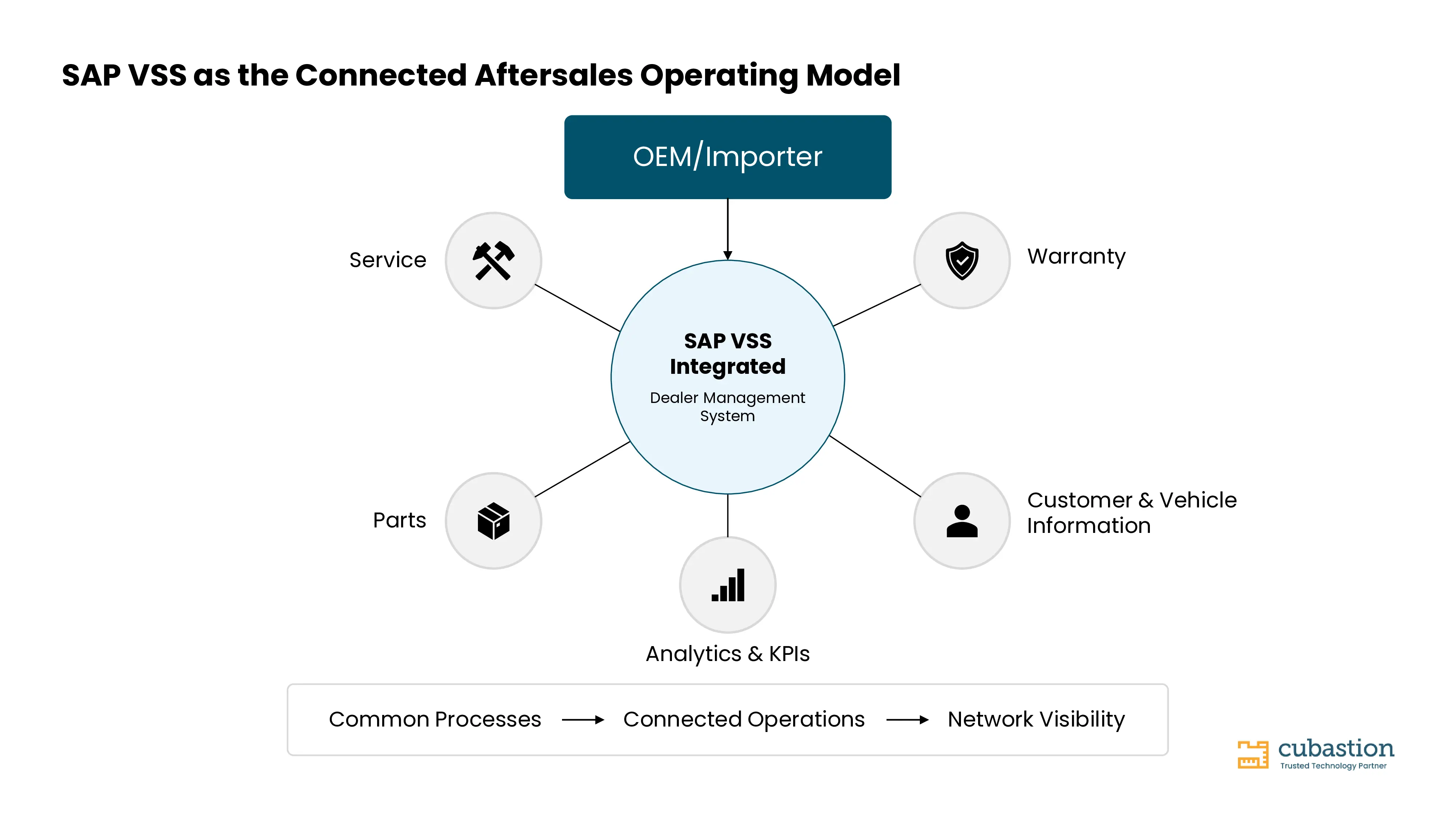

For automotive OEMs, strong aftersales performance depends not only on individual dealerships but also on how consistently processes, information, and service standards are executed across the network.
As dealer networks expand, maintaining this consistency becomes increasingly challenging. Dealers manage service, parts, warranty, and customer interactions across different locations while still needing to align with OEM processes.
SAP Vehicle Sales & Service (VSS) is positioned by SAP as an integrated Dealer Management System on SAP S/4HANA, supporting vehicle sales, aftersales, service, parts, warranty, analytics, and dealer operations.
The opportunity is therefore to move beyond digitizing individual dealer activities and establish a more consistent operating model across the network.
Why Dealer Network Consistency Matters
Automotive aftersales connects multiple functions, including:
- Vehicle service and repairs
- Workshop scheduling
- Spare parts
- Warranty processing
- Customer and vehicle information
- Financial processes
SAP documents dealer processes covering vehicle sales, service, spare parts, and warranty, along with dealer-facing processes connected to backend systems.
Because these processes are interconnected, variation at the dealer level can affect service execution, information flow, and customer experience.
SAP VSS supports an integrated approach to vehicle sales and service, with analytics and KPIs designed to support performance management across the distribution channel.
Why Standardizing Aftersales Across Dealers Is Difficult

Dealer networks operate at scale, but scale can introduce operational variation.
Key challenges include:
- Process Variation: Dealers may follow different approaches to service, warranty, and parts activities.
- Fragmented Information: Customer, vehicle, service, and transaction data may be spread across systems.
- Limited Network Visibility: OEMs may lack consistent visibility into dealer performance.
- Complex OEM–Dealer Coordination: Warranty, parts, and other processes require coordination between dealers and backend functions.
- Local Market Requirements: Organizations must maintain common processes while accommodating country- and location-specific requirements.
The objective is therefore not to make every dealership identical, but to establish consistent core processes, information, and governance while allowing appropriate local flexibility.
Standardizing the Dealer Network Around Integrated Processes

SAP VSS provides a foundation for standardization by bringing related sales and service processes into an integrated dealer management environment.
1. Standardize Core Processes
Establish common workflows for vehicle service, warranty, parts, and related dealer activities. SAP documents service processes covering repairs, inspections, service requests, technician assignments, and workshop activities.
2. Connect Dealer and OEM Operations
Connect dealer activities with OEM and importer functions through integrated processes, including warranty and spare parts operations.
3. Create Network-Level Visibility
Use analytics and KPIs to monitor sales and aftersales performance across the distribution channel.
4. Govern the Standard, Allow Local Flexibility
Standardize the processes that require consistency while retaining flexibility for market- or location-specific requirements.
A Representative Dealer Network Scenario
Consider an automotive OEM operating dealerships across multiple regions.
Each dealership manages servicing, warranty, spare parts, and customer interactions, but the OEM wants greater consistency in how these processes are executed and monitored.
Using SAP VSS, the organization can establish integrated processes across the dealer network:
Customer & Vehicle → Service → Warranty / Parts → Billing → Performance Monitoring
Service teams can work with customer and vehicle information while managing workshop activities. Warranty and parts processes can connect with the wider dealer operation, while analytics and KPIs provide management with visibility into sales and aftersales performance.
The result is a common process foundation that can be governed across the network while still supporting local operational requirements.
From Dealer-Level Operations to Network-Level Control
Dealer standardization creates value when it improves both local execution and network visibility.
An integrated operating model can help organizations:
- Establish common aftersales processes
- Improve OEM–dealer coordination
- Provide consistent access to operational information
- Monitor sales and aftersales KPIs
- Improve process transparency
SAP positions VSS as supporting process transparency, retail efficiency, and performance management across the distribution channel.
This moves the DMS beyond a dealer transaction system toward a broader network operating model.
What Standardized Aftersales Operations Can Enable

1. Operational Outcomes
- Consistent core service processes
- Better coordination across dealer functions
- Greater operational visibility
- Improved process transparency
2. Dealer Outcomes
- Integrated operational processes
- Clearer OEM and importer interactions
- More standardized workflows
- Better business performance visibility
3. OEM Outcomes
- Network-level performance visibility
- Stronger process governance
- Improved distribution-channel coordination
- A scalable foundation for evolving service models
These outcomes align with SAP's positioning of VSS as a scalable solution designed to support efficiency, transparency, and evolving automotive business models.
Standardization Is About Consistency, Not Uniformity
Dealer network standardization does not mean eliminating every local variation.
The objective is to establish consistency where it matters most:
Common Processes → Connected Information → Network Visibility → Controlled Local Flexibility
SAP VSS provides an integrated foundation for vehicle sales and service, supported by analytics, dealer-facing capabilities, and integration with the broader SAP environment.
For automotive organizations, this creates a path from independently managed dealer operations toward a connected network with common processes, measurable performance, and stronger OEM–dealer collaboration.
Building a More Consistent Dealer Network
Standardizing aftersales operations requires more than implementing a Dealer Management System. It requires alignment across processes, information, integration, governance, and business objectives.
At Cubastion, we help enterprises approach application and service transformation from both business-process and technology perspectives, enabling connected and scalable operating environments.