



Upgrading a standard, out-of-the-box Siebel installation is complex enough. Upgrading one that has been customized over years or decades of telecom-specific development is an entirely different challenge. Every time a platform version changes, every layer of customization sitting on top of it must survive that change too.
In the telecom environments, Siebel CRM is rarely close to its original form. Operators have extended it to support complex order journeys, service configurations, and customer interactions that the base product was never designed to handle alone. The new updates have rebuilt UI layers and business logic with integrations now directly wired to the platform’s internals.
Orchestrating a Siebel rebuild, especially in telecom companies is not easy as it sounds. With the complex necessity of having the systems in use almost 24/7, a downtime of even one hour can cost the enterprise a lot.
So, our point comes to how we can minimize the damage and successfully update the system?

Why Customization Debt Hinders your Telecom enterprise?
Customization debt is a collection of decisions made over time that seem reasonable in isolation but collectively create a fragile dependency over time one a specific platform state. Change of configuration, logic, UI modifications and data structure extensions means they all interact in ways that are rarely documented comprehensively.
Every version upgrade means the platform state will go against all those individual decisions. Some of the customizations might work in the new system but the others have no guarantee, signalling to potential failures in siles. The challenge is knowing which is before go-live, not after.
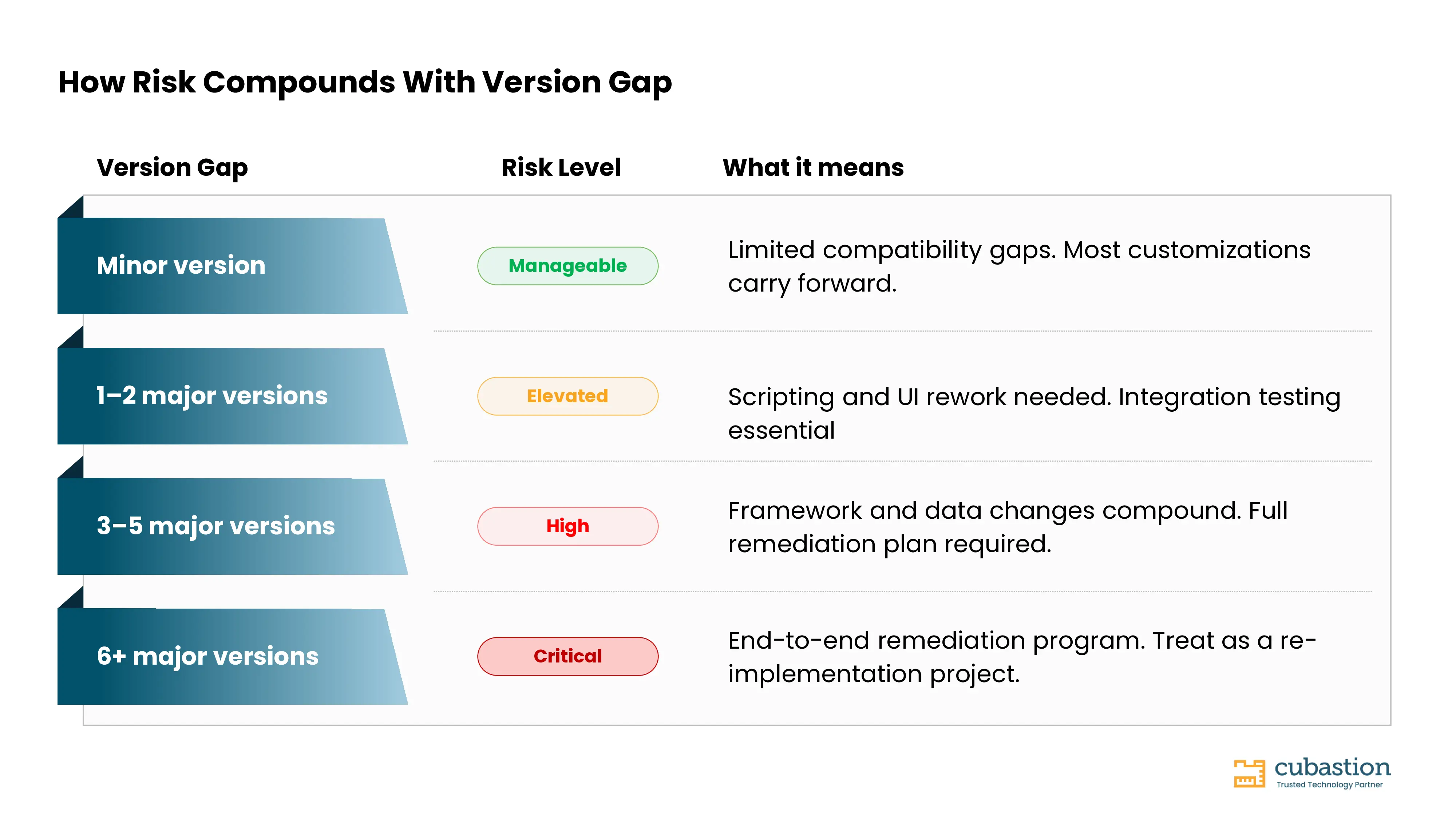
The degree of risk scales with the version gap. A modest version increment carries manageable compatibility concerns. A significant jump that has multiple major releases will compound the risk at every layer.

Risk Area in Repository and Configuration Alignment
One of the major risks in Seibel deployments are when design repository and product environment diverge. Both are supposed to be mirrors of each other. But hotfixes applied under pressure, configuration changes made directly in production, runtime adjustments never backported can lead to major differences.
That’s why it’s important to recognise and reconcile this gap. Database-level objects such as indexes, triggers, and structural definitions also need assessment to confirm alignment with what the upgraded platform will expect.
Risk Area in Data Compatibility
Complex and high-volume data like order configurations, service descriptions, and customer interaction histories is usually stored by Telecom Siebel deployments. This means with each update, the way the data is stored and retrieved can expose structural limitations in older customizations.
The outputs of structural compatibility scanning are only useful if they are acted on. A report that identifies potential incompatibilities but is not reviewed and remediated before going-live provides false assurance rather than genuine risk reduction.
Risk Area in Business logic and Scripting Compatibility
Siebel's approach to client-side scripting has evolved across major versions. Logic written in older scripting languages is embedded in application components, user interface elements, or business component behaviour. The older version may not run correctly, or at all, in a newer version of the platform.
The risk is not simply that the logic fails to execute. It is that the failure may not be immediately apparent.
Risk Area in User Interface Customization and OpenUI transition

The most recent major Siebel releases have moved toward Oracle JET as the underlying UI technology which is a more fundamental shift than a syntax update. Oracle JET brings genuine advantages: a modern rendering model, better performance, and more consistent cross-device behaviour. But for teams with extensive OpenUI customizations, the transition requires a deliberate migration effort.
Moving to a new Siebel version means a potential rearchitecting of how the interface is built, tested and maintained.
Risk Area in Process or workflow communities
Telecom often has complex workflows. The order journeys contain on route orders, downstream actions and state transitions. Internal mappings, routing logic, and process configurations valid in one version may need to be verified and updated to behave correctly in another.
If they are not validated and updated before go-live, workflow failures can halt all order progression. Especially because its hard to catch the errors in SIT environments due to their dependency on the full downstream integration chain. A chain that is rarely replicated completely in lower environments.
Post- Upgrade Environment Stability
Even when pre-upgrade preparation has been thorough, the period immediately after go-live carries its own category of risk. Certain platform-level configurations like server authentication settings, messaging system connections, and trigger definitions may need to be reapplied or recreated as part of the upgrade process itself.
Messaging infrastructure between interconnected systems warrants specific attention post-upgrade. Where the upgrade changes how Siebel communicates with external systems, the configuration and capacity of the messaging layer needs to be verified independently, not assumed to carry forward from the previous state.
What a Well-prepared Upgrade Looks Like

Key preparation priorities include these important milestones:
1. Reconcile all configuration state before anything else. The gap between what is running in production and what exists in the design repository must be closed before upgrade activities begin. Any divergence carried in becomes an uncontrolled variable.
2. Treat compatibility scanning outputs as a remediation input, not a report. Structural assessments identify risk. They only reduce it if findings are reviewed, prioritised, and addressed before go-live.
3. Map and assess all scripted business logic for compatibility. Identify every component containing logic that may be affected by scripting language changes. Volume is frequently underestimated, build in realistic time.
4. Audit UI customizations against the target version's framework. Do not assume UI customizations will carry forward. Assess each against the target version's rendering model, particularly for agent-facing order capture screens.
5. Validate workflow and process configurations explicitly. Include end-to-end order journey validation covering downstream integration handoffs, the failure mode that functional testing most consistently misses.
Build post-upgrade environment steps into the go-live runbook explicitly. Every known post-upgrade configuration step should be sequenced, assigned, and verified in rehearsal. Treating them as implicit is how avoidable instability gets introduced at go-live.
How The Broader Vision looks In Siebel CRM Upgrade
When companies customize their Siebel upgrade, it’s not just on random whim but an important necessity. It’s important to stay on top of the technologies since the more you delay, the bigger the chances are of your enterprise being left behind.
It’s important to evaluate your system and prepare a well mapped architecture to execute. We have thoroughly mentioned how it can be achieved successfully throughout this article because we have done it multiple times with a high success rate. At Cubastion, our utmost priority is to deliver technical excellence in short amount of downtime. Because of our partnerships with multiple telecom services over the decade, we can confidently provide a solution to the challenges a Siebel upgrade poses.
The customizations that make Siebel work for telecom order journeys are also the customizations that make upgrading it hard. Acknowledging that tension early, and resourcing the preparation, accordingly, is the decision that determines how the upgrade goes.