


Most status meetings are data queries in disguise. See how a governed semantic layer lifts AI accuracy from 20% to 95% and replaces meetings with prompts.
The most absurd meeting of 2026
Here is a scene playing out in thousands of companies right now. Eight senior people join the Monday status call. Three of them didn’t actually come, they sent their AI notetakers instead. The bots transcribe faithfully while humans take turns answering one question: "Where are we on X?"
Thirty percent of employees now admit they skip meetings entirely and let an AI capture what happened (Software Finder). Stop and appreciate the absurdity: we have taught AI to attend the meeting. We have not made the meeting unnecessary.
Because that meeting was never really a meeting. It is a query - executed manually, weekly, at the cost of eight salaries an hour. In 2026, it should be a prompt: "How is the pipeline versus target, and which three deals moved?" Four seconds, instant answer. Every company now owns tools that can do this. Almost none lets them.
Why? The number that explains it: 67% of organizations say they do not fully trust their own data for decision-making, up from 55% a year earlier (Precisely / Drexel, 2025). Most status meetings are not communication. They are reconciliation, humans negotiating which number is real, because the CRM says one thing, finance says another, and no system gets the benefit of the doubt. Only 11% of meetings are rated highly productive (Atlassian); 71% of senior executives call them unproductive (HBR). The meeting survives because the data cannot be trusted to speak for itself.

The reconciliation tax, 2026 edition
Three meetings, and the AI waiting to replace them
The Monday pipeline call. A sales leader asks ten account managers for their forecasts, ninety minutes rebuilding, verbally, a report the CRM was bought to produce. One client of ours ran this across four regions: six hours of leadership time weekly, reconciling three versions of the same pipeline. The AI-era version of this meeting is a morning brief: "Forecast moved ¥40M since Friday; these two deals slipped; this one needs an executive call." The technology for that brief exists today. What didn’t exist was one pipeline definition the system could stand behind. After that was fixed, one definition enforced, refreshed nightly, the call fell from ninety minutes to thirty, and became about which deals need help. The AI brief is now the obvious next step, because the data finally deserves it.
The daily operations huddle. Forty minutes reading yesterday’s numbers aloud - output, open work orders, pending parts, because the numbers live in systems nobody opens. A service organization we worked with replaced the read-out with a live wallboard; the huddle dropped to fifteen minutes. The AI version goes further: nobody reads anything aloud, because anomalies announce themselves - "line 2 will miss today’s plan; parts for these four jobs are at risk." Exception alerts instead of recitals.
The weekly project status review. The PMO chases updates by email, pastes them into a deck, and presents week-old numbers to a steering committee that questions them. People already spend around four hours a week preparing status updates. An AI status agent can draft that entire review from the work-tracking system in seconds, if the tracking system reflects reality. If it doesn’t, the AI simply automates the fiction.
The 20% problem
Now the uncomfortable part, and the reason this is not an article about buying a copilot.
When benchmark testers pointed a large language model at raw enterprise data and asked it ordinary business questions, accuracy came in below 20%. Same model, same data, but with a governed semantic layer on top, where every metric has one written definition - accuracy exceeded 95% (AtScale).
Read that again. The difference between an AI analyst that is wrong four times out of five and one that is right nineteen times out of twenty is not the model. It is whether your metrics are defined, owned and consistent, exactly the discipline your status meetings have been quietly compensating for all these years.
This is the new stake on the table. An untrusted dashboard fails politely: people ignore it and call a meeting. An untrusted AI fails confidently - fluent, plausible, wrong - what the industry now calls articulate hallucination. Gartner places conversational and agentic analytics at the peak of inflated expectations; the crash, where it comes, will not be caused by the models. It will be caused by pointing them at data nobody governed. Meanwhile only 12% of organizations say their data quality is sufficient for AI at all.

The 20% problem — the stat that decides your AI strategy
The prompt test
Run this on every recurring meeting in your calendar. Three questions.
One: is this meeting reading data or deciding on data? If more than half the time is spent establishing what happened, it is a query wearing a calendar invite.
Two: if an AI answered this meeting’s core question right now, from your systems as they are, would anyone act on the answer? Be honest. If the answer is no, you do not have an AI-adoption problem, you have a data-trust problem, and no amount of licensing fixes it.
Three: what would have to be true for that answer to be trusted? Write it down honestly and you have just produced your real data-quality backlog: the two systems that disagree, the field nobody fills in, the metric with three definitions.
That third answer is the valuable one. It converts a calendar complaint into an engineering plan.
Trust first - then ask the data
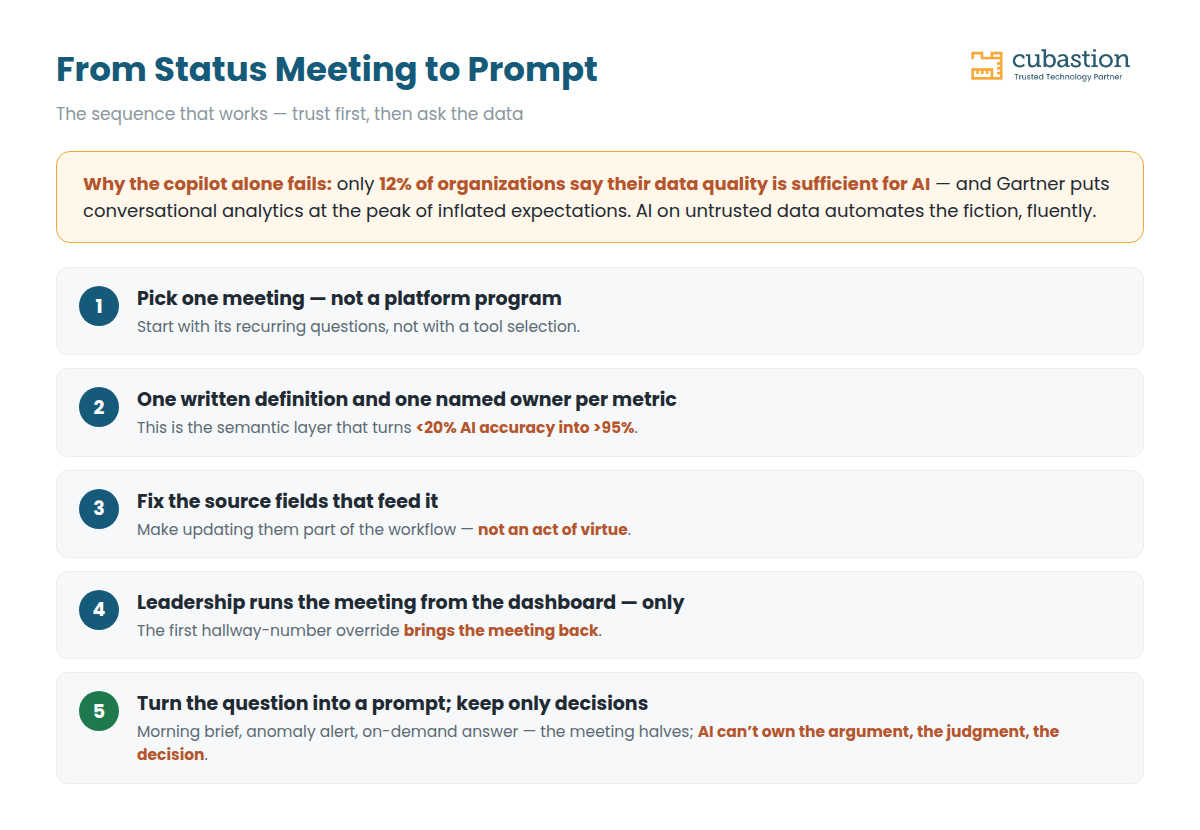
The sequence matters, and it starts smaller than a platform program. Pick one meeting. Give each of its recurring metrics a single written definition and a single named owner - this is precisely the "semantic layer" that turns 20% accuracy into 95%. Fix the two or three source fields that feed it, and make updating them part of the workflow rather than an act of virtue. Have leadership visibly run the meeting from the governed numbers, and only from them - the first hallway-number override brings the old meeting back. Then, and only then, turn the meeting’s core question into a prompt: a morning brief, an anomaly alert, an on-demand answer. Cut the meeting to half its length and spend what remains on the only agenda AI cannot own: exceptions, trade-offs and decisions.
Repeat with the next meeting.

From status meeting to prompt — the sequence that works
Time given back
Price your reconciliation habit: Shopify calculated a routine 30-minute meeting at $700 to $1,600, then deleted 12,000 recurring meetings and reclaimed a projected 322,000 hours. That was before AI could answer the questions those meetings existed to ask.
The prize in 2026 is bigger than shorter meetings. Clean, owned, defined data now pays twice: it kills the reconciliation meeting, and it is the entry ticket to AI that actually works. The organizations that get this run on a different clock - "where are we on X?" is a four-second answer, and the meetings that remain are the ones only humans can have. The argument. The judgment call. The decision.
AI can attend your meetings now. The real move is needing fewer of them.