



Executive Story
When McKinsey wanted to know what AI actually did to productivity, it did something unusual: it put more than 40 of its own software developers in a controlled lab and measured them. The results were striking, and instructive. On routine work, documenting code, writing straightforward functions, developers moved up to twice as fast. On complex, unfamiliar tasks, the advantage nearly vanished, shrinking to less than 10 percent. Same tool, same developers, wildly different returns depending only on the task. That single finding is the most important and least understood lesson in enterprise AI today. AI value is not evenly distributed. It concentrates. The enterprises that win are not the ones that deploy AI everywhere, but the ones that know exactly where it pays, and aim their investment accordingly.
Executive Summary
The previous article in this series established the paradox: near-universal AI adoption, rarely-realized value. This article answers the question it raised, where does AI actually deliver return today? The evidence points to a clear and narrow answer. McKinsey estimates generative AI could add 2.6 to 4.4 trillion dollars in annual value, and roughly 75 percent of it concentrates in just four business functions. Within those functions, value clusters further, in repetitive, well-scoped, data-rich work, and thins out in complex, judgment-heavy tasks. Capturing return is therefore less a question of capability than of cartography: mapping where value is real before spending against it, then prioritizing ruthlessly.

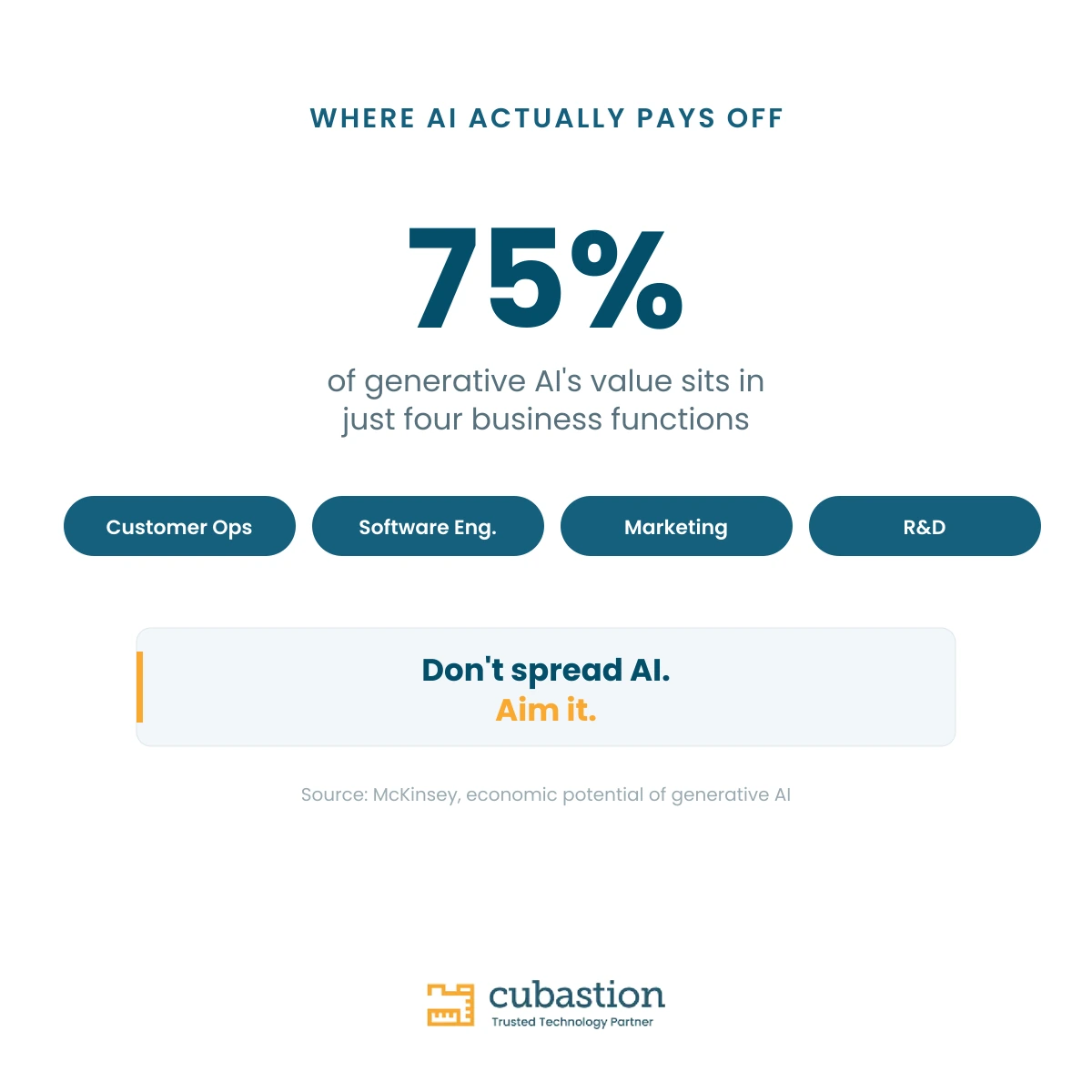
Figure 1. The four domains where roughly 75% of generative AI's value concentrates.
Industry Context
For two years, enterprises optimized for breadth, running as many AI experiments as possible to learn the technology. That phase is ending. Boards that once asked whether to use AI now ask where to invest, and the honest answer requires evidence rather than enthusiasm. The shift is from breadth to depth: fewer, better-chosen use cases, resourced to reach production. It is also a shift in posture, from technology-led experimentation to value-led prioritization. This is harder than it sounds, because the most visible opportunities are rarely the most valuable, and the most valuable are rarely the easiest. A value map imposes the discipline the moment demands, turning a scattered portfolio of pilots into a sequenced plan anchored to measurable outcomes.
The Value Map: Four Domains Where AI Pays Off
McKinsey's analysis of 63 use cases across 16 business functions found that about three-quarters of generative AI's potential value falls in four areas, and that the estimate roughly doubles when the technology is embedded into software already used for other work.
Customer operations is the largest near-term opportunity. Generative AI resolves routine inquiries end to end, drafts responses for human agents, and summarizes interactions, reducing human-serviced contacts by up to 50 percent in industries such as banking, telecommunications, and utilities.
Software engineering comes next, and the lab study is precise about where the gains live: roughly 45 to 50 percent time savings on documentation, 35 to 45 percent on writing new code, and 20 to 30 percent on refactoring, but under 10 percent on complex, unfamiliar problems. The value is real, and it is specific.
Marketing and sales benefits from content generation, personalized outreach, and campaign variants produced at scale, compressing cycles that once took days into hours. And in research and development, AI synthesizes literature, generates design candidates, and shortens the front end of discovery.
The value concentrates by industry as well as by function. McKinsey estimates banking alone could capture 200 to 340 billion dollars annually, and expects the largest gains as a share of revenue in banking, retail and consumer goods, and pharmaceuticals. The pattern is consistent: the money is where the work is language-heavy, high in volume, and measurable.
The Pattern Behind High-Value Use Cases
Look closely and the four domains share a signature. High-value AI work tends to be repetitive and high in volume, so small per-task gains compound across thousands of transactions; rich in language or data, which is what these models handle best; measurable, so return can be proven; and tolerant of a human check, so occasional error is caught before it matters. The economics follow directly: two minutes saved on a task performed ten thousand times a month is a larger prize than a dramatic one-off improvement no one repeats.
The inverse is equally clear. AI underdelivers on tasks that are complex, sparse in data, heavy in judgment, or intolerant of error. A high-volume claims triage or a first-line service inquiry fits the signature; a one-off strategic negotiation or a novel architecture decision does not, which is exactly why the developers in the lab watched their advantage collapse on unfamiliar, intricate problems. Recognizing this signature is what separates a use case that scales from one that stalls. It is also why "adopt AI" is the wrong instruction. The right one is "find the work that matches the signature, and start there."
A Framework for Prioritizing: Value versus Feasibility
Not every high-value use case is ready to build, and not every easy build is worth doing. We prioritize candidates on two axes: business value, and feasibility, the latter combining data readiness, workflow fit, and risk. Score each candidate on a simple scale, plot the result, and let position on the map dictate priority rather than the loudest voice in the room.

Figure 2. Prioritizing AI use cases by business value and feasibility.
Four quadrants result. Quick wins, high in both value and feasibility, fund the program and build organizational momentum, so start there and bank the credibility. Big bets, high in value but lower in feasibility, justify sustained investment in the data and governance that make them buildable, and should be sequenced deliberately rather than rushed. Incremental plays, easy but low in value, are worth doing only when they are genuinely cheap and non-distracting. And the rest can wait. Most enterprises invert this order, chasing the visible or the fashionable regardless of value or readiness, which is how portfolios of stranded pilots accumulate. A disciplined value map replaces enthusiasm with sequence.
Where Value Is Overestimated
Three errors distort the map. The first is confusing visibility with value: MIT found that most generative-AI budgets flow to sales and marketing, while the highest realized returns sat in back-office and operational automation. The second is assuming uniform gains, the belief that if AI helps somewhere it helps everywhere, which the complexity cliff in software engineering flatly disproves. The third is mistaking a compelling demo for deployed value, a pilot that dazzles in a controlled setting but never survives contact with a real workflow.

Figure 3. Where AI budgets flow versus where returns concentrate.
Each error sends money toward capability rather than return. The correction is the same in every case: follow the value, not the visibility. Enterprises that make it often find their real opportunity was hiding in plain sight, in the unglamorous, high-volume operations that never made the launch announcement.
The Sector Lens
The map shifts by industry. In banking and financial services, value concentrates in service automation, fraud, and risk, where McKinsey sizes the prize in the hundreds of billions. In automotive, it lies in software engineering for connected and software-defined vehicles, and in aftersales service and diagnostics. In the public sector, the return is in citizen service and case processing, high-volume, rules-based work that fits the signature exactly. In retail and consumer goods, it is personalization, merchandising, and service at scale; in telecommunications and utilities, it is contact deflection and network operations. The functions rhyme even as the industries differ, which is why a value map built once can be adapted, not rebuilt, across a portfolio.
From Map to Return
A value map only creates value when it is executed, and execution is measured at the use-case level, not in the abstract. The right metrics are operational: cost-to-serve, cycle time, resolution rate, conversion, deflection. Aggregate "AI ROI" tells a board little; a 40 percent fall in cost-to-serve in a named workflow, measured against a pre-deployment baseline, tells it everything. Set that baseline before launch, instrument the workflow, and review leading indicators alongside the business outcome. Done well, this reframes the entire conversation: not one aggregate technology bet the board must take on faith, but a portfolio of individually measured workflows, each with a return the finance function can audit. Turning a prioritized map into realized return, however, depends on the operating model around it, the data, workflow, governance, and ownership that convert a promising use case into a producing one. That is the subject of the next article.
Future Outlook and Conclusion
Agentic AI will widen the map, extending from assistance into autonomous execution in exactly the well-scoped, high-volume operational workflows where value already concentrates. But wider does not mean everywhere, and the discipline does not change: identify the work that matches the signature, prioritize by value and feasibility, and measure return where it lands. The enterprises pulling ahead are not using more AI than their peers. They are aiming it better. At Cubastion, we help enterprise leaders build that value map and turn it into measured return, one high-value workflow at a time. Knowing where AI pays is the first move. Building the operating model that captures it is the next.