



Every competent enterprise runs on a dense web of interconnected applications like CRM, ERP, SCM, Data and BI. These apps form a backbone of the organization to maximize the customer engagement, operational efficiency and data driven decision in business if used correctly. This is when a CIO should intervene and become a strategic architect to provide successful pathway for their business to thrive.
In recent years, AI has started to become a staple use for most users. The post-covid era has seen an exponential growth in modern AI technology. So much so that refusing to adopt AI technology might lead to companies falling behind others or missing out on an opportunity to boost their growth.
Yet when conversations turn to AI transformation, there’s an uneasy truth most CIOs know: “Not every application is ready for intelligence”. For some, stability is more important than intelligence. Some require clarity regarding process optimization prior to automation. And some just have to go.
AI, in this context, isn’t a silver bullet. It’s a multiplier - it amplifies what already works, or exposes what doesn’t.
So, what is the best way to navigate through this new technology? Investing With Strategic Intention. As much as we want to modernize everything quickly with the next available technology, it’s hard to do so in a realistic world. Therefore, evaluation rather than automation becomes the first step in the right direction.
[KH1] [KH2] How To Evaluate the Application’s Direction?
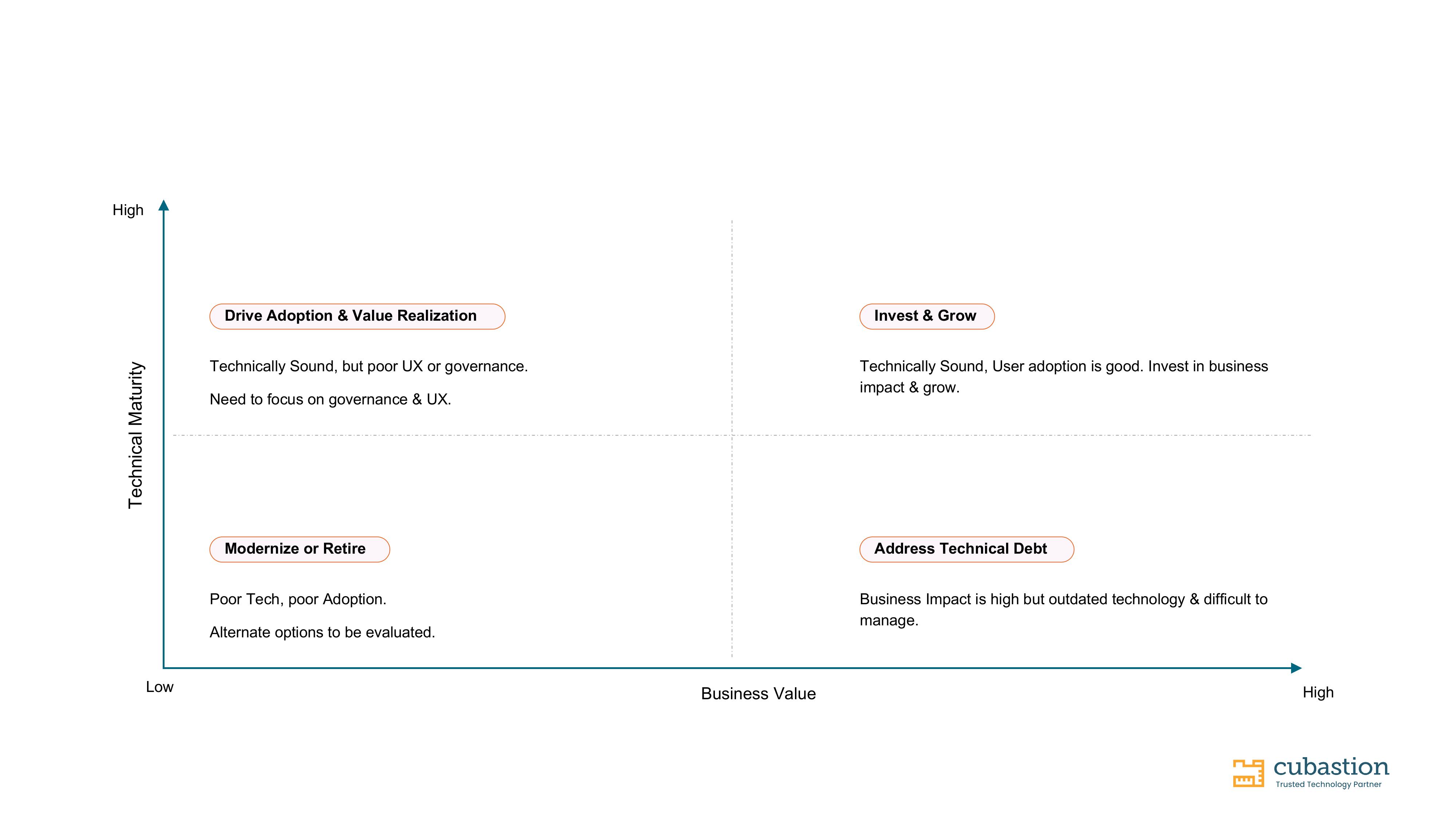
The most reliable way to evaluate an application's future potential is to assess two dimensions: ‘its technical and functional maturity’ and ‘the level of real user adoption and strategic alignment’. “A system might be used frequently but still perform poorly if its technology is outdated. On the other hand, even a highly advanced system can end up underused when it doesn’t align with the way people work.”

Figure 1.0
These Two factors matter the most:
1. Technical Capability: How sustainable, integrated, and upgradable is the system?
2. User & Business Adoption: How much real business value or process alignment does it deliver today?
These factors will also help us draw a clearer line between which product will bring you the best Return on Investment (ROI) for the current and future generation. We have designed a special framework and system through which you can assess and evaluate your current system to know where you stand in today’s generation.
How to Apply the Framework
[MS3] [KH4] There are five pillars through which you can test your system’s maturity and put them into a particular box given above. By going through these testing processes, an investor can get clarity on what could be his best ROI.

Figure 2.0
Rate each pillar objectively (Weak – Moderate – Strong) to assess where they fall in the category given in the figure 1.0.
Normally, the obvious choice is to invest in areas where you see clear growth. But with AI now in the mix, it’s important to look at both AI’s technical and business value. Business value helps improve the user experience and functional processes, while technical value strengthens data synergy, operations, and deliveries. For example, investing in technical debt may not seem exciting, but it can transform your systems into something more scalable, intelligent, and future-ready.
What Role AI can Play in Your Investment Journey
Deciding which investment logic, you will adopt from the options given above with Overlay AI strategically:
§ Use AI for business value (UX and functional capability)
§ Use AI for technical value (data synergy, operation and governance)

Figure 3.0
From the effect of AI all over the world, we can establish that AI works as an excellent multiplier. It enhances the experience tenfold if used properly. However, it could also expose weakness if not used correctly.
Applying the Framework: Automotive Parts & Service Operations
There are different industries where systems face difficult challenges that often need a helping hand to accelerate the efficiency. For example, in the Automotive Organizations, the “parts and services” operations always present a reappearing challenge, i.e. identifying the correct parts from complex catalogues, engineering drawings, vehicle configurations, and service documentation. Although through the years, the structure of catalogues has improved in accessibility, locating the exact component using chassis or model information can still be time-consuming and error-prone especially for frontline users under operational pressure.
These systems are typically mission-critical and widely used, yet they rely heavily on manual search and expert knowledge. As a result, even well-designed platforms can struggle to scale efficiency, leading to delays, incorrect orders, and inconsistent customer experiences. This is where a smart investment like AI comes in to change the scenario.
From a framework perspective, such applications usually fall into the “Invest & Grow” or “Drive Adoption” category:
Where AI Adds Value:
AI, in this context works as an intelligent interaction layer on top of the existing platforms. This means that AI is working as a helping act to the business’s core system.
It also adds additional feature of natural-language queries, context-aware search using vehicle or model information and guided part identification that reduces the manual effort and time for the end users. This new tech addition will allow you to leave the hassle of constantly searching and cross-referencing the ordered parts. Instead, you can directly confirm and move forward with the order because of the information provided to you in mere seconds.
The approach works because the foundations are already strong:
- Data is structured and governed
- Business logic is well-defined
- Usage is high and outcomes are measurable
One of the biggest reason AI is efficient in this environment is because it works as a multiplier – which simplifies the complexity of the network. By adding this intelligence, you are improving the speed, accuracy and user confidence without disrupting the underlying core. And it all happens because of the compatibility and readiness of the original system with the AI tech provided.
The above example perfectly illustrates how a strategic use of AI can lead to greater efficiency. But when AI is used prematurely, it can reveal systematic and governance gaps with no visibility and wayward growth. Therefore, it’s important that people evaluate their application and choose a systematic way forward to maximize their application’s effectiveness.
Conclusion
Today, the highest ROI isn’t achieved by deploying more systems, it comes from investing wisely. When applied thoughtfully, AI can accelerate modernization and unlock new value, but only in systems that are ready for it. The path forward is to enhance where intelligence can create impact and let go of what no longer serves a purpose. With AI now influencing both business potential and technical feasibility, these decisions must be made with greater precision.
Contact Cubastion to evaluate your application
[KH1]Xaxis as technical value - and y axis should be business value
[KH2]Xaxis as technical value - and y axis should be business value
[MS3]heading mismatch -> key pillars of the framework
[KH4]I think its ok to keep heading since we are explaining pillars as part of the section.