



When More Data Still Means Less Visibility
Automotive OEMs generate huge amounts of dealer data, from vehicle sales and service visits to warranty claims, parts transactions and customer interactions.
But having data is not the same as being able to use it.
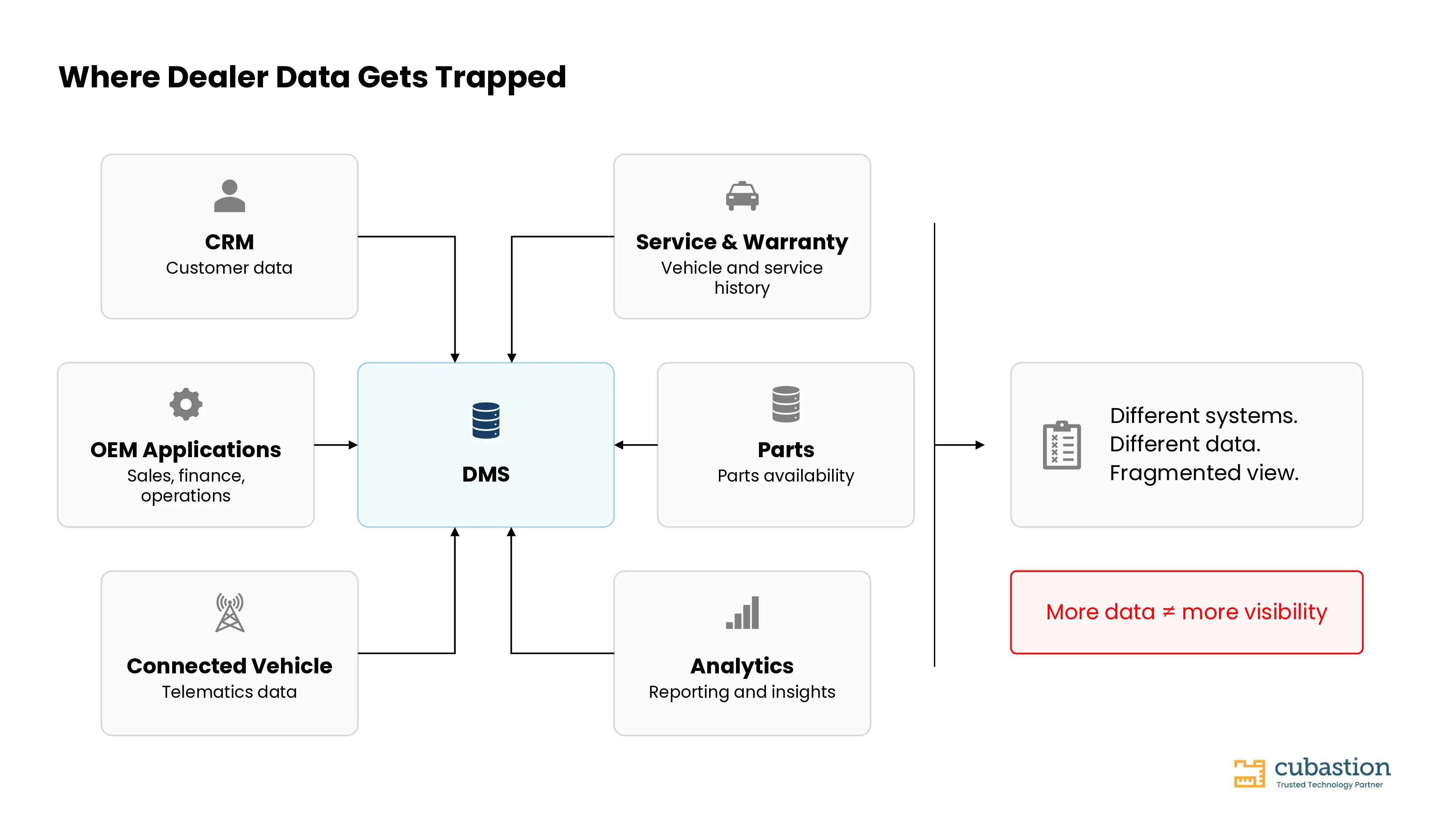
A customer's information may sit in the CRM, vehicle and transaction data in the DMS, warranty information in another platform, and service or connected-vehicle data somewhere else.
The result, OEMs can have plenty of data while still struggling to get a complete view of the customer, vehicle or dealer.
The real challenge is no longer collecting dealer data. It is connecting it.
The Dealer Ecosystem Has Changed
The DMS was traditionally the centre of dealer operations. Today, it is one part of a much larger technology ecosystem.
A typical journey can span:
Lead → Sale → Delivery → Service → Parts → Warranty → Retention
Behind this journey are DMS, CRM, OEM applications, finance platforms, connected-vehicle systems and analytics tools.
Each system may work well independently. The problem begins when the business needs information across them.
Salesforce highlights the importance of connecting customer, vehicle, dealership and service data to create a more complete view of the automotive lifecycle.

Data Exists, But the Context Is Missing
Imagine an OEM wants to understand why a customer has not returned for service.
It may need to bring together:
- Customer and purchase history from CRM/DMS
- Vehicle and service history
- Warranty information
- Dealer interactions
- Parts availability
- Customer engagement data

If these records sit across disconnected systems, answering a simple business question can require significant data gathering and reconciliation.
This creates three common challenges:
1. Fragmented information — the same customer, vehicle or dealer may be represented differently across systems.
2. Limited network visibility — OEM teams see individual transactions but struggle to build a complete network-level picture.
3. Slow decision-making — valuable information may need to be manually consolidated before it can be acted upon.
And as OEMs introduce AI, the problem becomes even more important. An AI system can identify an opportunity, but fragmented data can prevent the organization from acting on it.
Make the DMS Part of a Connected Data Ecosystem
Breaking the DMS data trap does not always mean replacing the existing platform. It means modernizing it without losing the integrations and business processes that already depend on it.
A practical approach is to:
- Assess the existing DMS ecosystem — understand applications, interfaces, customizations and dependencies before making changes.
- Strengthen data and interface reliability — validate how information moves between the DMS and connected systems.
- Address data consistency at source — particularly for core information such as customer, vehicle, dealer and location data.
- Improve how business information is consumed — through structured reporting and automated communication where relevant.
- Validate the entire business flow — so upgrades or changes do not create downstream issues.
This is where DMS modernization becomes more than a technology upgrade. The objective is to make the existing dealer ecosystem more connected, reliable and usable without disrupting the operations built around it.
Use Case: DICV
A Cubastion engagement with Daimler India Commercial Vehicles (DICV) illustrates this challenge in a real dealer environment.
DICV's Dealer Management System supported dealership operations including inventory, sales and finance. The DMS also interacted with systems such as Microsoft Dynamics CRM, SAP PI Middleware and Azure Blob.
The challenge was ensuring reliable data exchange across systems with different formats, protocols and APIs. The environment also involved sensitive dealership information, including customer data, financial records and vehicle inventory.
Cubastion provided 24×7 Application Management Services, including application monitoring, production support, problem management and process automation. Automation was also applied to activities such as master-data management and data cleansing.
The lesson is straightforward, A DMS delivers greater value when it can reliably exchange information with the wider dealer and enterprise ecosystem.
Business Impact
A more connected dealer data environment can enable:
- Better network visibility across sales, service and dealer operations
- Faster access to information with less manual reconciliation
- More consistent customer experiences across touchpoints
- Greater operational efficiency through automation
- Stronger AI readiness through connected business context

From Dealer Data to Dealer Intelligence
The goal is to move from dealer data management to dealer intelligence.
Connected Data → Unified Visibility → Faster Decisions → Smarter Operations → Better Customer Experiences
Instead of treating the DMS, CRM, vehicle platforms and analytics systems as separate technology silos, OEMs can build an ecosystem where information supports the entire customer and vehicle lifecycle.
The Next Evolution of the DMS
The next evolution of the DMS is not simply about moving it to the cloud.
It is about how effectively it connects with everything around it.
A modern DMS can still become a data silo if critical information remains trapped inside individual applications.
For OEMs, the bigger opportunity is to transform the DMS from a system that records dealer transactions into part of an ecosystem that turns dealer data into business intelligence.
Cubastion helps automotive organizations connect fragmented systems, applications and data across dealer and enterprise ecosystems to create better digital experiences and stronger business outcomes.
Connect with a Cubastion consultant today to explore your digital transformation journey.