



Executive Story
Most AI agent business cases die in the same place: a finance review. The demo was impressive. The pilot showed promise. Then someone from finance asked two questions, what is the fully loaded cost, and when does it pay back, and the numbers did not survive contact. It is a scene playing out in enterprises everywhere, and it puts a statistic from the earlier articles in a new light: Gartner expects more than 40 percent of agentic projects to be cancelled by 2027, citing cost and unclear value above all. The agents that fail rarely fail on the demo stage. They fail in the spreadsheet, because their economics were never modelled honestly. Understanding the true economics of autonomy, what it costs, what it earns, and what unit you are buying, is what separates a program the CFO funds from one the CFO shuts down.
Executive Summary
This series has moved from what the agentic shift is, to where agents create value, to how to build them. It closes with the question that ultimately decides their fate: the economics. Agentic AI does not just change the tooling; it changes the cost structure. It shifts enterprise spending from fixed labour to variable compute, replaces the software seat with the agentic labour unit, and moves the meaningful metric from cost per seat to cost per outcome. The returns can be substantial, with McKinsey reporting 5.8 times ROI within fourteen months for well-scoped deployments, but only where the pattern holds, and the full cost is modelled. As one 2026 analysis put it, the loudest conversation about AI is about what it costs; the more important one is about what it earns.

Figure 1. Autonomy changes the unit of work, from paying for time to paying for outcomes.
The New Unit of Work
For decades, enterprises bought software by the seat and labour by the hour. Both are payments for access and time, inputs, on the assumption that a human turns them into output. Agentic AI breaks that assumption by delivering the output directly, and the economics follow. The industry is shifting, in Deloitte's words, away from per-seat licensing toward usage-based, outcome-based, and value-based models, a definitive move from software seats to agentic labour units, where pricing reflects productivity rather than access. The deeper change is structural: cost moves from a fixed line tied to headcount to a variable one tied to consumption. That is a profound shift for a CFO, because a cost that scales with usage behaves nothing like a salary, and it demands a different way to budget, forecast, and control. It also changes the comparison: the right benchmark is no longer the price of the software it replaces, but the fully loaded cost of the work it now does.
Cost per Decision, not per Token
The first mistake enterprises make is watching the wrong number. Every vendor quotes a price per million tokens, and token prices are public and falling. Yet agent budgets still explode, because the cost that matters is not the price of a token but how many tokens an architecture burns to complete one unit of business work: one loan file reviewed, one claim adjudicated, one ticket resolved. That figure, the cost per decision, is where architectures separate. Two systems using the identical model at the identical price can differ by three to ten times per decision, and one 2026 study found variation up to thirtyfold across runs. EY illustrates the trend starkly: a simple 2023 workflow cost about four cents per interaction, while a 2026 orchestrated system with tools, reasoning, and iterative loops can cost around a dollar twenty, roughly thirty times more. The lesson for finance is to treat inference like cloud compute, allocate it by workflow, measure cost per decision, and favour architectures whose cost is predictable.
The Token Bill Is the Cheapest Part
Even cost per decision understates the picture, because the token bill is the cheapest part of an agent. The real total cost of ownership is dominated by everything around the model: integration with enterprise systems, human oversight of the actions the agent takes, ongoing maintenance and evaluation, security, and the handling of incidents and exceptions. Industry analyses consistently find that development itself is only a quarter to a third of a three-year total, so an agent built for eighty thousand dollars can carry a three-year cost closer to a quarter of a million. And accuracy is not free: a ninety percent-accurate agent still needs humans on the other ten percent, which is a permanent line item, not a rounding error. A business case without the fully loaded cost, including exception handling, is not a business case. It is a demo with a price tag.

Figure 2. The token bill is the smallest line. Real cost lives in the stack and the oversight.
When Autonomy Pays
None of this argues against agents; it argues for honesty, because where the economics hold, the returns are real and large. McKinsey's 2026 data shows 5.8 times ROI within fourteen months for well-scoped deployments, with average enterprise returns near 170 to 190 percent and roughly three-quarters of adopters seeing payback within the first year. Customer service and sales automation return fastest, often 200 to 500 percent within six months, while regulated domains take longer because compliance adds cost. The pattern that predicts payback is the same one the earlier articles identified: high-volume, repetitive, review-tolerant work measured against a real baseline. The inverse also holds. Low-volume, high-stakes, ambiguous work, and work where the human is already cheap, usually does not pay back. The use case, not the enthusiasm, determines the return, which is why the ROI question and the use-case question are ultimately the same question, answered in a spreadsheet rather than on a stage.
Three Sources of Return
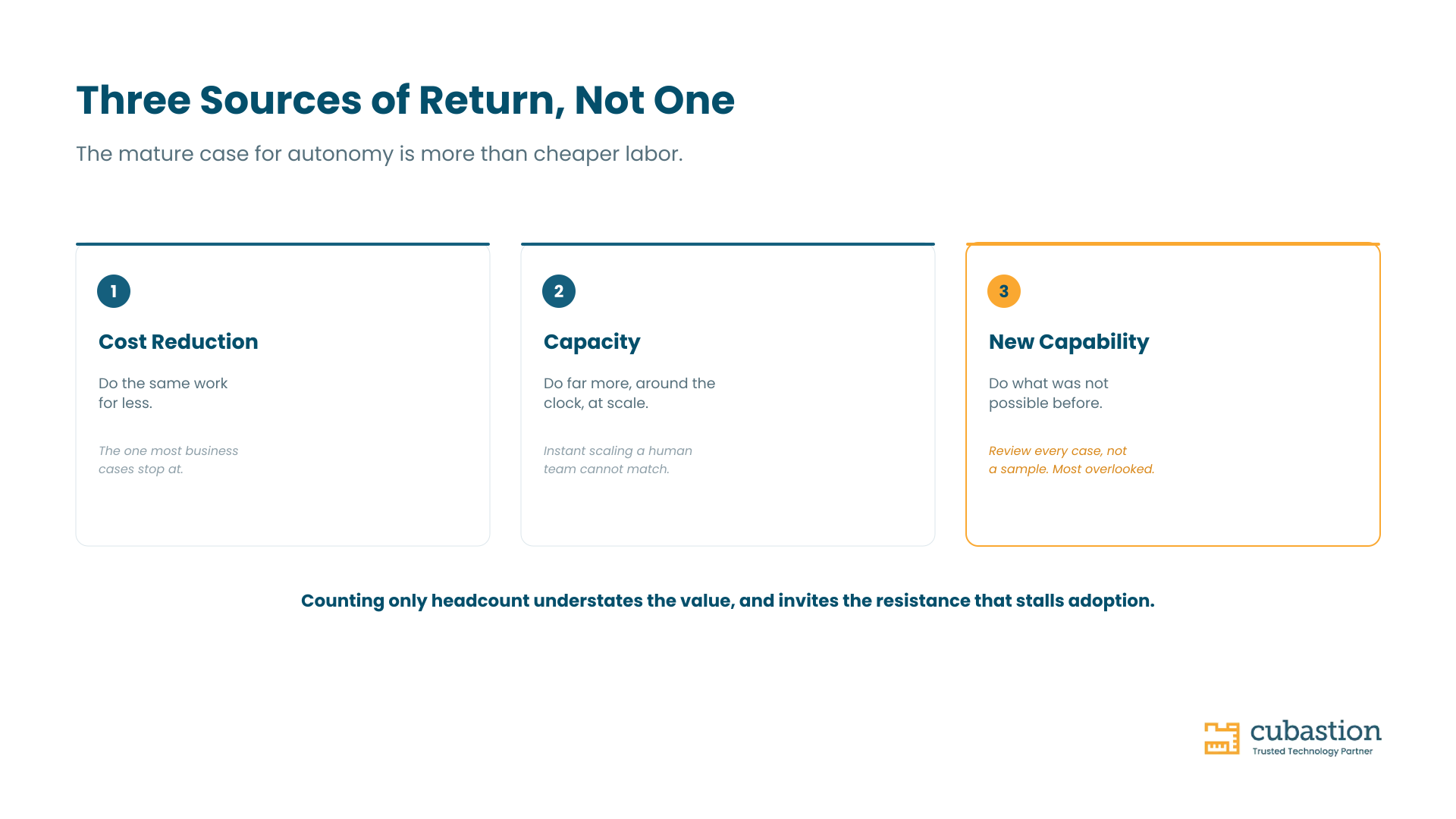
The most common error in an agent business case is to count only one kind of value: reduced headcount. Mature cases count three. The first is cost reduction, doing the same work for less. The second is capacity, doing far more of it, around the clock, and scaling instantly with demand in a way a human team cannot. The third, and the most overlooked, is new capability, doing work that was simply not possible before, such as reviewing every transaction rather than a sample, or personalizing every interaction. Framing autonomy purely as a way to cut labour both understates its value and invites the zero-sum resistance that stalls adoption. The stronger case, and the more accurate one, is that agents remove repetitive load, redeploy people to work only they can do, and unlock capacity and capability that were previously out of reach.

Figure 3. Three sources of return, not one: cost, capacity, and new capability.
Agentic FinOps: Governing the Spend
A variable cost that acts autonomously needs a new financial discipline, one the field is beginning to call agentic FinOps. Because an agent can run up a bill at machine speed, the controls have to be built in, not reviewed after the fact: spend ceilings, call-volume caps, and automatic shutoffs at the level of the agent, the workflow, and the business unit. Without such circuit breakers, the bill becomes visible only after the damage is done. The same discipline applies to the business case, which should carry both capital and operating costs from the outset and be scored against a measured baseline, not a projection. Agents are best treated as growth investments with clear ownership, hard cost controls, and explicit value metrics, so that scaling is a decision grounded in return rather than momentum. Managed this way, a variable cost becomes a controllable one, and autonomy becomes an investment rather than an open-ended liability.
Recommendations
Five priorities for putting the economics of autonomy on a sound footing:
- Measure cost per decision, not per token. Allocate inference by workflow and forecast on a stable per-decision cost.
- Model the fully loaded cost. Include integration, oversight, maintenance, evals, security, and exception handling, not just the token bill.
- Fund by the signature. Back high-volume, repeatable, review-tolerant work with a measured baseline; be skeptical elsewhere.
- Count all three returns. Build the case on cost, capacity, and new capability, not headcount alone.
- Install circuit breakers. Put spend ceilings and kill switches at agent, workflow, and business-unit level before scaling.
Conclusion
The economics of autonomy reward exactly what the rest of this journey has: not the flashiest model or the largest deployment, but the discipline to model cost honestly, aim at the right work, and govern the spend. Across eight articles and two chapters, the through-line has been consistent. Enterprises have poured money into AI and captured too little, because value comes from conversion, not acquisition; that value is concentrated, captured through an operating model and, now, through autonomy that is governed and costed with care. The loudest conversation about AI will keep being what it costs. The enterprises that win will be the ones holding the more important conversation, about what it earns, and building the discipline to make the answer a number their board can trust. At Cubastion, this is the work we do with enterprise leaders end to end, from the first value map to agents that are governed, measured, and worth what they cost. The tools are ready. The advantage now belongs to those disciplined enough to make them pay.