



The 98% paradox
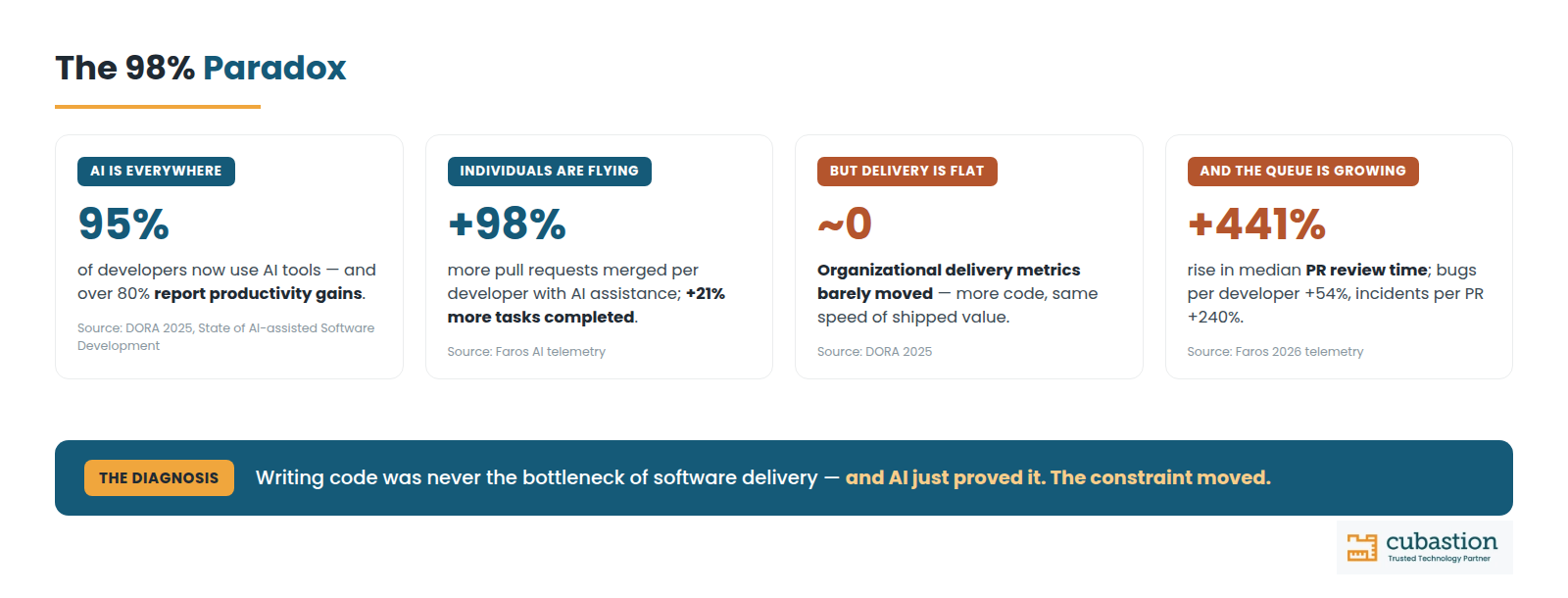
Software teams have never shipped code this fast. As of the latest industry research, 95% of developers use AI tools daily, individual developers complete about 21% more tasks, and pull requests merged per developer have nearly doubled upto 98% with AI assistance.
Now the uncomfortable part: across the same organizations, delivery outcomes have barely moved. DORA’s landmark study of AI-assisted development found that while individual productivity soared, organizational delivery metrics stayed essentially flat. Teams are producing dramatically more code and shipping value at roughly the same speed as before.
That is not a contradiction. It is a diagnosis. Writing code was never the bottleneck of software delivery, and AI just proved it.
Where the time actually went
Every experienced engineering leader has quietly known this. Developers historically spent a minority of their working time actually writing code; the rest went to understanding requirements, waiting for reviews, testing, coordinating, and operating what was already shipped. The typing was never the constraint. The thinking, the checking, and the deciding were.
The theory of constraints predicts exactly what happens when you accelerate a non-bottleneck: work piles up in front of the real one. And the 2026 numbers show the pile-up in high definition. Median pull-request review time has risen 441% as AI-generated code floods the review queue. Bugs per developer are up 54%. Incidents per pull request have jumped over 240%. The middle of the SDLC got dramatically faster; the edges - where humans specify, verify, and operate, are drowning in its output.
AI did not remove the bottleneck of software delivery. It moved it, from writing the code to specifying it before and absorbing it after.

Visual: The 98% paradox
The SDLC, rebalanced
Walk the lifecycle end to end and the new shape becomes clear.
Requirements are now the highest-leverage phase. When code was expensive, a vague requirement wasted a sprint. When code is nearly free, a vague requirement gets implemented - precisely, confidently, and wrong - at machine speed. The old joke has inverted: the spec is no longer paperwork before the real work; increasingly, the spec is the work, because everything downstream of it is accelerating.
Design still belongs to humans. AI multiplies whatever architecture you give it, a clean, modular system lets generated code land safely; a tangled one lets AI generate tangle faster than any team in history. Architecture has become the steering wheel of a much faster car.
Build has gone from constraint to near-commodity. At major technology companies, roughly 25–30% of new code is already AI-generated, and on heavily assisted teams it approaches half. This phase will keep compressing. Planning around it is planning for the past.
Review and test are the new center of gravity. Every line still needs judgment - does it do the right thing, safely, in our context? - and that capacity did not double when generation did. This is where the 441% shows up. The teams coping best fight fire with fire: AI-assisted review and AI-generated tests to absorb volume, with human judgment concentrated where consequence is highest, the same consequence-based thinking that governs AI agents applies to AI code.
Operate inherits everything. More code shipped means more change, and more change means instability unless release discipline scales with it. DORA’s finding is blunt: AI amplifies what you already are. Strong platforms and small batches translate AI speed into delivery; weak ones translate it into incidents.

Visual: Where the bottleneck went
What the fast teams do differently
The organizations converting AI speed into shipped value keep showing the same five disciplines.
They write requirements as if they will be executed, because they will be. Sharp acceptance criteria, explicit constraints, examples: the input quality now sets the ceiling on everything downstream.
They keep batches small. A hundred small pull requests flow through review; ten giant ones dam it. Small-batch discipline was always good practice; at AI volumes it is survival.
They engineer review capacity instead of assuming it. AI pre-review for the mechanical checks, routing by risk, and explicit human ownership of consequential changes - review is treated as a designed system, not a queue that developers get to eventually.
They make tests the quality gate. Generated code arrives with generated tests, and the test suite, not the author’s confidence - decides what merges. Evaluation before trust, exactly as with any AI system.
And they invest in the platform and the data around the lifecycle. DORA’s amplifier capabilities - quality internal platforms, healthy data, clear AI policies, are what turn individual gains into organizational ones. Without them, AI speeds up developers and nothing else.

Visual: Feeding the new bottleneck
Feed the bottleneck, not the hype
The theory of constraints has one more lesson: improving anything other than the bottleneck is an illusion of progress. Buying more code-generation capacity for a team that is drowning in review debt makes the pile bigger, not the delivery faster.
So the question for engineering leaders in 2026 is not "how much code can our teams generate?" - that number is rising on its own. The question is: where is our constraint now, and are we investing there? For most organizations that means sharper specification, engineered review, serious test automation, and platform work - the unglamorous edges of the SDLC that AI just made decisive.
The teams that win the AI era will not be the ones generating the most code. They will be the ones absorbing it.