



When One Customer Journey Becomes Multiple Digital Journeys
Automotive customers no longer interact with an OEM through a single channel. They may discover a vehicle online, contact a dealer, access a customer portal, check vehicle information, schedule maintenance, make payments, or purchase services through different digital platforms.
For the customer, however, these are not separate activities. They are one journey.
The challenge for OEMs is that the technology supporting these interactions is often spread across CRM platforms, customer portals, service applications, finance systems, vehicle platforms and dealer systems.
When these systems work independently, customers experience the gaps between them, even when each individual application works well.
The real digital transformation challenge is therefore not simply adding more digital channels. It is making those channels work together as one customer experience.
The Automotive Customer Journey Has Become a Connected Journey
Modern automotive experiences extend well beyond vehicle purchase.
A customer may move through:
Enquiry → Purchase → Vehicle Ownership → Service → Maintenance → Parts → Finance → Renewal
Each stage can involve different applications, teams and touchpoints.
This creates a fundamental challenge: the customer sees one brand, while the enterprise may be operating multiple digital journeys behind it.
A customer who checks their vehicle information in one channel may have to provide the same information again when contacting another. A service request may require switching between platforms. A dealer or service representative may not have the same context that the customer already provided digitally.
The result is friction, even when the underlying systems are individually capable.

Where the Customer Experience Breaks
The problem is not necessarily the absence of digital platforms. It is the lack of continuity between them.
Common challenges include:
- Multiple customer touchpoints — web, portals, dealers, service applications and other channels operate separately.
- Limited customer context — customer, vehicle, service and financial information may not be available together when needed.
- Reactive engagement — customers often interact with the OEM only when they initiate an enquiry or require service.
- Manual processes — activities such as maintenance scheduling can still require manual intervention.
- Disconnected backend systems — customer-facing applications depend on multiple enterprise systems to complete a single journey.
- Inconsistent experiences — customers may encounter different processes, information or levels of service across channels.
This is where digital transformation needs to move beyond digitizing individual processes toward orchestrating the complete customer journey.
Design the Experience Around the Journey, Not the Application
Creating a connected automotive experience does not mean replacing every existing system. It means making the systems work together around the customer journey.
A practical approach is to:
- Create a unified customer layer — bring customer identity and relevant information together through CRM and digital experience platforms.
- Connect customer and vehicle context — make relevant vehicle, ownership and service information available within the experience.
- Integrate business processes — connect customer-facing channels with service, finance and other enterprise applications through secure APIs.
- Digitize high-friction journeys — such as maintenance scheduling, service booking and other frequently used interactions.
- Build for continuous evolution — use scalable architecture and disciplined delivery so new channels and capabilities can be added without disrupting existing operations.
The objective is simple: the customer should not have to understand the OEM's technology landscape to complete a journey.

Real-World Example: MFTBC's Central Customer Portal
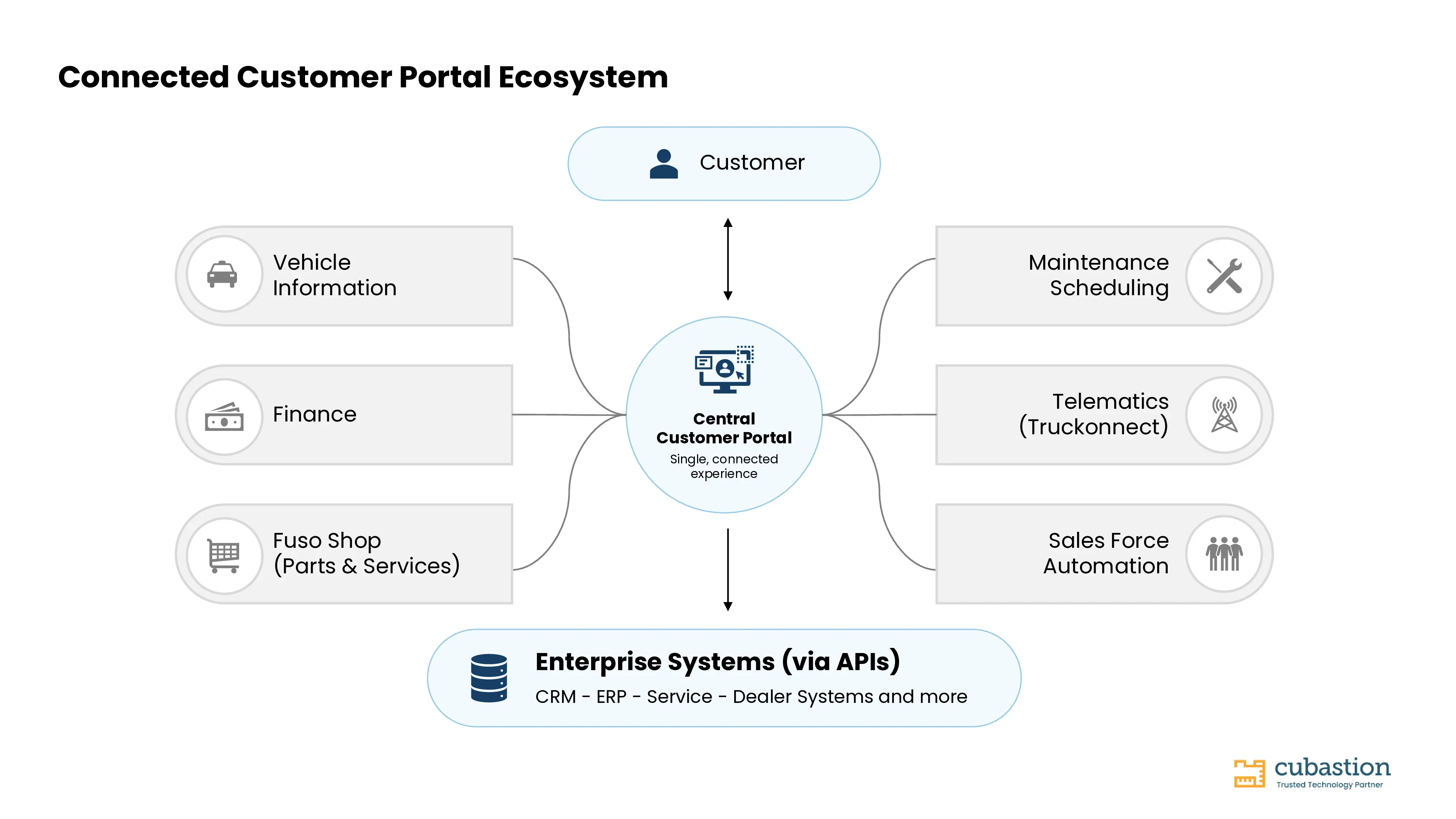
Mitsubishi Fuso Truck and Bus Corporation (MFTBC) faced several challenges as it advanced its digital customer experience. Customers were accessing multiple fragmented applications, while gaps in customer visibility and manual maintenance workflows created friction across support and maintenance journeys. Customer engagement was also largely reactive.
Cubastion addressed these challenges through the Central Customer Portal (CCP).
The solution used Salesforce Experience Cloud to bring together customer identity, vehicle history and finance information, synchronized with the internal Sales Force Automation (SFA) system. It also introduced vehicle management capabilities and integrated maintenance scheduling through a calendar-based interface.
The experience was further connected with external platforms such as Truckonnect for telematics and Fuso Shop for service booking, with secure APIs connecting eight enterprise systems.
The result was a more connected customer journey rather than another standalone digital channel.
The transformation delivered a 30% reduction in maintenance scheduling time, an 80% reduction in manual errors through automated data synchronization, and a 20% projected increase in lead conversion.

From Digital Channels to One Connected Experience
A connected automotive experience creates value at multiple levels:
- For customers: fewer handoffs, less repetition and easier access to relevant services.
- For dealers and service teams: better access to customer and vehicle context.
- For operations: less manual intervention and smoother process execution.
- For the enterprise: greater value from existing CRM, enterprise applications and digital investments.
- For future transformation: an integrated foundation for AI, automation and new digital services.
The important shift is from channel management to journey orchestration.
The Next Evolution of Automotive CX
Adding another app does not automatically improve customer experience.
The real opportunity lies in connecting the applications, processes and touchpoints that already exist, so customers experience them as one journey.
For automotive OEMs, this means bringing together CRM, customer experience platforms, enterprise applications, APIs, vehicle services and digital channels around the moments that matter to the customer.
Once that foundation is in place, emerging technologies such as AI can build on it to deliver more proactive and personalized experiences.
Cubastion helps automotive organizations connect CRM, enterprise applications, digital platforms and business processes to create seamless customer journeys and stronger digital experiences.
Connect with a Cubastion consultant today to explore your digital transformation journey.